
Category · 8 materials
Gravel and Crushed Stone
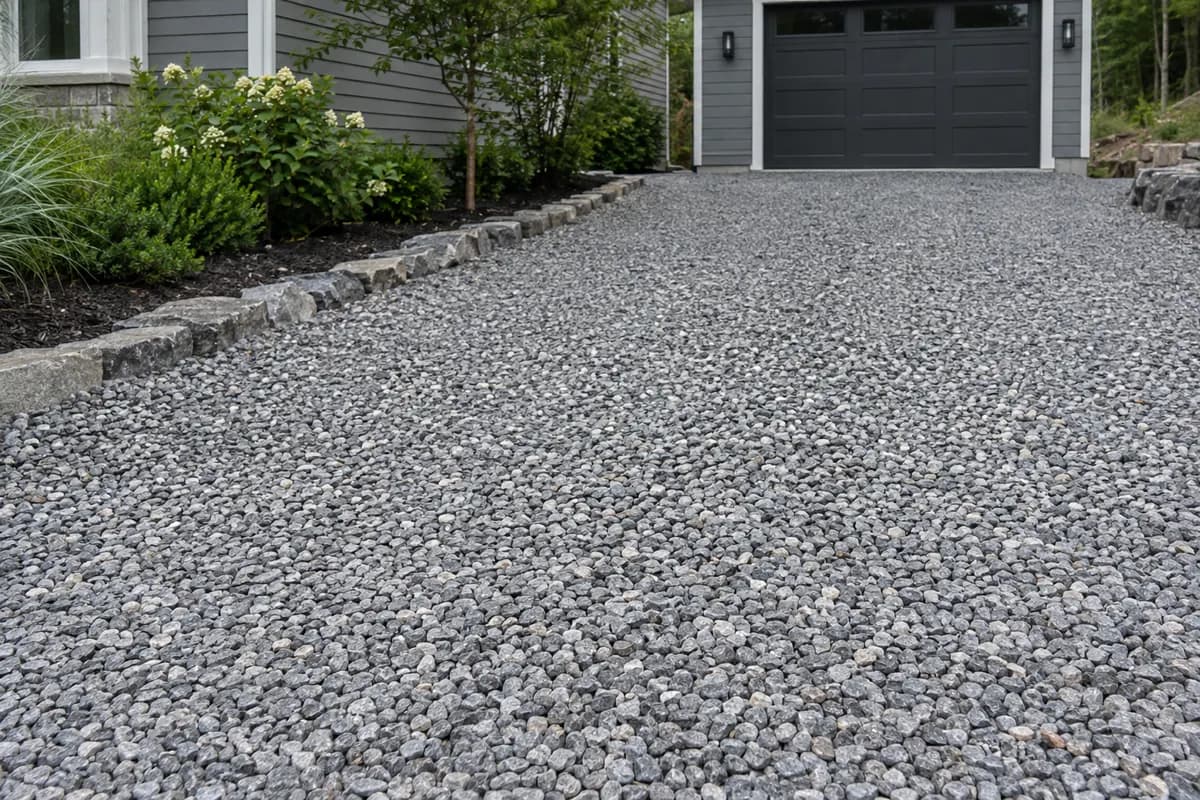
Crushed stone is quarried rock broken into angular pieces and screened to a size. This group holds eight of those sizes, from #89 Crushed Stone chips up to the fist-sized #4 Crushed Stone and Railroad Ballast. Each one is gray or close to it, each one is sold by the ton, and the size you pick decides how the stone drains, packs and feels under a wheel.
 From$4242 ton delivered
#57 Crushed Stone
Gravel and Crushed Stone- Size
- 3/4 to 1 inch
- Weight
- 2,700 lb/yd³
- Color
- Gray
 From$4372 ton delivered
#67 Stone
Gravel and Crushed Stone- Size
- 3/4 inch and under
- Weight
- 2,700 lb/yd³
- Color
- Gray
 From$4252 ton delivered
#89 Crushed Stone
Gravel and Crushed Stone- Size
- 3/8 inch
- Weight
- 2,700 lb/yd³
- Color
- Gray
 From$4452 ton delivered
#4 Crushed Stone
Gravel and Crushed Stone- Size
- 1-1/2 to 2-1/2 inches
- Weight
- 2,700 lb/yd³
- Color
- Gray
 From$4272 ton delivered
3/4" Crushed Stone
Gravel and Crushed Stone- Size
- 3/4 inch
- Weight
- 2,700 lb/yd³
- Color
- Gray
 From$4272 ton delivered
3/8" Crushed Stone
Gravel and Crushed Stone- Size
- 3/8 inch
- Weight
- 2,700 lb/yd³
- Color
- Gray
 From$4242 ton delivered
1-1/2" Crushed Gravel
Gravel and Crushed Stone- Size
- 1-1/2 inch
- Weight
- 2,700 lb/yd³
- Color
- Gray to tan
 From$6352 ton delivered
Railroad Ballast
Gravel and Crushed Stone- Size
- 1-1/2 to 2-1/2 inches
- Weight
- 2,700 lb/yd³
- Color
- Gray
What this category covers
Two naming systems share this shelf. The number grades come from the standard sieve chart that road crews and engineers use, and a smaller number means a bigger stone. #4 Crushed Stone runs 1-1/2 to 2-1/2 inches, #57 Crushed Stone runs 3/4 to 1 inch, #67 Stone is 3/4 inch and under, and #89 Crushed Stone is 3/8 inch. The inch names describe the top size in plain terms: 3/4" Crushed Stone, 3/8" Crushed Stone and 1-1/2" Crushed Gravel. Railroad Ballast is named for the track beds it was made for, and it shares the 1-1/2 to 2-1/2 inch range of #4.[1]
What ties the group together is the broken face. Every piece leaves the crusher with sharp corners and flat sides, and those edges catch on one another when the stone is packed. That grip is the reason crushed stone holds a driveway and round gravel does not. Color varies only a little. Most of the sizes are gray, and 1-1/2" Crushed Gravel leans gray to tan, since it is crushed from a gravel deposit with mixed parent rock.[1]
The jobs are structural and practical: driveway surfaces and sub-layers, French drains and footing drains, the bed under a slab or a shed, fill behind a wall, the pad at a site entrance. This group is not a decorative shelf. It does not include polished or colored stone, and the screened sizes hold too few fines to set up like a dense base course on their own. For a smooth tread or a bedding layer, look at the finer materials elsewhere in the catalog.[1]
When to use which crushed stone material
For the top of a gravel driveway, #57 Crushed Stone is the default. The 3/4 to 1 inch pieces are big enough to stay put under a turning tire and small enough to rake smooth. #67 Stone does the same job with a finer finish, since its 3/4 inch and under mix carries smaller pieces that fill the gaps, so the surface packs tighter and feels smoother to walk on. 3/4" Crushed Stone sits between the two and suits the buyer who wants one plain size for a drive, a shed pad and a bin pad from a single load.[1]
For drainage, open space between the stones matters most. #57 Crushed Stone is the usual fill around a perforated pipe, because the gaps stay open for years. 1-1/2" Crushed Gravel moves even more water and suits a deeper trench, a dry well or the bottom course of a drain field. #89 Crushed Stone and 3/8" Crushed Stone are too fine for a pipe trench, since silt can bridge their smaller gaps, but they make a good bedding and joint fill for permeable pavers and a neat top dressing for a path.[1]
For soft ground and heavy loads, go big. #4 Crushed Stone, at 1-1/2 to 2-1/2 inches, is the bottom layer of a driveway built over wet clay, and it is the classic stone for a construction entrance where trucks leave the site. Railroad Ballast shares that size and is crushed to sharp, blocky pieces that resist rolling, so it holds a steep ditch, a culvert end or a heavy equipment pad. Neither stone is pleasant on foot, so cap them with a smaller size where people walk.[1]
Under concrete, the choice turns on the pour. A slab or a shed floor sits well on #57 Crushed Stone or #67 Stone, which drain and level easily. For mixing your own footings, #67 Stone or 3/4" Crushed Stone makes the coarse part of the mix.[1]
Layer math for crushed stone by the ton
Each size in this group weighs 2,700 lb per cubic yard, so one set of coverage figures covers all eight. For 100 square feet, you need 0.83 tons at 2 inches deep, 1.25 tons at 3 inches, 1.67 tons at 4 inches and 2.50 tons at 6 inches. Measure the length and width in feet, multiply them, and read the row for your depth. For each further hundred square feet, add the same amount again.[1]
Depth has to suit the stone. A layer should be thicker than its largest piece, or the stones sit in a single course and roll loose. That rules out the 2 inch row for #4 Crushed Stone and Railroad Ballast, whose pieces reach 2-1/2 inches. Order those at 4 inches, which takes 1.67 tons of #4 Crushed Stone for 100 square feet, or better at 6 inches, which takes 2.50 tons. The small sizes work fine thin. A 2 inch top dressing of #89 Crushed Stone takes 0.83 tons for the same area.[1]
Most driveways are built in two layers, and the math stacks. A bottom course of #4 Crushed Stone at 4 inches takes 1.67 tons for 100 square feet, and a top course of #57 Crushed Stone at 2 inches takes 0.83 tons. The two layers together come to the same weight as the 6 inch row, 2.50 tons, because every size here has the same weight per cubic yard.[1]
For a trench, treat the floor as the area and the stone depth as the depth. A pipe trench filled with 1-1/2" Crushed Gravel to 6 inches deep takes 2.50 tons for each 100 square feet of trench floor.[1]
Pricing and tonnage
Every size in this group is sold by the ton. Crushed stone leaves the quarry over a scale, and weight stays the same no matter how the pile settles in the truck, so the coverage figure you work out is the amount you order. There is no conversion step between the plan and the order.[1]
Weight also caps each truck. Stone is dense, and a dump truck reaches its legal weight long before the bed looks heaped. Since all eight sizes weigh the same per cubic yard, a full load of #89 Crushed Stone covers the same area as a full load of #4 Crushed Stone at the same depth. The size you pick changes how the layer behaves, and the number of trucks depends only on the area and the depth.[1]
Three factors move a delivered price. Distance is the first, because each load is a round trip from the stone yard to your site. Load size is the second, since a full truck spreads that trip across more tons. The third is the stone itself. Common sizes made in volume, such as #57 Crushed Stone, move through the plant fastest, while a special size such as Railroad Ballast is crushed and screened in smaller runs. The table below this section lists what each size runs in your area.[1]
| Material | Sold by | Delivered from (2 units) | Cities priced |
|---|---|---|---|
| #57 Crushed Stone | the ton | $424 to $803 | 366 |
| #67 Stone | the ton | $437 to $588 | 366 |
| #89 Crushed Stone | the ton | $425 to $924 | 366 |
| #4 Crushed Stone | the ton | $445 to $763 | 366 |
| 3/4" Crushed Stone | the ton | $427 to $806 | 366 |
| 3/8" Crushed Stone | the ton | $427 to $879 | 366 |
| 1-1/2" Crushed Gravel | the ton | $424 to $1,200 | 360 |
| Railroad Ballast | the ton | $635 to $641 | 366 |
Installation patterns that fail
A single thin course is the first trap. A driveway topped with one layer of #57 Crushed Stone over bare soil ruts as soon as the soil under it softens, because nothing spreads the load. Build a bottom course of #4 Crushed Stone on soft ground, then the top course, and compact each one with a plate or roller before the next goes on.[1]
The wrong size causes the second set of failures. #89 Crushed Stone around a perforated pipe can clog as silt fills its small gaps, so use #57 Crushed Stone or 1-1/2" Crushed Gravel there. Railroad Ballast on a walking path turns ankles and wears out shoes, so keep it to ditches, slopes and pads. A finer stone like #67 Stone laid on a steep drive with no base can wash out in a hard storm, since small pieces move more easily than large ones.[1]
Soft subgrade and missing fabric account for most of the rest. Strip the sod and dark topsoil, which keep compressing for years. On clay or silt, roll out a woven geotextile before the first stone goes down, or the stone presses into the mud and the soil pumps up through it. In a French drain, wrap the stone in a non-woven fabric so fines stay out of the trench.[1]
No edge is the last common miss. Loose crushed stone spreads sideways under traffic and leaves a thin crown down the middle of a drive. Set a timber, steel or stone edge, or shape a shallow swale at each side, so the layer holds its width and water leaves the surface.[1]
Frequently Asked Questions
What is the difference between #57 Crushed Stone and #67 Stone?
#57 Crushed Stone is screened to 3/4 to 1 inch, so the pieces are fairly even and the gaps stay open, which suits drainage and driveway tops. #67 Stone is 3/4 inch and under, so it holds smaller pieces as well. It packs a little tighter and gives a smoother finish, while it drains a little more slowly. Each of the two weighs 2,700 lb per cubic yard.
Which crushed stone is best for a French drain?
#57 Crushed Stone is the usual choice. Its 3/4 to 1 inch pieces leave open space for water to reach the pipe. For a larger trench or a dry well, 1-1/2" Crushed Gravel moves water even faster. Avoid the small sizes such as #89 Crushed Stone in a drain, since fine silt can fill their gaps over time. Wrap the stone in fabric.
What size stone goes at the bottom of a driveway?
On soft or wet ground, start with #4 Crushed Stone at 1-1/2 to 2-1/2 inches. The large pieces spread the weight of a vehicle across the subgrade and resist sinking. Lay it at 4 inches or more, compact it, and then add a top course of #57 Crushed Stone or #67 Stone for a surface that is easier to drive and walk on.
What is Railroad Ballast used for at home?
Railroad Ballast is 1-1/2 to 2-1/2 inch angular stone made to hold rail track in place. Around a home or a farm it suits ditches, culvert ends, steep slopes, construction entrances and pads for heavy equipment, where the sharp, blocky pieces resist rolling and washing out. It is rough on foot, so cap it with a smaller size where people walk.
How many tons of crushed stone do I need?
For every 100 square feet, any size in this group takes 0.83 tons at 2 inches, 1.25 tons at 3 inches, 1.67 tons at 4 inches and 2.50 tons at 6 inches. Measure the area, choose a depth thicker than the largest stone, and add the same amount again for each further hundred square feet.
Is crushed stone the same as gravel?
The two terms overlap in everyday speech. Gravel in the strict sense is rounded stone shaped by water, while crushed stone is quarried rock broken into angular pieces. The angles let crushed stone lock together and hold a load. 1-1/2" Crushed Gravel is a middle case: gravel that has been run through a crusher, so many of its faces are broken and it grips better than round stone.
Where we deliver
Gravel and Crushed Stone delivery coverage across the US
ARArkansas2 cities
AZArizona15 cities
CACalifornia70 cities
- American Canyon
- Anaheim
- Antioch
- Bakersfield
- Berkeley
- Burbank
- Carlsbad
- Chico
- Chula Vista
- Clovis
- Concord
- Corona
- Costa Mesa
- Daly City
- Downey
- El Cajon
- El Monte
- Elk Grove
- Fairfield
- Fremont
- Fresno
- Fullerton
- Garden Grove
- Glendale
- Hayward
- Hollister
- Huntington Beach
- Imperial Beach
- Inglewood
- Irvine
- Lancaster
- Lemoore
- Long Beach
- Los Angeles
- Modesto
- Oakland
- Oceanside
- Ontario
- Orange
- Oxnard
- Palm Desert
- Palmdale
- Pasadena
- Pomona
- Richmond
- Riverside
- Roseville
- Sacramento
- Salinas
- San Diego
- San Francisco
- San Jose
- San Mateo
- Santa Ana
- Santa Clara
- Santa Maria
- Santa Rosa
- Simi Valley
- Stockton
- Sunnyvale
- Temecula
- Thousand Oaks
- Torrance
- Tracy
- Turlock
- Vacaville
- Vallejo
- Ventura
- Visalia
- West Covina
COColorado12 cities
DCDistrict of Columbia1 city
FLFlorida32 cities
- Boca Raton
- Brandon
- Cape Coral
- Clearwater
- Coral Springs
- Davie
- Deltona
- Fort Lauderdale
- Gainesville
- Hialeah
- Hollywood
- Jacksonville
- Kissimmee
- Lakeland
- Lehigh Acres
- Miami
- Miami Gardens
- Miramar
- Orlando
- Palm Bay
- Palm Coast
- Pembroke Pines
- Pompano Beach
- Port Saint Lucie
- Saint Petersburg
- Sanford
- Sarasota
- Spring Hill
- Sunrise
- Tallahassee
- Tampa
- West Palm Beach
GAGeorgia14 cities
IAIowa3 cities
ILIllinois4 cities
MNMinnesota2 cities
MSMississippi3 cities
NCNorth Carolina19 cities
NDNorth Dakota1 city
NHNew Hampshire1 city
RIRhode Island1 city
SCSouth Carolina8 cities
SDSouth Dakota1 city
TXTexas42 cities
- Abilene
- Allen
- Amarillo
- Anna
- Arlington
- Austin
- Beaumont
- Brownsville
- Carrollton
- College Station
- Corpus Christi
- Dallas
- Del Rio
- Denton
- Edinburg
- El Paso
- Fort Worth
- Frisco
- Garland
- Georgetown
- Grand Prairie
- Houston
- Irving
- Killeen
- Laredo
- Lewisville
- Lubbock
- McAllen
- McKinney
- Mesquite
- Midland
- Odessa
- Pasadena
- Pearland
- Plano
- Richardson
- Round Rock
- San Angelo
- San Antonio
- Tyler
- Waco
- Wichita Falls