
Category · 4 materials
Drainage and Base
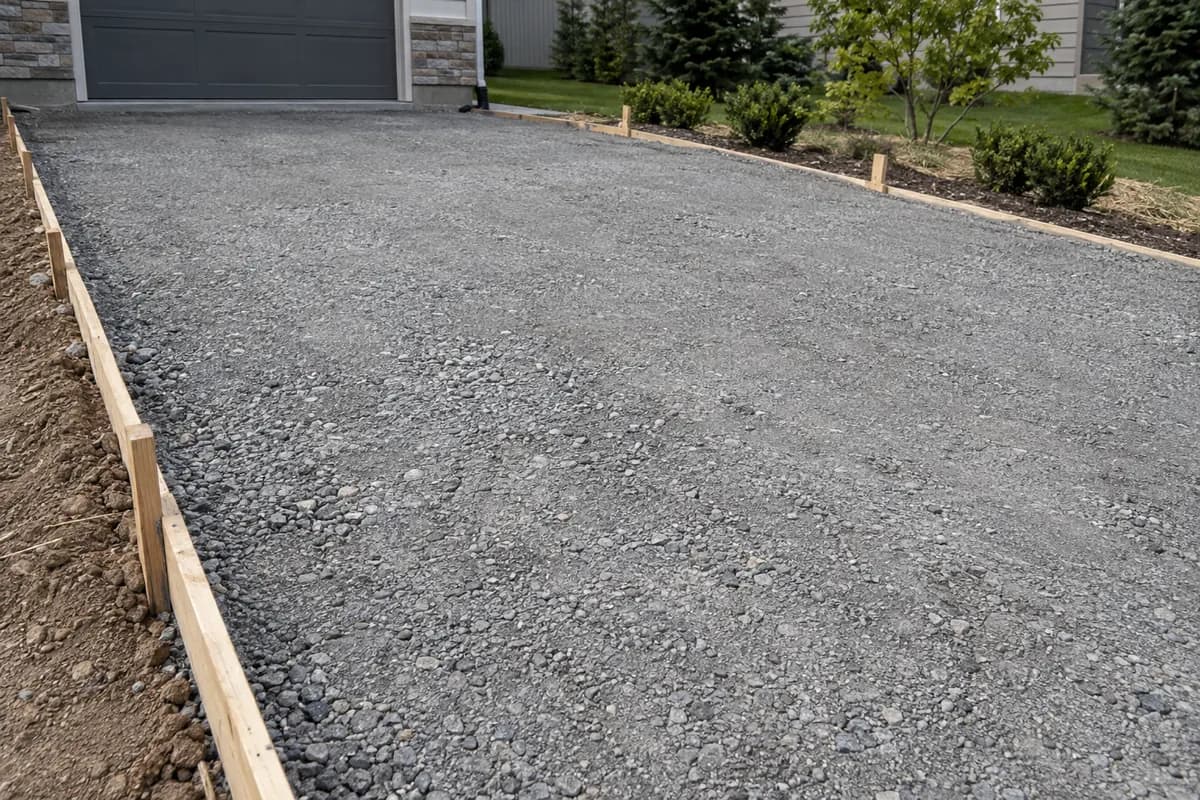
The materials in this group do their work out of sight. Road Base and Stone Dust Screenings pack into a firm layer that carries pavers, slabs and driveways. Drain Rock and Riprap do the opposite, leaving open space so water can move or so a bank can hold against it. Gravel Valet sells all four by the ton for builders and homeowners alike.
 From$4152 ton delivered
Road Base
Drainage and Base- Size
- 3/4 inch minus
- Weight
- 2,800 lb/yd³
- Color
- Gray
 From$4252 ton delivered
Drain Rock
Drainage and Base- Size
- 3/4 to 1-1/2 inches
- Weight
- 2,700 lb/yd³
- Color
- Gray
 From$4432 ton delivered
Riprap
Drainage and Base- Size
- 6 to 12 inches
- Weight
- 2,700 lb/yd³
- Color
- Gray
 From$4462 ton delivered
Stone Dust Screenings
Drainage and Base- Size
- 1/4 inch and fines
- Weight
- 2,800 lb/yd³
- Color
- Gray
What this category covers
Four materials make up this shelf, and they split cleanly into two pairs. The first pair is built to pack. Road Base is 3/4 inch minus, a gray blend of crushed stone that runs from the top size all the way down to dust. Stone Dust Screenings are finer still, at 1/4 inch and fines, the gray grit left when stone is crushed and screened. A cubic yard of either one weighs 2,800 lb, the heaviest figure in the group, because the fine particles fill nearly every gap between the larger pieces.[1]
The second pair is built to stay open. Drain Rock is clean gray stone from 3/4 to 1-1/2 inches with the fines washed and screened out, so water passes straight through a trench full of it. Riprap is far larger, at 6 to 12 inches, and its job is armor. Heavy angular blocks laid on a bank, a ditch or the end of a culvert break up flowing water and keep the soil behind them from washing away. A cubic yard of either weighs 2,700 lb.[1]
This group handles the layers people never see: the base under a patio, the course under a gravel or paved drive, the bedding under a shed, the stone around a buried pipe, the toe of a slope. It is not a shelf for decorative ground cover. Road Base and Stone Dust Screenings look like dusty gray earth when finished, and Drain Rock and Riprap look plain and industrial. Put a surface material on top where looks count.[1]
When to use which drainage material
Under pavers, a patio or a driveway, Road Base wins. Its 3/4 inch minus blend compacts into a layer that barely moves, since the small particles lock the large ones in place. Spread it slightly damp in lifts and run a plate compactor over each lift, and it turns almost as firm as rock. That firmness spreads the weight of a car or a paver joint across the soil below and stops ruts before they start.[1]
Directly under pavers or flagstone, Stone Dust Screenings take over for the final thin layer. At 1/4 inch and fines, they screed flat with a straight board, so each paver sits level. The same material makes a firm, natural path or a level bed for a shed made of timber. Screenings hold water once packed, so keep them to dry, well drained spots and give them a firm base of Road Base below.[1]
Wherever water has to leave, choose Drain Rock. The washed 3/4 to 1-1/2 inch stone fills a French drain, wraps a perforated pipe, backs a retaining wall and lines the floor of a dry well. Because it carries no fines, it cannot compact into a sealed layer, so water keeps moving through it. Drain Rock makes a stable, quick-draining bed under a hot tub pad or an outdoor unit where puddles would be a problem.[1]
Wherever moving water cuts into soil, choose Riprap. Pieces of 6 to 12 inches are too heavy for a storm flow to roll, and their rough faces slow the water down. Use Riprap on a creek bank, at a culvert outlet, along a steep ditch or at the edge of a pond. It is far too large for a drain trench or a base, and it never packs, so it does none of the jobs the other three do.[1]
Base course math for driveways and patios
Start with the area. Measure the length and width in feet, multiply them for square feet, and split odd shapes into rectangles. Then choose the depth of each layer. The coverage figures give the weight for 100 square feet at 2, 3, 4 and 6 inches, and for each further hundred square feet you add the same amount again.[1]
A patio or a walkway base of Road Base runs 4 inches for foot traffic and 6 inches for heavier use. For 100 square feet, Road Base takes 1.73 tons at 4 inches and 2.59 tons at 6 inches. A driveway base is thicker still and is built in lifts, so add the 4 inch and 6 inch rows layer by layer for the full depth you plan. Road Base weighs 2,800 lb per cubic yard, which is why its rows run a little higher than those of the open stones.[1]
On top of that base, a bedding layer of Stone Dust Screenings is thin. The smallest coverage row, 2 inches, takes 0.86 tons for 100 square feet, and a paver bed needs less depth than that, so the 2 inch figure leaves room for screeding and waste. A screenings path laid at 3 inches takes 1.30 tons for the same area.[1]
For a drain, treat the trench floor as the area. A trench floor covered with Drain Rock 6 inches deep takes 2.50 tons for each 100 square feet of floor, and a 4 inch layer takes 1.67 tons. Riprap is the odd one out. Its stones are 6 to 12 inches, so a real armor layer is thicker than the largest piece. Even the 6 inch row, 2.50 tons for 100 square feet, describes only part of that layer. Stack the 6 inch row for each 6 inches of thickness you need.[1]
Pricing and tonnage
All four materials in this group are sold by the ton. A scale reading is the same at the yard and at your site, while a loose pile of Road Base or Drain Rock settles on the road. Order the tonnage your coverage figures give and you get what you planned.[1]
Weight decides how much each truck can carry. Road Base and Stone Dust Screenings are the densest here, so a truck reaches its weight limit with fewer cubic yards on board than it would with Drain Rock. For a big base job, that sets the number of loads. Riprap adds its own limits. The blocks are loaded with heavy equipment, they land in a rough pile, and they cannot be spread from the tailgate the way a fine material can.[1]
What moves the delivered price comes down to three things. Distance from the source yard to your site is the first, since each load is a round trip. Load size is the second, because a full truck spreads that trip over more tons. The material is the third. Washed Drain Rock passes through more screening and rinsing than a blended Road Base, and oversized Riprap takes slower handling. The table below this section shows what each material runs for your area.[1]
| Material | Sold by | Delivered from (2 units) | Cities priced |
|---|---|---|---|
| Road Base | the ton | $415 to $676 | 366 |
| Drain Rock | the ton | $425 to $764 | 366 |
| Riprap | the ton | $443 to $737 | 366 |
| Stone Dust Screenings | the ton | $446 to $481 | 366 |
Installation patterns that fail
A base that is too thin fails first. A patio laid on a skim of Road Base sinks at the corners within a season or two, and a drive on a thin base ruts wherever tires track. Plan at least the 4 inch row under foot traffic and more under vehicles, and never let the paver bed stand in for the base.[1]
Skipping compaction comes next. Road Base only locks when it is damp and compacted in lifts of a few inches. Dumped dry and raked flat, it stays loose, and the pavers above it settle unevenly. Stone Dust Screenings need the same care, wet down and tamped flat before the pavers go on.[1]
Wrong material in the wrong spot is the most expensive mistake. Road Base or Stone Dust Screenings in a drain trench seal up and hold water instead of moving it. Drain Rock under pavers rolls and shifts, because open stone has no fines to lock it. A thick bed of screenings under pavers, laid deeper than a thin leveling course, holds water and lets the pavers sink. Riprap dumped on a bank with no fabric under it lets water pull soil out through the gaps, and the stones slowly drop into the hole.[1]
A soft subgrade and a missing edge finish the list. Strip the sod and the dark topsoil, compact the soil you reach, and lay a woven fabric over clay before the base goes down. Hold the edges of a paver patio with a restraint, or the outer row walks outward and the base spills from under it. Wrap a Drain Rock trench in non-woven fabric so silt stays out of the stone.[1]
Frequently Asked Questions
What goes under pavers, Road Base or Stone Dust Screenings?
Each material has its own layer. Road Base is the main base, compacted in lifts to the depth the job needs, from 4 inches under a walkway and more under a drive. Stone Dust Screenings go on top as a thin, level bed that the pavers sit in. Laying screenings alone, with no Road Base under them, leads to sinking and uneven joints.
Can I use Road Base in a French drain?
No. Road Base is 3/4 inch minus, and the fines that make it pack so well also block water. In a trench it compacts into a layer that holds water instead of moving it. Use Drain Rock at 3/4 to 1-1/2 inches, wrapped in non-woven fabric, so water can reach the pipe and flow away.
How much Road Base do I need for a patio?
Measure the patio in square feet. For each 100 square feet, Road Base takes 1.73 tons at 4 inches deep and 2.59 tons at 6 inches deep. For each further hundred square feet, add the same amount again. Plan the 4 inch layer for a walking patio and go deeper where a grill, a hot tub or vehicles will sit.
What size Riprap do I need for a ditch?
The Riprap in this group is 6 to 12 inches, a medium size that suits most home ditches, culvert outlets and pond edges. The stones are heavy enough to stay in place under storm flow. Lay a fabric first, place the stones in a layer thicker than the largest piece, and fit them together so the soil behind them stays covered.
Does Drain Rock compact?
Drain Rock settles a little and seats when you tamp it, but it does not compact into a solid layer the way Road Base does. The washed 3/4 to 1-1/2 inch stone has no fines to fill the gaps, and that open space is what lets water through. For a firm surface, put Road Base where you need strength and keep Drain Rock where you need drainage.
Are Stone Dust Screenings good for a path?
Yes, on a dry, level site. Stone Dust Screenings are 1/4 inch and fines, so when you wet them and tamp them they bind into a firm, gray tread. They hold water once packed, so give the path a slight slope to one side, build it over a compacted base and keep it away from low spots where water collects.
Where we deliver
Drainage and Base delivery coverage across the US
ARArkansas2 cities
AZArizona15 cities
CACalifornia70 cities
- American Canyon
- Anaheim
- Antioch
- Bakersfield
- Berkeley
- Burbank
- Carlsbad
- Chico
- Chula Vista
- Clovis
- Concord
- Corona
- Costa Mesa
- Daly City
- Downey
- El Cajon
- El Monte
- Elk Grove
- Fairfield
- Fremont
- Fresno
- Fullerton
- Garden Grove
- Glendale
- Hayward
- Hollister
- Huntington Beach
- Imperial Beach
- Inglewood
- Irvine
- Lancaster
- Lemoore
- Long Beach
- Los Angeles
- Modesto
- Oakland
- Oceanside
- Ontario
- Orange
- Oxnard
- Palm Desert
- Palmdale
- Pasadena
- Pomona
- Richmond
- Riverside
- Roseville
- Sacramento
- Salinas
- San Diego
- San Francisco
- San Jose
- San Mateo
- Santa Ana
- Santa Clara
- Santa Maria
- Santa Rosa
- Simi Valley
- Stockton
- Sunnyvale
- Temecula
- Thousand Oaks
- Torrance
- Tracy
- Turlock
- Vacaville
- Vallejo
- Ventura
- Visalia
- West Covina
COColorado12 cities
DCDistrict of Columbia1 city
FLFlorida32 cities
- Boca Raton
- Brandon
- Cape Coral
- Clearwater
- Coral Springs
- Davie
- Deltona
- Fort Lauderdale
- Gainesville
- Hialeah
- Hollywood
- Jacksonville
- Kissimmee
- Lakeland
- Lehigh Acres
- Miami
- Miami Gardens
- Miramar
- Orlando
- Palm Bay
- Palm Coast
- Pembroke Pines
- Pompano Beach
- Port Saint Lucie
- Saint Petersburg
- Sanford
- Sarasota
- Spring Hill
- Sunrise
- Tallahassee
- Tampa
- West Palm Beach
GAGeorgia14 cities
IAIowa3 cities
ILIllinois4 cities
MNMinnesota2 cities
MSMississippi3 cities
NCNorth Carolina19 cities
NDNorth Dakota1 city
NHNew Hampshire1 city
RIRhode Island1 city
SCSouth Carolina8 cities
SDSouth Dakota1 city
TXTexas42 cities
- Abilene
- Allen
- Amarillo
- Anna
- Arlington
- Austin
- Beaumont
- Brownsville
- Carrollton
- College Station
- Corpus Christi
- Dallas
- Del Rio
- Denton
- Edinburg
- El Paso
- Fort Worth
- Frisco
- Garland
- Georgetown
- Grand Prairie
- Houston
- Irving
- Killeen
- Laredo
- Lewisville
- Lubbock
- McAllen
- McKinney
- Mesquite
- Midland
- Odessa
- Pasadena
- Pearland
- Plano
- Richardson
- Round Rock
- San Angelo
- San Antonio
- Tyler
- Waco
- Wichita Falls