
Sand · Tan
Mason Sand Delivered by the Ton
Mason Sand is among the finest, softest sands a stone yard sells. Its small, even grains mix into smooth mortar, sweep neatly into paver joints and feel soft in a sandbox. Gravel Valet sells it by the ton and delivers it in bulk, so a masonry job or a backyard project starts with one tidy pile.
- From
- $418 delivered
- Size
- Fine
- Weight
- 2,700 lb/yd³
- Sold by
- the ton
See local Mason Sand pricing for your ZIP
Checking your saved delivery area.
- US cities served
- 368
- From, 2 tons delivered
- $418
- Weight
- 2,700 lb/yd³
- Size
- Fine

About Mason Sand
Masons need sand that blends into a creamy mortar with no gritty lumps, and that need gave this product its name. The grains are Fine and close to one another in size, with the coarse bits screened away and much of the silt and clay washed out. Pick up a handful and it runs through your fingers like sugar. That smooth texture lets mortar spread thin in a joint and gives a clean finish on brick, block and stone.[1]
Most loads are Tan, a soft beige that dries lighter in the sun and turns golden when wet. A cubic yard of Mason Sand comes in near 2,700 lb, so even a modest pile is heavy, and Gravel Valet sells it by the ton. Because the grains are small and fairly round, the sand packs down when tamped but stays workable with a trowel or a rake.[1]
Mason Sand is Fine, tan, about 2,700 lb per cubic yard, sold by the ton with a 2 ton minimum.
Specifications
| Material | Mason Sand |
|---|---|
| Category | sand |
| Typical size | Fine |
| Color | Tan |
| Weight | 2,700 lb/yd³, about 1.35 tons per cubic yard |
| Sold by | the ton |
| Order minimum | 2 tons per delivery |
| Online order steps | half tons, up to 40 per order; more by quote |
Coverage: how much Mason Sand do you need?
Square feet one ton of Mason Sand covers at common spread depths. For exact tonnage, use the calculator.
- 120
- sq ft at 2" deep
- Top dressing, beds
- 80
- sq ft at 3" deep
- Paths, patios, drainage
- 60
- sq ft at 4" deep
- Driveways, base layers
Best uses for Mason Sand
Mortar comes first. Mixed with masonry cement and water, Mason Sand makes the bed and joint mortar for brick walls, block foundations, chimneys and stone veneer. Plasterers add it to stucco finish coats and thin-set work where a smooth surface matters. Any job where a trowel meets the sand is a good fit.[1]
Around the yard it has other work too. Swept across a finished brick or concrete paver patio, the fine grains settle into narrow joints and help hold each unit in place. It makes a soft, clean fill for a home sandbox or a small beach area by a fire pit. Lawn owners spread a thin layer over the grass to smooth out bumps and fill low spots, a practice called top dressing. It can also cushion the floor under an above-ground pool liner.[1]
Skip it as a structural base. Fine, rounded grains roll under weight, so Mason Sand does not lock together the way crushed stone does. Under a slab or a drive, use a compacted stone base and keep the sand for the finish work on top.[1]
How to install Mason Sand
For mortar, follow the bag directions on the cement and add sand by the shovelful until the mix holds a ridge on the trowel. Keep the sand pile covered so leaves and rain do not change the mix from batch to batch. Damp sand bulks up, so measure it the same way each time.[1]
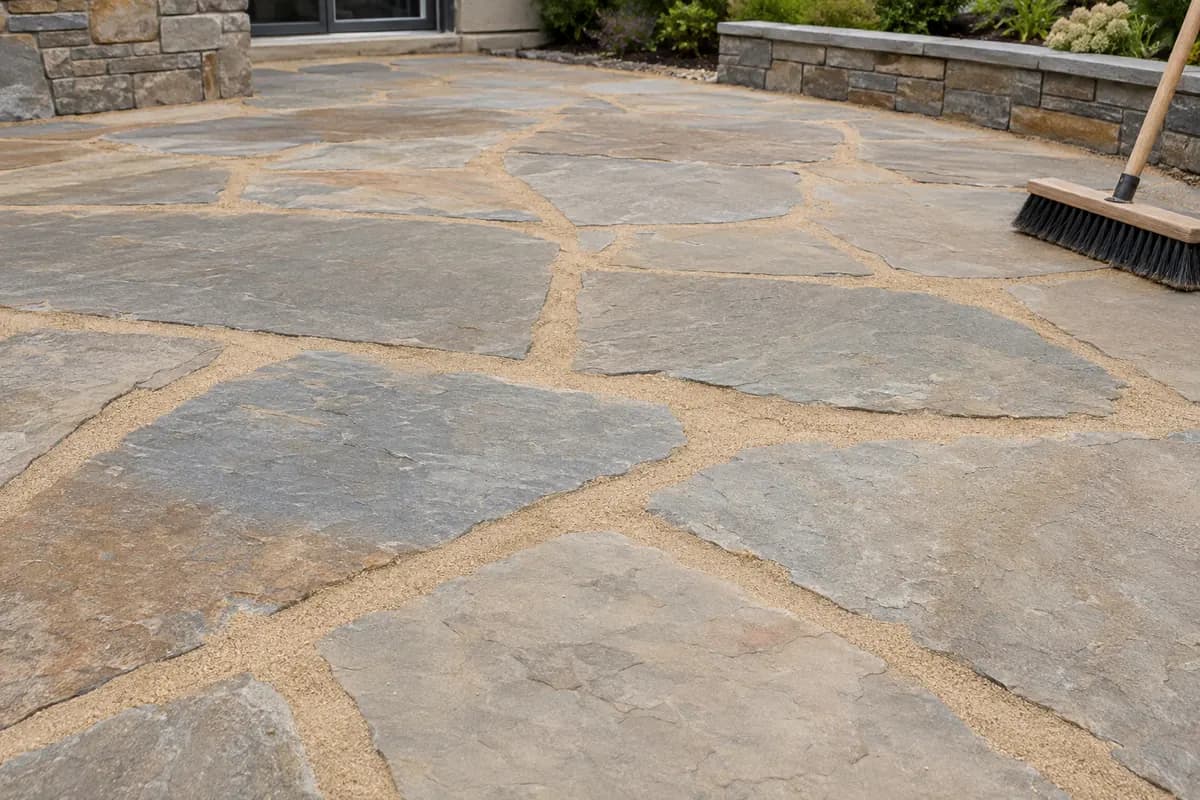
To fill paver joints, spread a dry layer across the finished surface and sweep it back and forth with a stiff broom. Run a plate compactor over the pavers with a pad on it, then sweep in more sand until the joints stay full. Mist it lightly to settle the grains. A few shovels per patio is all this takes, so most joint work comes out of a larger order.[1]
For a sandbox or play beach, dig a shallow pit, lay a permeable fabric on the floor so the sand stays clean, and frame it with timber or stone. Spread the sand 2 inches deep at the edges, about 0.83 tons per 100 square feet, and deeper in the middle where kids dig. A 3 inch layer needs about 1.25 tons per 100 square feet. A 4 inch fill takes about 1.67 tons, and a 6 inch fill about 2.50 tons, per 100 square feet.[1]
Comparable materials
Concrete Sand is the coarser sibling. Its larger, sharper grains make a stronger concrete mix and a firmer bedding layer under pavers, though it feels rough to the hand. Choose Concrete Sand for the bed under pavers and for concrete, and Mason Sand for mortar and the joints between pavers.[1]
Playground Sand is the closest look-alike. It is also fine and washed, and it is screened with play areas in mind, so it suits a sandbox where little hands dig all day. Mason Sand fills the same role well and doubles as a building sand. Fill Sand sits at the other end: it is unscreened and holds more fines, which makes it fine for raising a grade or backfilling a trench and a poor choice for mortar or play.[1]
Stone Dust Screenings are another option for paver joints on wide flagstone gaps, since the angular chips pack harder than round sand grains. For tight brick joints, the Fine grains of Mason Sand slide in more easily and leave a cleaner face.[1]
 From$4152 ton delivered
Concrete Sand
Sand- Size
- Coarse
- Weight
- 2,700 lb/yd³
- Color
- Tan to gray
 From$4162 ton delivered
Fill Sand
Sand- Size
- Unscreened
- Weight
- 2,700 lb/yd³
- Color
- Tan
 From$4152 ton delivered
Playground Sand
Sand- Size
- Fine, washed
- Weight
- 2,700 lb/yd³
- Color
- Light tan
Where we source Mason Sand
Mason Sand comes from two kinds of local operations. Sand and gravel pits dig natural deposits left by rivers and ancient shorelines, then wash and screen the sand to the fine grade. Crushed stone quarries also make a manufactured version by crushing rock and washing the result. Sand from either source runs over the same fine screens before it leaves the yard as Mason Sand.[1]
Gravel Valet fills each order from a pit or yard near the delivery address. The rock in a region decides the exact shade, so one area's Tan may lean toward cream and another's toward light brown. If color matching matters, for example on a mortar repair beside an old wall, mention it in your order notes.[1]
Why bulk delivery saves money
Sand from a store shelf comes in small bags, and bags of sand are a slow, heavy way to move a large amount. A brick wall or a backyard sandbox can call for many of them, along with sore backs and torn plastic. A bulk order arrives as one pile on a tarp or a driveway, and the shovel does the rest.[1]
Near 2,700 lb to the cubic yard, a single yard of sand would overload most car trunks and many small pickups. One truck brings the whole job at once. Ordering everything in a single delivery also keeps the color and grain the same from the first mortar batch to the last, which shows on a finished wall.[1]
Ordering Mason Sand from Gravel Valet
Add up what each part of the job needs. For a sandbox or a beach area, measure the square feet and use the calculator at your chosen depth. For mortar, estimate from the number of bricks or blocks, and allow extra for waste. Enter your ZIP to see the delivered total, then choose the tons.[1]
Choose a drop spot on firm, level ground that the truck can reach without driving on soft turf. A tarp under the pile keeps the sand clean and makes the last shovels easy to scoop. Keep the pile covered between work days, since rain packs Fine sand into a crust and wind can scatter a dry pile.[1]
Think about timing as well. Mortar work goes best in mild, dry weather, so plan the delivery a few days before the mason starts rather than weeks ahead. A pile that sits a long time collects leaves and seeds, and a sandbox fill is easier to spread while the sand is still dry from the yard.[1]
FAQ: Mason Sand
What is the difference between Mason Sand and Concrete Sand
Mason Sand has fine, even grains that make smooth mortar and fill narrow paver joints. Concrete Sand has coarser, sharper grains that give concrete its strength and make a firm bed under pavers. Use Mason Sand where a trowel meets the sand or a finish must be smooth, and Concrete Sand where the sand carries weight.
Can I use Mason Sand in a sandbox
Yes. Its soft, fine grains are pleasant to dig in, and the washing removes much of the clay that makes some sand stain clothes. Lay a fabric floor under it and keep the box covered when not in use so leaves and pets stay out. Playground Sand is the other common choice for the same job.
Is Mason Sand good for leveling a lawn
It works well for top dressing. Spread a thin layer over the grass, rake it into low spots and water it in. The grass grows up through the sand within a few weeks. Keep each pass thin so the blades are not buried, and repeat later in the season for deeper dips.
How much Mason Sand do I need for mortar
Mortar for brick and block is mostly sand by volume. A small wall may need only a fraction of a ton, while a full foundation or a chimney needs much more. Count the units, check the cement maker's mix chart, and order a little extra for spills and the joints you will repoint later.
Should I put Mason Sand under pavers
Not as the bed. A fine sand can shift under load and let pavers settle. Use a compacted stone base, then a thin layer of Concrete Sand or Stone Dust Screenings for the bed. Sweep Mason Sand into the joints after the pavers are set and compacted.
Does Mason Sand drain
Water passes through it more slowly than through a coarse sand, because the grains are small and leave tiny gaps. That is fine for a sandbox with a fabric floor on free-draining soil. In a low spot that holds water, add a layer of drainage stone under the sand first.
Order Mason Sand today
Enter your ZIP for the delivered price, or send the job and we quote it by hand.
By state
Mason Sand by state
- Mason Sand in Alaska
- Mason Sand in Alabama
- Mason Sand in Arkansas
- Mason Sand in Arizona
- Mason Sand in California
- Mason Sand in Colorado
- Mason Sand in Connecticut
- Mason Sand in District of Columbia
- Mason Sand in Florida
- Mason Sand in Georgia
- Mason Sand in Hawaii
- Mason Sand in Iowa
- Mason Sand in Idaho
- Mason Sand in Illinois
- Mason Sand in Indiana
- Mason Sand in Kansas
- Mason Sand in Kentucky
- Mason Sand in Louisiana
- Mason Sand in Massachusetts
- Mason Sand in Maryland
- Mason Sand in Michigan
- Mason Sand in Minnesota
- Mason Sand in Missouri
- Mason Sand in Mississippi
- Mason Sand in Montana
- Mason Sand in North Carolina
- Mason Sand in North Dakota
- Mason Sand in Nebraska
- Mason Sand in New Hampshire
- Mason Sand in New Jersey
- Mason Sand in New Mexico
- Mason Sand in Nevada
- Mason Sand in New York
- Mason Sand in Ohio
- Mason Sand in Oklahoma
- Mason Sand in Oregon
- Mason Sand in Pennsylvania
- Mason Sand in Rhode Island
- Mason Sand in South Carolina
- Mason Sand in South Dakota
- Mason Sand in Tennessee
- Mason Sand in Texas
- Mason Sand in Utah
- Mason Sand in Virginia
- Mason Sand in Washington
- Mason Sand in Wisconsin