
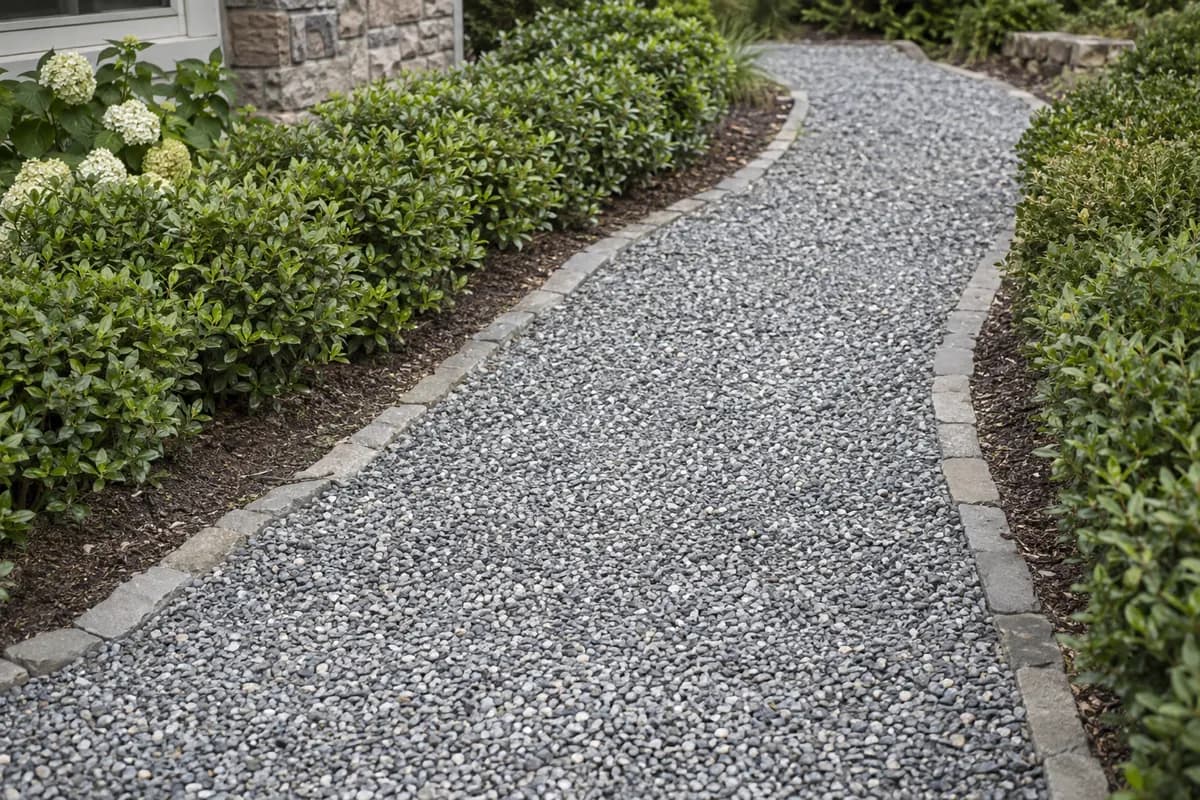
Gravel and Crushed Stone · Gray
3/8" Crushed Stone for Paths, Top Dressing and Pavers
3/8" Crushed Stone is a fine, gray crushed rock, small enough to feel smooth under a shoe yet angular enough to stay where you rake it. Homeowners use it to surface garden paths, freshen worn gravel areas and set pavers on a level bed. Gravel Valet brings it by the ton so a whole path or patio can be finished from one pile.
- From
- $427 delivered
- Size
- 3/8 inch
- Weight
- 2,700 lb/yd³
- Sold by
- the ton
See local 3/8" Crushed Stone pricing for your ZIP
Checking your saved delivery area.
- US cities served
- 368
- From, 2 tons delivered
- $427
- Weight
- 2,700 lb/yd³
- Size
- 3/8 inch

About 3/8" Crushed Stone
Each piece of 3/8" Crushed Stone is a small shard of quarried rock, roughly the width of a pencil. Up close the bits are sharp and irregular. From a few steps back, a raked bed reads as a fine, even gray texture that suits tidy, modern yards as well as cottage gardens. The tone can lean blue, brown or silver depending on the source rock.[1]
It is sold by the ton, and a cubic yard weighs about 2,700 lb. Small crushed pieces nest closely, which makes the stone feel solid underfoot after a little traffic. The layer still lets rain soak in, so a path does not hold puddles the way packed soil does.[1]
The fine grade sets how it feels. Larger crushed rock can be awkward to walk on in soft shoes, and round pebbles roll. A small, angular stone sits between those two, offering grip without an uneven, ankle-turning surface.[1]
3/8" Crushed Stone is 3/8 inch, gray, about 2,700 lb per cubic yard, sold by the ton with a 2 ton minimum.
Specifications
| Material | 3/8" Crushed Stone |
|---|---|
| Category | crushed stone |
| Typical size | 3/8 inch |
| Color | Gray |
| Weight | 2,700 lb/yd³, about 1.35 tons per cubic yard |
| Sold by | the ton |
| Order minimum | 2 tons per delivery |
| Online order steps | half tons, up to 40 per order; more by quote |
Coverage: how much 3/8" Crushed Stone do you need?
Square feet one ton of 3/8" Crushed Stone covers at common spread depths. For exact tonnage, use the calculator.
- 120
- sq ft at 2" deep
- Top dressing, beds
- 80
- sq ft at 3" deep
- Paths, patios, drainage
- 60
- sq ft at 4" deep
- Driveways, base layers
Best uses for 3/8" Crushed Stone
Garden paths top the list. A ribbon of fine gray stone through planting beds looks clean, drains fast and is gentle on knees when you kneel to weed. It works for side yards, routes to a shed and the walk from a driveway to a back gate.[1]
Top dressing is the second big job. Older gravel areas lose their surface stone over time as it sinks or scatters, and a thin coat of this grade brings back a fresh, uniform finish without rebuilding the base. A fresh coat brings a tired crushed stone patio or the floor of a seating nook back to life as well.[1]
Under pavers and flagstones, a screeded layer gives a level setting bed that drains better than sand. Around stepping stones it fills the spaces with a firm, walkable surface. Some gardeners also spread it around succulents and alpine plants, where a gritty mulch keeps crowns dry.[1]
Small courtyards and narrow side yards benefit from the fine grade too. In tight spaces, a large stone can look clumsy, while a fine gray surface keeps the area calm and tidy. The fine stone pairs well with steel edging and modern planters for a clean, simple look.[1]
How to install 3/8" Crushed Stone
Outline the path with a garden hose, cut along it with a spade and dig out the turf. A shallow excavation is enough for foot traffic. Lay landscape fabric to keep weeds down, then fix an edge of steel, aluminum or brick so the fine stone stays in place.[1]
A top dressing over an existing gravel bed needs only a 2 inch layer, about 0.83 tons per 100 square feet. A new path on firm soil is better at 3 inches, about 1.25 tons per 100 square feet, raked level and tamped once or twice.[1]
Patios and areas with chairs or a table do better with more depth. A 4 inch layer uses about 1.67 tons per 100 square feet, and a 6 inch layer uses about 2.50 tons per 100 square feet. For these, put a compacted base of a larger crushed grade underneath and use the fine stone as the top layer.[1]
Dampen the stone and run a hand tamper or plate compactor across it before use. The light watering helps the small pieces settle, and the first week of foot traffic will finish the job.[1]
Comparable materials
#89 Crushed Stone is close to the same size and is the name engineers use in pipe bedding specs. For a garden path, the two are near equals. 3/4" Crushed Stone and #57 Crushed Stone are larger, better for a driveway or drain and rougher underfoot.[1]
#67 Stone mixes larger pieces with small ones and makes a firm path base under this finer top layer. #4 Crushed Stone is a heavy base rock with no place on a walkway surface. If a path will see bikes, carts or wheelbarrows, a compacted #67 Stone base topped with 3/8" Crushed Stone gives a good mix of strength and comfort.[1]
Round gravel of the same size is a common alternative for paths. It looks softer and suits play areas, but it shifts more underfoot. Crushed stone of this grade is the steadier choice for a path that older visitors or people pushing wheelbarrows will use.[1]
 From$4242 ton delivered
#57 Crushed Stone
Gravel and Crushed Stone- Size
- 3/4 to 1 inch
- Weight
- 2,700 lb/yd³
- Color
- Gray
 From$4372 ton delivered
#67 Stone
Gravel and Crushed Stone- Size
- 3/4 inch and under
- Weight
- 2,700 lb/yd³
- Color
- Gray
 From$4252 ton delivered
#89 Crushed Stone
Gravel and Crushed Stone- Size
- 3/8 inch
- Weight
- 2,700 lb/yd³
- Color
- Gray
 From$4452 ton delivered
#4 Crushed Stone
Gravel and Crushed Stone- Size
- 1-1/2 to 2-1/2 inches
- Weight
- 2,700 lb/yd³
- Color
- Gray
 From$4272 ton delivered
3/4" Crushed Stone
Gravel and Crushed Stone- Size
- 3/4 inch
- Weight
- 2,700 lb/yd³
- Color
- Gray
 From$4242 ton delivered
1-1/2" Crushed Gravel
Gravel and Crushed Stone- Size
- 1-1/2 inch
- Weight
- 2,700 lb/yd³
- Color
- Gray to tan
Where we source 3/8" Crushed Stone
This grade comes from the last screens in a quarry's crushing line. After the bigger grades are taken off, the remaining rock is screened down to the 3/8 inch size and washed at many plants to remove fine dust. The washing gives the stone a cleaner look and keeps paths from turning chalky in the rain.[1]
Gravel Valet sources from quarries and landscape yards near your home. The local bedrock decides the exact gray, so stone delivered in one region may look slightly different from the same grade in another. A short route keeps delivery simple.[1]
Not every yard keeps a washed version, and an unwashed load carries more grit. That grit helps a path bind into a firmer crust, which some people prefer for a walkway. For a paver bed, where drainage matters, the washed stone is the better pick.[1]
Why bulk delivery saves money
A long garden path can take more bags of fine stone than a car can carry in several trips. Ordering by the ton in bulk removes those runs, the lifting and the waste of torn bags. The stone arrives as one pile, ready to be raked out over the weekend.[1]
With a weight of about 2,700 lb per cubic yard, fine stone is no lighter than coarse rock. Moving it by the truckload is far more efficient than moving it by the bag. Leftover stone keeps well in a corner of the yard for future top dressing.[1]
Bulk stone gives you one consistent batch, too. Bags bought on different days can come from different sources and look slightly mismatched once spread. A single load by the ton keeps the color even from one end of the path to the other.[1]
Ordering 3/8" Crushed Stone from Gravel Valet
Measure your path or patio in feet, choose a depth and use the area calculator to get tons. Type your ZIP into the order box to confirm we deliver there. Pick the amount, the date and where the truck should leave the pile.[1]
Paths are long and narrow, so think about where the pile should land. Midway along the route can halve the wheelbarrow distance. For a path at 3 inches, about 1.25 tons per 100 square feet, add a little extra for the edges and for touch-ups after the first season of use.[1]
FAQ: 3/8" Crushed Stone
Is 3/8" Crushed Stone good for walking paths?
Yes. The fine, angular pieces settle into a firm surface that is comfortable underfoot and does not roll like round pebbles. Edging keeps the stone on the path, and a light rake after heavy rain keeps the surface even. It suits garden walks, side yards and routes to a shed.
What is the difference between 3/8" Crushed Stone and Pea Gravel?
Size is similar, but shape is not. Pea Gravel is rounded and smooth, so it shifts and feels soft underfoot. 3/8" Crushed Stone is broken rock with sharp faces, so it locks into a firm surface. For a path that stays put, crushed stone is the better pick. For a play area, round pebbles are gentler.
Can I use 3/8" Crushed Stone as a top dressing?
Yes. A thin layer over an existing gravel area restores a clean, even finish without rebuilding the base. Rake out the old surface first to break up any crust, then spread the new stone and tamp it lightly so it binds with what is already there.
How much 3/8" Crushed Stone covers 100 square feet?
About 0.83 tons at 2 inches, 1.25 tons at 3 inches, 1.67 tons at 4 inches and 2.50 tons at 6 inches. Most paths fall in the 2 to 3 inch range. Add a small extra for compaction and edges.
Does 3/8" Crushed Stone stick to shoes?
Small stone can travel on deep shoe treads now and then, especially when it is freshly laid and loose. Tamping the path firms the surface and cuts down on stray pieces. A doormat or a strip of pavers at the end of the path where it meets the house catches what does get picked up.
Order 3/8" Crushed Stone today
Enter your ZIP for the delivered price, or send the job and we quote it by hand.
By state
3/8" Crushed Stone by state
- 3/8" Crushed Stone in Alaska
- 3/8" Crushed Stone in Alabama
- 3/8" Crushed Stone in Arkansas
- 3/8" Crushed Stone in Arizona
- 3/8" Crushed Stone in California
- 3/8" Crushed Stone in Colorado
- 3/8" Crushed Stone in Connecticut
- 3/8" Crushed Stone in District of Columbia
- 3/8" Crushed Stone in Florida
- 3/8" Crushed Stone in Georgia
- 3/8" Crushed Stone in Hawaii
- 3/8" Crushed Stone in Iowa
- 3/8" Crushed Stone in Idaho
- 3/8" Crushed Stone in Illinois
- 3/8" Crushed Stone in Indiana
- 3/8" Crushed Stone in Kansas
- 3/8" Crushed Stone in Kentucky
- 3/8" Crushed Stone in Louisiana
- 3/8" Crushed Stone in Massachusetts
- 3/8" Crushed Stone in Maryland
- 3/8" Crushed Stone in Michigan
- 3/8" Crushed Stone in Minnesota
- 3/8" Crushed Stone in Missouri
- 3/8" Crushed Stone in Mississippi
- 3/8" Crushed Stone in Montana
- 3/8" Crushed Stone in North Carolina
- 3/8" Crushed Stone in North Dakota
- 3/8" Crushed Stone in Nebraska
- 3/8" Crushed Stone in New Hampshire
- 3/8" Crushed Stone in New Jersey
- 3/8" Crushed Stone in New Mexico
- 3/8" Crushed Stone in Nevada
- 3/8" Crushed Stone in New York
- 3/8" Crushed Stone in Ohio
- 3/8" Crushed Stone in Oklahoma
- 3/8" Crushed Stone in Oregon
- 3/8" Crushed Stone in Pennsylvania
- 3/8" Crushed Stone in Rhode Island
- 3/8" Crushed Stone in South Carolina
- 3/8" Crushed Stone in South Dakota
- 3/8" Crushed Stone in Tennessee
- 3/8" Crushed Stone in Texas
- 3/8" Crushed Stone in Utah
- 3/8" Crushed Stone in Virginia
- 3/8" Crushed Stone in Washington
- 3/8" Crushed Stone in Wisconsin