
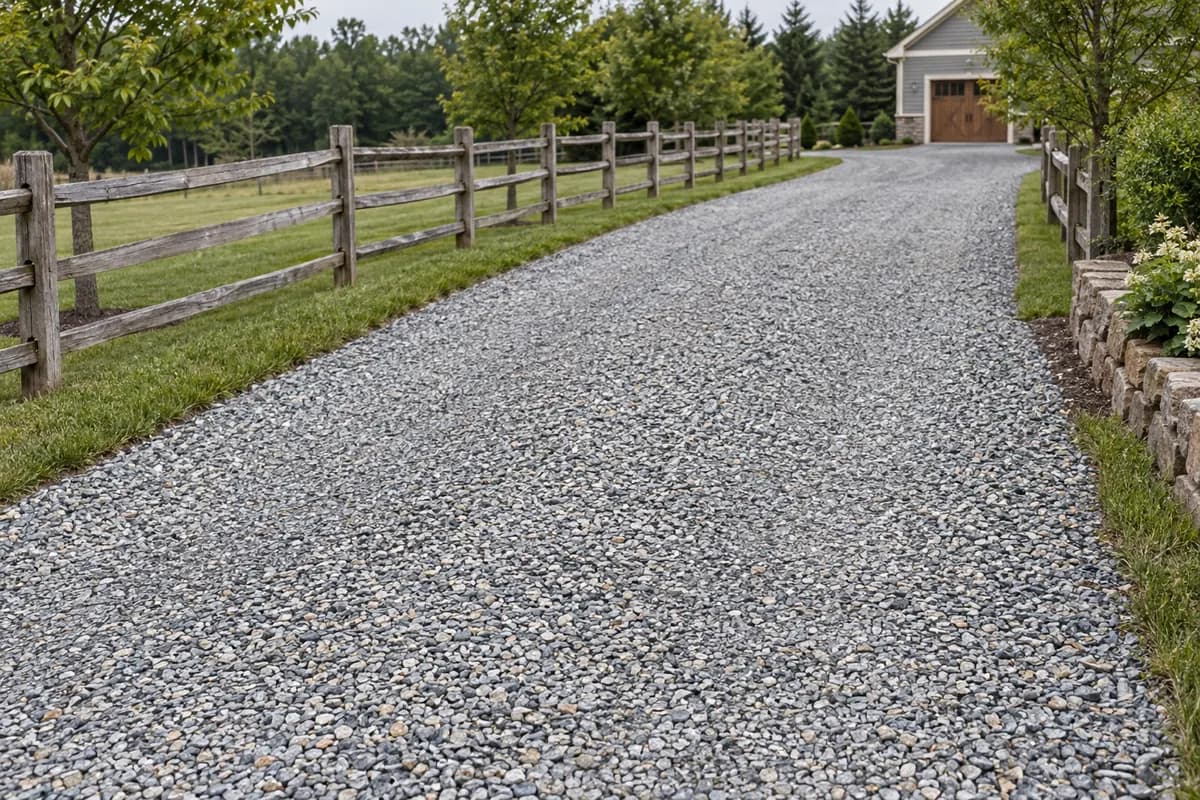
Driveway and Landscaping · Gray
Driveway Gravel Delivered in Bulk
Driveway Gravel is 3/4 inch clean crushed stone in plain gray. Sharp faces let the pieces wedge against each other, and the washed grading lets rain drop straight through. Gravel Valet brings it by the ton for new drives, worn drives that need a fresh top and gravel parking areas.
- From
- $426 delivered
- Size
- 3/4 inch clean crushed
- Weight
- 2,700 lb/yd³
- Sold by
- the ton
See local Driveway Gravel pricing for your ZIP
Checking your saved delivery area.
- US cities served
- 368
- From, 2 tons delivered
- $426
- Weight
- 2,700 lb/yd³
- Size
- 3/4 inch clean crushed

About Driveway Gravel
Driveway Gravel is hard rock run through a crusher and then washed and screened to one size: 3/4 inch clean crushed. Clean means the dust and small grit are gone. Every piece has broken, angular faces, so a layer of it behaves like a pile of tiny bricks that interlock instead of a heap of marbles that roll apart.[1]
With the fines removed, water has open channels through the whole layer. A gravel drive built from this stone dries fast after a storm and rarely holds puddles on a sound base. The color is gray, a neutral shade that sits well beside lawns, brick and siding of almost any tone. A cubic yard weighs about 2,700 lb, and the stone is sold by the ton.[1]
Driveway Gravel is 3/4 inch clean crushed, gray, about 2,700 lb per cubic yard, sold by the ton with a 2 ton minimum.
Specifications
| Material | Driveway Gravel |
|---|---|
| Category | base |
| Typical size | 3/4 inch clean crushed |
| Color | Gray |
| Weight | 2,700 lb/yd³, about 1.35 tons per cubic yard |
| Sold by | the ton |
| Order minimum | 2 tons per delivery |
| Online order steps | half tons, up to 40 per order; more by quote |
Coverage: how much Driveway Gravel do you need?
Square feet one ton of Driveway Gravel covers at common spread depths. For exact tonnage, use the calculator.
- 120
- sq ft at 2" deep
- Top dressing, beds
- 80
- sq ft at 3" deep
- Paths, patios, drainage
- 60
- sq ft at 4" deep
- Driveways, base layers
Best uses for Driveway Gravel
Its main role is the top course of a gravel driveway. Spread over a packed base, it gives tires grip, sheds water and can be raked back into place after a hard winter. It suits long rural lanes, turnarounds, the apron by a garage and side parking for a boat or a camper.[1]
The same stone fills plenty of jobs away from the drive. It makes a clean, draining floor for a shed or a carport, a firm path to a barn, a pad for trash bins and the backfill around a culvert where the drive crosses a ditch. Under a deck it keeps weeds and standing water down. Some builders also use it as drainage stone along a foundation or as the bottom layer of a paver patio where water needs a way out.[1]
Care over the years is simple. Snowplows and spinning tires push stone toward the edges, so a spring pass with a rake or a drag pulls it back to the center and restores the crown. Every few seasons, a fresh skim of Driveway Gravel over worn tracks brings the surface back to an even gray. Keeping grass and leaves off the stone stops soil from building up between the pieces, which is what slowly turns an old drive muddy.[1]
How to install Driveway Gravel
A good gravel drive is built in layers, and the surface stone is the last one. Start by stripping sod and soft topsoil down to firm ground and shaping a crown so the center stands a little higher than the edges. On clay or damp soil, lay a woven driveway fabric. Next comes the base, usually a compacted crushed stone with fines, which carries the weight.[1]
Spread the Driveway Gravel over the finished base with a skid steer, a box blade or a rake. A top course of 2 inches uses about 0.83 tons per 100 square feet, and 3 inches uses about 1.25 tons. Thicker than that, the loose top stone starts to shift under tires, so most drives keep the surface layer thin and put the depth into the base below.[1]
Where a drive has no separate base and sits on firm, well-drained ground, some owners lay the clean stone deeper: 4 inches at about 1.67 tons per 100 square feet, or 6 inches at about 2.50 tons per 100 square feet, packed in two passes. Run a roller or a plate compactor over it to seat the stones, and check the crown and the side ditches so runoff leaves the drive instead of cutting across it.[1]
Comparable materials
Road Base is the stone that belongs under Driveway Gravel. It is 3/4 inch minus, so it keeps the fines that Driveway Gravel has lost, and those fines let it pack into a hard foundation. Picture the pair as a wall and its paint: Road Base gives strength, and the clean stone on top gives drainage and a tidy finish.[1]
Stone Dust Screenings are the opposite of clean stone, nearly all grit and powder. They pack smooth and work as a bed under pavers or as a fine path surface, but on a drive they turn to dust when dry and mush when soaked. Some owners rake a thin dusting of screenings into a loose top course to help it bind, though most leave Driveway Gravel clean so it keeps draining.[1]


Where we source Driveway Gravel
Driveway Gravel comes from local quarries that crush hard rock such as limestone, granite or trap rock. After crushing, the stone runs over vibrating screens that sort out the 3/4 inch size, then through a wash that strips the dust. The washing step is what keeps the finished gravel clean and free draining.[1]
Gravel Valet buys from the quarry or stone yard nearest the delivery address. The gray of a load reflects the rock that local crushers work, so one region's driveway stone can look bluish gray and another's closer to a pale silver gray. If you are topping up an old drive and want a close match, mention it at checkout and we will look at what the nearby yards carry.[1]
Why bulk delivery saves money
A driveway takes far more stone than any car trunk could hold, and bagged crushed stone is sold in sizes meant for a flowerpot. Bulk Driveway Gravel comes off a loader into a dump truck and leaves the truck the same way, with no sacks, no pallets and no hand loading. You pay for stone and hauling, and the bulk unit is the ton.[1]
A loose load can also land right where it helps. On a straight run, the driver may be able to spread the gravel down the lane while driving forward, which leaves only raking. One delivery for the whole drive means one haul instead of a string of trips, and the work goes faster when the stone is already close to where it belongs.[1]
Ordering Driveway Gravel from Gravel Valet
Measure the drive's length and width, then pick the depth of the top course. The calculator works out tons from the weight of about 2,700 lb per cubic yard. For a fresh top on an existing drive, 2 or 3 inches is common. For a drive with low spots or bare patches, add a bit more where the old gravel has worn thin.[1]
Enter your ZIP to see the delivered total, choose your tons and check out. Let us know if you want the load spread along the drive or dumped in one pile, and flag gates, tight turns, soft shoulders or overhead lines. Our team follows up by phone or email to set the delivery day.[1]
Before the truck comes, mark the edges of the drive with stakes or paint and move cars, bins and anything else in the path. If the old surface has ruts, rake or grade them out first so the new stone goes on an even bed and spreads to a uniform depth.[1]
FAQ: Driveway Gravel
How much Driveway Gravel do I need for a new top layer?
Most drives get a surface course of 2 to 3 inches over a packed base. At 2 inches, 100 square feet takes about 0.83 tons of Driveway Gravel, and at 3 inches about 1.25 tons. Measure the full length and width, include turnarounds and the apron, and the calculator will total it in tons.
Why is clean stone better than gravel with fines for the top?
Clean 3/4 inch crushed stone has no dust to turn into mud or blow away, and water drains straight through it. The angular faces still wedge together under tires. Stone with fines packs harder, which is why it goes underneath as the base, but on top it can rut, puddle and track onto shoes.
Do I need a base under Driveway Gravel?
On soft soil, clay or a drive that carries trucks, yes. A packed base of crushed stone with fines spreads the weight so the top stone does not sink. On firm, sandy or rocky ground some owners lay the clean stone alone in a deeper layer, packed in two passes.
How do I keep a gravel drive from washing out?
Water is the main enemy. Keep a crown down the middle so rain runs to the edges, cut or clear side ditches, and add a culvert or a drain crossing where water flows over the drive. Angular stone like Driveway Gravel holds better on a slope than rounded gravel does. Rake displaced stone back each spring.
What color is Driveway Gravel?
Gravel Valet's Driveway Gravel is gray crushed stone. The exact shade follows the rock at the nearby quarry, so it can lean bluish in one region and paler in another. Gray stays neutral next to most houses and lawns, and it hides dirt and tire marks well between rains.
How heavy is a cubic yard of Driveway Gravel?
A cubic yard of Gravel Valet's Driveway Gravel weighs about 2,700 lb. The stone is sold by the ton, and the calculator uses that weight to convert your measurements. Order a little extra if your drive has dips, since low spots soak up more stone than a flat measurement shows.
Order Driveway Gravel today
Enter your ZIP for the delivered price, or send the job and we quote it by hand.
By state
Driveway Gravel by state
- Driveway Gravel in Alaska
- Driveway Gravel in Alabama
- Driveway Gravel in Arkansas
- Driveway Gravel in Arizona
- Driveway Gravel in California
- Driveway Gravel in Colorado
- Driveway Gravel in Connecticut
- Driveway Gravel in District of Columbia
- Driveway Gravel in Florida
- Driveway Gravel in Georgia
- Driveway Gravel in Hawaii
- Driveway Gravel in Iowa
- Driveway Gravel in Idaho
- Driveway Gravel in Illinois
- Driveway Gravel in Indiana
- Driveway Gravel in Kansas
- Driveway Gravel in Kentucky
- Driveway Gravel in Louisiana
- Driveway Gravel in Massachusetts
- Driveway Gravel in Maryland
- Driveway Gravel in Michigan
- Driveway Gravel in Minnesota
- Driveway Gravel in Missouri
- Driveway Gravel in Mississippi
- Driveway Gravel in Montana
- Driveway Gravel in North Carolina
- Driveway Gravel in North Dakota
- Driveway Gravel in Nebraska
- Driveway Gravel in New Hampshire
- Driveway Gravel in New Jersey
- Driveway Gravel in New Mexico
- Driveway Gravel in Nevada
- Driveway Gravel in New York
- Driveway Gravel in Ohio
- Driveway Gravel in Oklahoma
- Driveway Gravel in Oregon
- Driveway Gravel in Pennsylvania
- Driveway Gravel in Rhode Island
- Driveway Gravel in South Carolina
- Driveway Gravel in South Dakota
- Driveway Gravel in Tennessee
- Driveway Gravel in Texas
- Driveway Gravel in Utah
- Driveway Gravel in Virginia
- Driveway Gravel in Washington
- Driveway Gravel in Wisconsin