
Category · 7 materials
Driveway and Landscaping
Seven materials sit on this shelf of the catalog, from round Pea Gravel and River Rock to crushed Driveway Gravel and two recycled options, Asphalt Millings and Crushed Concrete. They make the ground you drive on, walk on and plant around. Gravel Valet sells each one by the ton and brings it in bulk, so the choice comes down to the job, the look and the load.
 From$4162 ton delivered
Pea Gravel
Driveway and Landscaping- Size
- 3/8 inch
- Weight
- 2,600 lb/yd³
- Color
- Mixed tan and brown
 From$4582 ton delivered
River Rock
Driveway and Landscaping- Size
- 1 to 3 inches
- Weight
- 2,600 lb/yd³
- Color
- Mixed earth tones
 From$4702 ton delivered
Decomposed Granite
Driveway and Landscaping- Size
- 1/4 inch and fines
- Weight
- 2,500 lb/yd³
- Color
- Gold to tan
 From$4262 ton delivered
Driveway Gravel
Driveway and Landscaping- Size
- 3/4 inch clean crushed
- Weight
- 2,700 lb/yd³
- Color
- Gray
 From$4242 ton delivered
Walkway Gravel
Driveway and Landscaping- Size
- 3/8 inch
- Weight
- 2,600 lb/yd³
- Color
- Mixed
 From$4162 ton delivered
Asphalt Millings
Driveway and Landscaping- Size
- 1 inch minus
- Weight
- 2,900 lb/yd³
- Color
- Black
 From$4132 ton delivered
Crushed Concrete
Driveway and Landscaping- Size
- 3/4 inch minus
- Weight
- 2,600 lb/yd³
- Color
- Light gray
What this category covers
The stone in this group splits along two lines: shape and origin. Pea Gravel and River Rock come from water-worn deposits, so their edges are smooth and the pieces roll against each other. Pea Gravel is 3/8 inch and shows a mixed tan and brown color, while River Rock is far bigger at 1 to 3 inches, in mixed earth tones. Driveway Gravel sits on the other side of the line. It is 3/4 inch clean crushed stone in gray, with broken faces that grab one another once a roller or a few weeks of tires press the layer down.[1]
Walkway Gravel, at 3/8 inch in a mixed color, is sized for shoes rather than wheels. Decomposed Granite is the finest material here, at 1/4 inch and fines, gold to tan, made of granite that has weathered down to grit. Wet it and roll it, and those fines lock into a firm path that still looks like loose earth. The two recycled products finish the list. Asphalt Millings are ground old pavement, black and 1 inch minus. Crushed Concrete is broken slab and curb, light gray and 3/4 inch minus. In a size name, minus means the load holds every size from the top size down to dust, and that spread is why these two pack so hard.[1]
The jobs here are surface jobs: the top of a driveway, a garden path, a sitting area of loose stone, a bed border, the strip along a fence or a foundation. This shelf is not where you shop for pipe bedding, sand under pavers or a deep structural base. The round stones should never carry a car on their own, because the pieces keep shifting under load. Use this group where the stone is seen and touched, and put a compacted base course under anything that takes wheels.[1]
When to use which driveway and landscape material
For the surface of a working driveway, Driveway Gravel wins. Its 3/4 inch crushed pieces interlock, so tires do not push them aside, and the clean grading lets rain fall through instead of pooling on top. Crushed Concrete is the pick for the layer that has to set up hard, such as a long lane, a parking pad or a farm turnaround. The fines in a 3/4 inch minus load fill the gaps, and a rolled layer turns almost as firm as a slab. Asphalt Millings do the same work with a dark, road-like look. The black 1 inch minus pieces still carry some binder, so a compacted layer knits together more each warm season and sheds dust better than any stone on the shelf.[1]
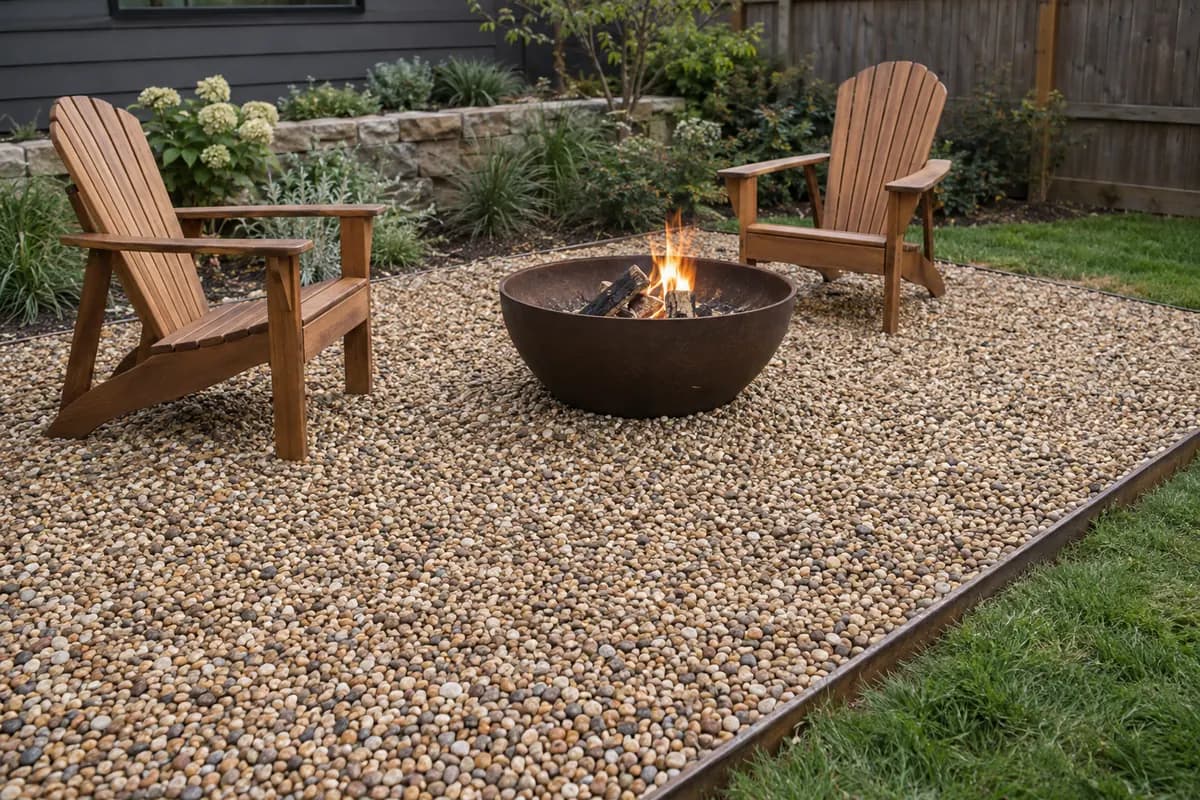
Paths ask a different question: firm or loose. Decomposed Granite gives the firm answer. Its fines pack into a smooth, gold to tan tread that a wheelbarrow or a stroller can cross, and it suits a formal garden or a dry yard look. Walkway Gravel gives the loose answer. At 3/8 inch it crunches underfoot, drains at once and never turns to mud, which makes it a good choice for a side yard or a path to the shed. Pea Gravel is the softest stone to walk on. The round 3/8 inch pieces suit a play area, a fire pit circle or a dog run, as long as you accept that they roll and need an edge to hold them.[1]
Beds and water paths belong to River Rock. At 1 to 3 inches, the stones are too heavy for a hose or a storm to move, so they work in a dry creek bed, under a downspout or as a border between lawn and planting. They are uncomfortable to walk on and they do not lock, so keep them off paths and drives. A sitting area with chairs shows the gap between the round and the packed materials clearly. Chair legs sink into Pea Gravel and stand level on rolled Decomposed Granite.[1]
Coverage math for drives, paths and beds
Every order starts with an area and a depth. Measure the length and the width of the space in feet and multiply them for square feet. Break an odd shape into rectangles and add them up. Then pick a depth from the job: a thin top dressing, a full path layer or a driveway surface. The coverage figures below give the weight for 100 square feet at each depth. For each further hundred square feet, add the same amount again, and add a part of the amount for any area left over.[1]
Driveway work runs at 4 to 6 inches. At 4 inches, 100 square feet takes 1.67 tons of Driveway Gravel, 1.60 tons of Crushed Concrete or 1.79 tons of Asphalt Millings. At 6 inches the same area takes 2.50 tons of Driveway Gravel, 2.41 tons of Crushed Concrete or 2.69 tons of Asphalt Millings. The millings need the most weight because a cubic yard of them weighs 2,900 lb, against 2,700 lb for Driveway Gravel and 2,600 lb for Crushed Concrete.[1]
Paths sit at 2 to 3 inches. Walkway Gravel needs 0.80 tons for 100 square feet at 2 inches and 1.20 tons at 3 inches. Decomposed Granite needs 1.16 tons at 3 inches and 1.54 tons at 4 inches, a little less than the stones because a cubic yard of it weighs 2,500 lb, the lightest in the group. A deeper path of Decomposed Granite holds up better under a wheelbarrow, so the 4 inch row is the safer order where traffic is heavy.[1]
Pea Gravel, River Rock, Walkway Gravel and Crushed Concrete each weigh 2,600 lb per cubic yard, so their coverage rows match. A bed of River Rock at 2 inches takes 0.80 tons for 100 square feet, and at 3 inches it takes 1.20 tons. A play area of Pea Gravel at 6 inches takes 2.41 tons for the same 100 square feet.[1]
Pricing and tonnage
All seven materials in this group are sold by the ton. Weight is the honest way to measure stone, because a loose pile can settle or fluff up in the truck and a scale reading does not change. Your coverage figure, in tons, is also the figure you order, so nothing needs converting between the plan and the checkout.[1]
Weight also sets how much fits on one truck. A dump truck hits its weight limit long before its bed is heaped full of stone, and the heavier the material per cubic yard, the sooner it gets there. Asphalt Millings are the densest material on this shelf, so a load of them covers less ground than the same load of Decomposed Granite, the lightest. That gap matters most on large drives, where the number of trucks drives the bill as much as the stone does.[1]
Three things move a delivered price. Distance comes first, since every load is a round trip from the source yard to your site. Load size comes next, because a full truck spreads that trip across more tons than a small drop does. The material itself is the third. Recycled Asphalt Millings and Crushed Concrete come from torn-out pavement, while washed, sorted decorative stone such as River Rock takes more handling before it ships. The table below this section shows what each material runs where you are.[1]
| Material | Sold by | Delivered from (2 units) | Cities priced |
|---|---|---|---|
| Pea Gravel | the ton | $416 to $1,044 | 366 |
| River Rock | the ton | $458 to $1,374 | 366 |
| Decomposed Granite | the ton | $470 to $1,362 | 354 |
| Driveway Gravel | the ton | $426 to $1,203 | 366 |
| Walkway Gravel | the ton | $424 to $878 | 366 |
| Asphalt Millings | the ton | $416 to $502 | 366 |
| Crushed Concrete | the ton | $413 to $746 | 364 |
Installation patterns that fail
Too thin is the most common mistake. A driveway topped with a light skim of Driveway Gravel ruts in the first wet spell, because the tires reach the soil below and churn it into the stone. Order a full 4 inch layer at the least, and build up worn tracks before you top dress. A path of Walkway Gravel laid at under 2 inches shows bare spots wherever people turn.[1]
Skipping compaction ruins the materials that depend on it. Decomposed Granite, Crushed Concrete and Asphalt Millings only turn firm when the fines are pressed into the gaps. Spread them in lifts of a few inches, wet each lift lightly and run a plate compactor or a roller over it before the next one goes down. A loose, uncompacted layer of any of the three stays soft, holds footprints and washes out on a slope.[1]
The wrong size causes slow failures. Pea Gravel on a sloped drive creeps downhill and piles up at the bottom, and River Rock on a walkway turns ankles. Missing edging lets round stone walk into the lawn, where a mower throws it. Set steel, stone or timber edging before the stone arrives, and set it a little higher than the finished layer.[1]
A soft subgrade undoes even a good surface. Strip the sod and dark topsoil, since they compress for years, and roll a woven fabric over clay before any stone goes in. Keep these materials out from under pavers as well. Round stone shifts beneath a paver and rocks it loose, so pavers need a compacted base and a sand bed, with this group used only as the joint fill or the border around them.[1]
Frequently Asked Questions
What is the best gravel for a driveway?
For the top layer, Driveway Gravel is the safest choice. It is 3/4 inch clean crushed stone, so the pieces lock together under tires and water drains through the gaps. Put it over a compacted base and order a full layer. For a dark, hard surface, Asphalt Millings are a strong option. For a very firm pad, Crushed Concrete packs nearly solid.
Is Pea Gravel good for a driveway?
Pea Gravel works on a flat, short drive that sees light use, but it is not the best choice for most driveways. The round 3/8 inch stones roll under tires, spread to the sides and creep downhill on any slope. If you love the look, lay it over a firm base, keep the drive level and install solid edging. For a busy or sloped drive, choose a crushed stone instead.
Which material makes the firmest garden path?
Decomposed Granite makes the firmest path in this group. It is 1/4 inch and fines, and once you wet it and compact it in thin lifts, the fines bind into a smooth tread that a wheelbarrow can roll over. For a loose path that drains instantly and crunches underfoot, use Walkway Gravel instead.
Do Asphalt Millings get hard?
Yes, compacted Asphalt Millings get harder over time. The 1 inch minus pieces still hold some of the old binder, so a rolled layer knits together, most of all in warm weather and under regular traffic. Spread them evenly, compact them well and expect a dark, firm surface that sheds dust better than loose stone.
How much River Rock do I need for a flower bed?
Measure the bed in square feet and choose a depth. For each 100 square feet, River Rock takes 0.80 tons at 2 inches and 1.20 tons at 3 inches. Because the stones are 1 to 3 inches across, a 2 inch layer can leave gaps, so many beds look fuller at 3 inches. Lay fabric under the stone to slow weeds.
Can Crushed Concrete replace new crushed stone?
For a driveway, a parking pad or a base under a gravel surface, Crushed Concrete does much of the same work. Its 3/4 inch minus mix packs very tight, and the light gray color suits a utility area. It holds more dust than a clean stone such as Driveway Gravel, so it drains more slowly. Keep it out of drainage trenches and away from spots where the look matters most.
Where we deliver
Driveway and Landscaping delivery coverage across the US
ARArkansas2 cities
AZArizona15 cities
CACalifornia70 cities
- American Canyon
- Anaheim
- Antioch
- Bakersfield
- Berkeley
- Burbank
- Carlsbad
- Chico
- Chula Vista
- Clovis
- Concord
- Corona
- Costa Mesa
- Daly City
- Downey
- El Cajon
- El Monte
- Elk Grove
- Fairfield
- Fremont
- Fresno
- Fullerton
- Garden Grove
- Glendale
- Hayward
- Hollister
- Huntington Beach
- Imperial Beach
- Inglewood
- Irvine
- Lancaster
- Lemoore
- Long Beach
- Los Angeles
- Modesto
- Oakland
- Oceanside
- Ontario
- Orange
- Oxnard
- Palm Desert
- Palmdale
- Pasadena
- Pomona
- Richmond
- Riverside
- Roseville
- Sacramento
- Salinas
- San Diego
- San Francisco
- San Jose
- San Mateo
- Santa Ana
- Santa Clara
- Santa Maria
- Santa Rosa
- Simi Valley
- Stockton
- Sunnyvale
- Temecula
- Thousand Oaks
- Torrance
- Tracy
- Turlock
- Vacaville
- Vallejo
- Ventura
- Visalia
- West Covina
COColorado12 cities
DCDistrict of Columbia1 city
FLFlorida32 cities
- Boca Raton
- Brandon
- Cape Coral
- Clearwater
- Coral Springs
- Davie
- Deltona
- Fort Lauderdale
- Gainesville
- Hialeah
- Hollywood
- Jacksonville
- Kissimmee
- Lakeland
- Lehigh Acres
- Miami
- Miami Gardens
- Miramar
- Orlando
- Palm Bay
- Palm Coast
- Pembroke Pines
- Pompano Beach
- Port Saint Lucie
- Saint Petersburg
- Sanford
- Sarasota
- Spring Hill
- Sunrise
- Tallahassee
- Tampa
- West Palm Beach
GAGeorgia14 cities
IAIowa3 cities
ILIllinois4 cities
MNMinnesota2 cities
MSMississippi3 cities
NCNorth Carolina19 cities
NDNorth Dakota1 city
NHNew Hampshire1 city
RIRhode Island1 city
SCSouth Carolina8 cities
SDSouth Dakota1 city
TXTexas42 cities
- Abilene
- Allen
- Amarillo
- Anna
- Arlington
- Austin
- Beaumont
- Brownsville
- Carrollton
- College Station
- Corpus Christi
- Dallas
- Del Rio
- Denton
- Edinburg
- El Paso
- Fort Worth
- Frisco
- Garland
- Georgetown
- Grand Prairie
- Houston
- Irving
- Killeen
- Laredo
- Lewisville
- Lubbock
- McAllen
- McKinney
- Mesquite
- Midland
- Odessa
- Pasadena
- Pearland
- Plano
- Richardson
- Round Rock
- San Angelo
- San Antonio
- Tyler
- Waco
- Wichita Falls