
Best picks
Best Gravel for a French Drain: 2026 Picks
A French drain is a trench of stone that gives water an easy path away from a wet spot. The gravel inside does most of the work, so the choice matters more than people expect. Our pick is Drain Rock, a clean gray stone sized from 3/4 to 1-1/2 inches. Below we cover why it wins, what else can work and how many tons to order.
Drain Rock
drainage · size 3/4 to 1-1/2 inches · 2,700 lb/yd³ · sold by the ton

Bottom line: Drain Rock for gravel for a french drain
Our top pick: Drain Rock
Drain Rock is stone graded from 3/4 to 1-1/2 inches, with the fine grit screened out. What remains is a pile of open, chunky pieces with large gaps between them. Those gaps are the whole reason the product exists. Water that reaches the trench finds empty space at once and moves along the bottom toward the outlet, instead of soaking into the soil beside the trench.[1]
The gray color matters less in a buried trench, yet it helps where the top of the drain stays open to view. A strip of plain gray stone along a lawn edge or under a downspout looks like a tidy border along the grass. Plenty of owners leave the top of the trench uncovered for that reason, so surface water can drop straight into the stone.[1]
Weight helps as well. A cubic yard of Drain Rock weighs about 2,700 lb, and it is sold by the ton. Heavy pieces sit still once they are placed. They stay put when the trench fills during a storm, and they hold a perforated pipe down so it keeps its slope toward the exit.[1]
Why Drain Rock fits a French drain
A French drain has one task. It must collect water over its whole length and carry it somewhere harmless. Whether it keeps doing that for decades depends on the stone. The fill has to leave open space for water, stay open while fine soil tries to creep in, and hold firm around the pipe. Drain Rock meets all of those needs.[1]
The range of 3/4 to 1-1/2 inches is large enough that the voids between stones stay wide. Wide voids clog slowly. Silt carried in by water settles on the fabric wrap or in the outer edge of the stone and leaves the core open. A drain filled with small or mixed stone loses its flow far sooner, because fine particles pack into every gap.[1]
Angular faces help in a second way. Crushed pieces lean on each other and lock in place, so the trench does not slump when a mower or a person crosses it. Round stone can roll and settle, and a settled trench forms a low spot that gathers the water it was built to remove.[1]
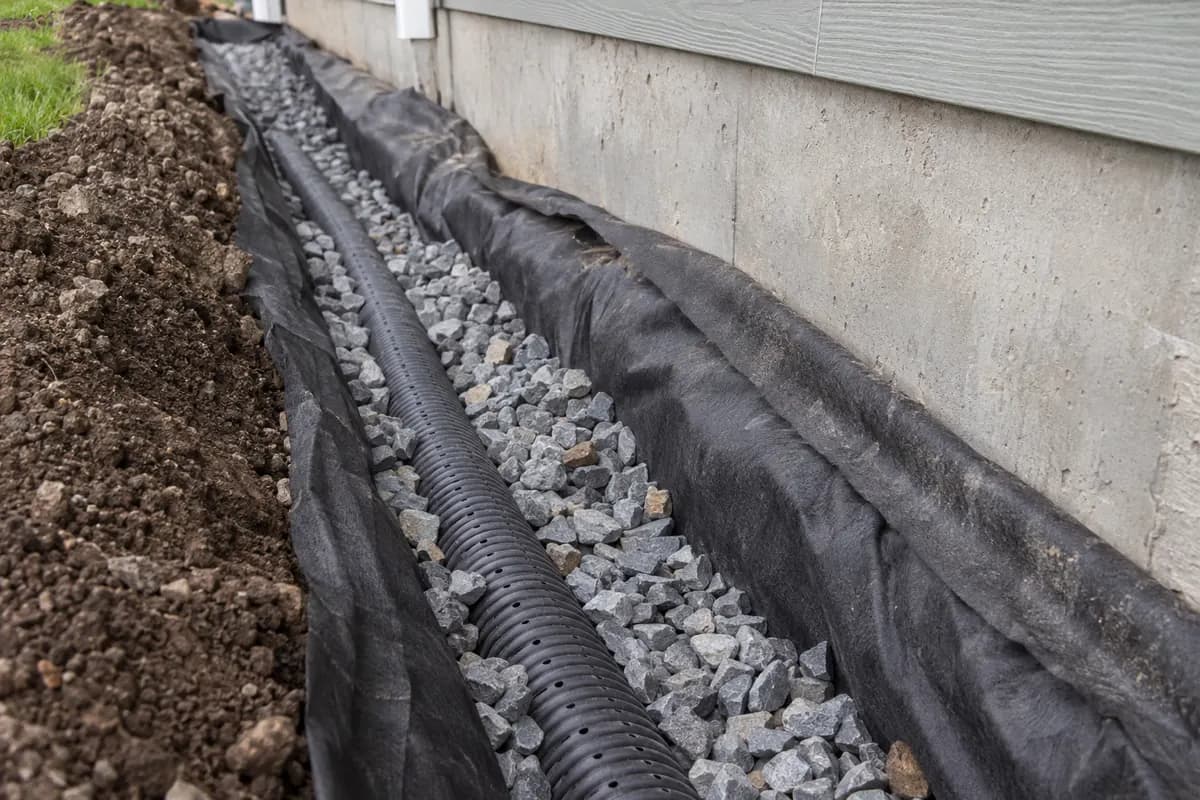
Drain Rock pairs well with the two other parts of a good French drain. Landscape fabric lining the trench keeps the surrounding soil out of the stone, and a perforated pipe resting on a bed of the rock carries water faster than stone alone. The rock shields the pipe from crushing loads, and the fabric shields the rock from silt. Together they make a drain that keeps running long after it disappears under the lawn.[1]
Plan the outlet before you dig. The trench bottom should fall steadily toward a spot lower than the wet area, such as a swale, a dry well or the edge of a slope, and the stone should continue right to that exit. A French drain with no place to empty only stores water in its gaps. With a clear outlet, the open spaces in Drain Rock keep emptying after every storm and the trench is ready for the next one.[1]
Worth considering
#57 Crushed Stone is the closest substitute. It is clean and angular, and its pieces run a little smaller and more even than Drain Rock. That evenness makes it easy to rake level around a pipe, and plenty of installers like it for bedding. It wins on short drains next to a foundation or a patio, where the trench is narrow and the stone has to sit snugly against the pipe walls.[1]
River Rock is the choice when the drain doubles as a garden feature. Its smooth, rounded stones look like a dry creek bed, which suits a drain that crosses a visible part of the yard. Use it as the top layer over Drain Rock instead of the full fill. Round stone settles more and grips a pipe less firmly, so the gray rock should do the work below while the River Rock handles the looks above.[1]
Some owners also ask about pea gravel. It lets water pass, but its small round pieces leave tighter gaps and roll underfoot, so it suits a shallow soak-away better than a working trench. For a drain that must carry real volume after a hard rain, the larger gray stone is the safer fill.[1]
 From$4242 ton delivered
#57 Crushed Stone
Gravel and Crushed Stone- Size
- 3/4 to 1 inch
- Weight
- 2,700 lb/yd³
- Color
- Gray
 From$4372 ton delivered
#67 Stone
Gravel and Crushed Stone- Size
- 3/4 inch and under
- Weight
- 2,700 lb/yd³
- Color
- Gray
 From$4252 ton delivered
#89 Crushed Stone
Gravel and Crushed Stone- Size
- 3/8 inch
- Weight
- 2,700 lb/yd³
- Color
- Gray
How much to order
Work out the floor area of the trench first. Multiply its length by its width in feet to get square feet. A trench a foot wide and 100 feet long has a floor of 100 square feet, which makes the coverage figures below easy to apply to your own run.[1]
Over 100 square feet of trench floor, Drain Rock takes about 0.83 tons at 2 inches deep, 1.25 tons at 3 inches, 1.67 tons at 4 inches and 2.50 tons at 6 inches. A deeper trench is just a stack of these layers. Two layers of 6 inches over that same floor need twice the 2.50 tons.[1]
The pipe takes up a little room inside the trench, but in a home drain the space it saves is small, so most people ignore it and treat the difference as a buffer. Leave a band at the top for soil and sod if the drain will be hidden, or fill to grade if you want an open stone strip. Order a touch more than the math says, because dug trench walls are rarely straight.[1]
A load of Drain Rock is dense. At about 2,700 lb per cubic yard, even a modest trench adds up to a heavy pile. Pick a drop spot close to the trench on firm ground, and have a wheelbarrow and a flat shovel ready. Moving stone by hand is the slowest part of the job, so a short haul saves your back.[1]
| Project size | 3 inch depth | 4 inch depth |
|---|---|---|
| 100 sq ft | 0.9 cu yd / 1.3 tons | 1.2 cu yd / 1.7 tons |
| 300 sq ft | 2.8 cu yd / 3.8 tons | 3.7 cu yd / 5.0 tons |
| 600 sq ft | 5.6 cu yd / 7.5 tons | 7.4 cu yd / 10.0 tons |
Top picks side by side
| Material | Spec | Fit and price |
|---|---|---|
| Drain RockTop pick | 3/4 to 1-1/2 inches, gray, 2,700 lb/yd³, by the ton | from $425 delivered, 2 tons |
| #57 Crushed Stone | 3/4 to 1 inch, gray, 2,700 lb/yd³, by the ton | from $424 delivered, 2 tons |
| #67 Stone | 3/4 inch and under, gray, 2,700 lb/yd³, by the ton | from $437 delivered, 2 tons |
| #89 Crushed Stone | 3/8 inch, gray, 2,700 lb/yd³, by the ton | from $425 delivered, 2 tons |
Verdict
Drain Rock is the best gravel for a French drain. Its 3/4 to 1-1/2 inch pieces leave wide gaps that stay open for years, its weight keeps pipe and trench in place, and its plain gray finish looks neat where the stone shows. Line the trench with fabric, bed a perforated pipe in the rock and fill to the depth you need.[1]
Reach for #57 Crushed Stone on narrow, short runs where a more even size beds the pipe neatly. Choose River Rock only as a top dressing on a drain you want people to notice. For the body of the trench, we recommend the larger clean gray stone almost every time.[1]
Get a delivered quote for Drain Rock
Tell us your project and we price Drain Rock delivered to your ZIP, no obligation.
Frequently Asked Questions
What size gravel is best for a French drain?
Clean stone between 3/4 and 1-1/2 inches works best. Pieces in that range leave wide gaps for water and resist clogging with silt. Drain Rock is graded to that range with the fine grit removed, so water moves through it freely along the full length of the trench.
Do I need a pipe in a French drain?
A pipe is optional, but it helps a lot on long runs or where a lot of water collects. Stone alone moves water slowly. A perforated pipe bedded in Drain Rock carries water to the outlet much faster, while the stone around it keeps the holes from blocking.
Should I wrap the gravel in landscape fabric?
In most soils, yes. Fabric lining the trench lets water through but keeps fine soil from washing into the stone. Without it, silt slowly fills the gaps in the rock and the drain loses flow. Fold the fabric over the top of the stone before you add soil or sod.
Can I use pea gravel for a French drain?
It can work in a short, shallow drain, but we pick larger stone. Pea gravel is small and round, so its gaps are tighter and it shifts under weight. Angular stone like Drain Rock keeps more open space and holds the pipe steady as the trench settles.
How deep should a French drain be?
Depth depends on what you are draining. A drain that catches surface water from a soggy lawn sits fairly shallow, while one that protects a basement wall goes deeper, near the level of the footing. Over a trench floor of 100 square feet, every 6 inches of Drain Rock takes about 2.50 tons.
How many tons of gravel does a French drain need?
Measure the trench floor in square feet and choose your stone depth. Drain Rock takes about 1.25 tons per 100 square feet at 3 inches deep and about 1.67 tons at 4 inches. Add the layers together for a deeper trench, then round up a little for uneven walls.