
Drainage and Base · Gray
Riprap Delivered in Bulk
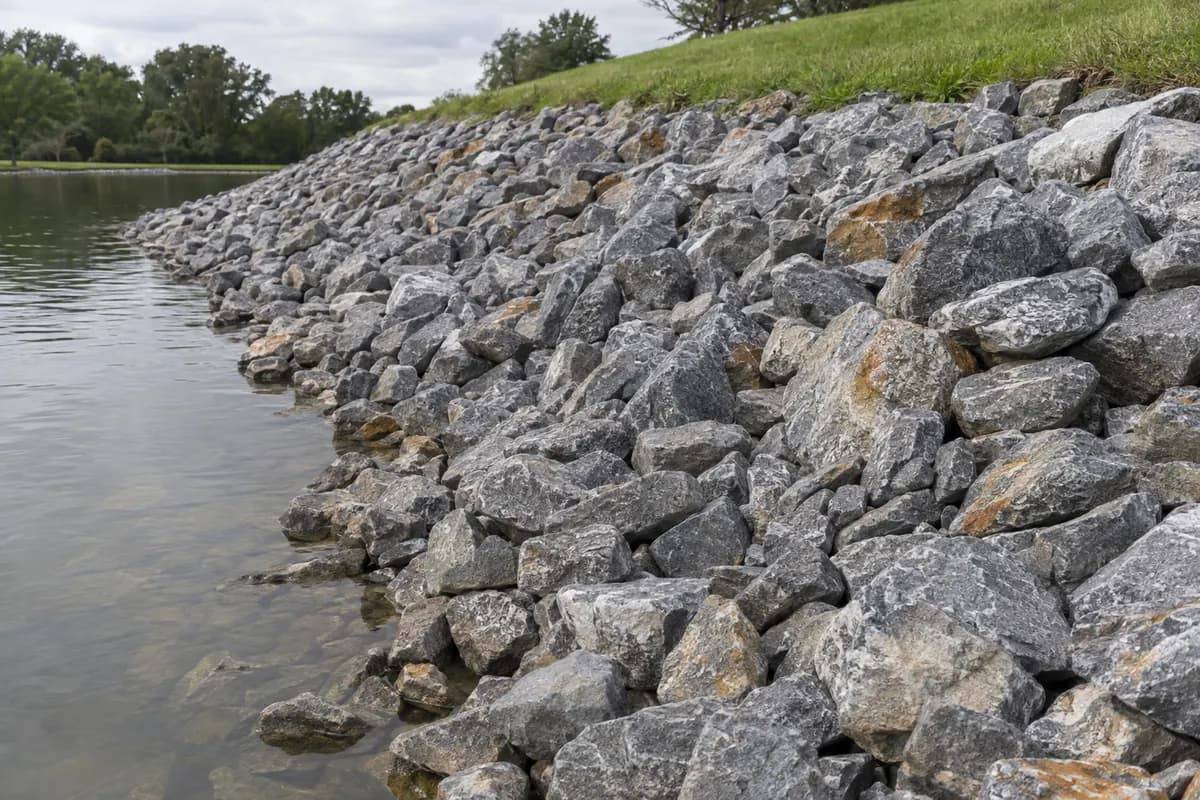
Riprap is large, broken gray rock from 6 to 12 inches. Heavy, angular pieces like these stay put where moving water would strip soil away. Gravel Valet delivers it by the ton for eroding slopes, stream and pond banks, drainage ditches and the outlets of culverts and pipes.
- From
- $443 delivered
- Size
- 6 to 12 inches
- Weight
- 2,700 lb/yd³
- Sold by
- the ton
See local Riprap pricing for your ZIP
Checking your saved delivery area.
- US cities served
- 368
- From, 2 tons delivered
- $443
- Weight
- 2,700 lb/yd³
- Size
- 6 to 12 inches

About Riprap
Riprap is armor for soil. When water runs fast across a bank or pours out of a pipe, it picks up loose dirt and carries it away, and the gully grows with every storm. A layer of heavy rock breaks that force. The water still flows, but it has to work around and between stones it cannot move, so the ground beneath stays where it is.[1]
This grade of Riprap runs from 6 to 12 inches, a size a person can still place by hand one piece at a time, though a machine makes faster work of it. The rock is quarried and broken, so the pieces have flat, rough faces that lean and lock against each other. It is gray, it weighs about 2,700 lb per cubic yard, and it is sold by the ton.[1]
A mix of sizes inside that range is a feature. The larger stones resist the current, and the smaller ones wedge into the gaps between them, which closes the openings where water could reach the soil. A well-placed layer looks rough and natural, and plants take root in the spaces over time, which binds the bank even more.[1]
Riprap is 6 to 12 inches, gray, about 2,700 lb per cubic yard, sold by the ton with a 2 ton minimum.
Specifications
| Material | Riprap |
|---|---|
| Category | erosion |
| Typical size | 6 to 12 inches |
| Color | Gray |
| Weight | 2,700 lb/yd³, about 1.35 tons per cubic yard |
| Sold by | the ton |
| Order minimum | 2 tons per delivery |
| Online order steps | half tons, up to 40 per order; more by quote |
Coverage: how much Riprap do you need?
Square feet one ton of Riprap covers at common spread depths. For exact tonnage, use the calculator.
- 120
- sq ft at 2" deep
- Top dressing, beds
- 80
- sq ft at 3" deep
- Paths, patios, drainage
- 60
- sq ft at 4" deep
- Driveways, base layers
Best uses for Riprap
The classic job is a stream or pond bank that is caving in. Riprap laid along the waterline stops waves and current from undercutting the slope. Culvert and pipe outlets are another frequent use: water leaves a pipe with a lot of force, and an apron of rock at the outlet spreads it out before it reaches bare soil.[1]
Steep drainage ditches that wash out after every storm get a lining of it. Steep road cuts and embankments use it to hold soil that will not stay seeded. On farms and rural lots, it protects the corners of a drive where runoff swings around a bend, and it lines spillways for small ponds. Some landscapers use the larger pieces as a rugged face on a slope that would be dangerous to mow.[1]
Keep Riprap off paths, drives and flower beds. The stones are big, sharp and uneven, and they shift if stepped on. For a path or a pad nearby, use a smaller crushed stone.[1]
How to install Riprap
Start by shaping the slope. Cut back overhanging soil and grade the bank to a gentle, even angle, since rock slides off a slope that is too steep. Lay a heavy non-woven geotextile over the soil, overlapping the seams with the upper piece of fabric over the lower one, like shingles on a roof, so water running down cannot slip underneath. On a stream bank, extend it below the waterline.[1]
Dig a toe trench along the bottom of the slope and fill it with the largest stones first. That toe holds the rest of the layer up and keeps the current from scouring under the edge. Then place the Riprap from the bottom up, setting each stone so it leans into the slope and fills gaps with smaller pieces. Dumping rock from the top of a bank tends to roll the biggest stones to the bottom and leave holes.[1]
Layer thickness follows stone size. A blanket should be thicker than the biggest pieces in it, so with stones up to 12 inches most jobs place a layer well over a foot deep. For a sense of scale, even a thin 6 inch layer takes about 2.50 tons per 100 square feet, so a full layer on a bank of any length adds up to many tons. Finish by walking the slope and filling any open pockets by hand.[1]
Comparable materials
Railroad Ballast is smaller and more uniform. It works for lining a shallow ditch, a culvert outlet with modest flow or a construction entrance, and it spreads easily with a loader. When water runs fast or a bank is tall, the bigger stones of Riprap hold better because the current cannot move them.[1]
#4 Crushed Stone fills a similar role on gentler jobs and makes a good filter layer under larger rock. River Rock, with its rounded 1 to 3 inch stones, suits a decorative dry creek bed in a yard, where flows are light and looks matter more. A common build stacks them: a bedding of smaller crushed stone on the fabric, Riprap on top for the armor, and plants or River Rock at the upper edge where the water rarely reaches.[1]
 From$4242 ton delivered
#57 Crushed Stone
Gravel and Crushed Stone- Size
- 3/4 to 1 inch
- Weight
- 2,700 lb/yd³
- Color
- Gray
 From$4372 ton delivered
#67 Stone
Gravel and Crushed Stone- Size
- 3/4 inch and under
- Weight
- 2,700 lb/yd³
- Color
- Gray
 From$4252 ton delivered
#89 Crushed Stone
Gravel and Crushed Stone- Size
- 3/8 inch
- Weight
- 2,700 lb/yd³
- Color
- Gray
 From$4452 ton delivered
#4 Crushed Stone
Gravel and Crushed Stone- Size
- 1-1/2 to 2-1/2 inches
- Weight
- 2,700 lb/yd³
- Color
- Gray
 From$4272 ton delivered
3/4" Crushed Stone
Gravel and Crushed Stone- Size
- 3/4 inch
- Weight
- 2,700 lb/yd³
- Color
- Gray
 From$4272 ton delivered
3/8" Crushed Stone
Gravel and Crushed Stone- Size
- 3/8 inch
- Weight
- 2,700 lb/yd³
- Color
- Gray
Where we source Riprap
Riprap comes from local quarries that blast hard rock such as granite, limestone or sandstone and sort the broken pieces by size. The 6 to 12 inch grade is screened or picked from the shot rock and loaded in bulk. Good Riprap is dense and resists cracking when wet and frozen, so quarries choose rock that holds up in water.[1]
Gravel Valet places each order with the quarry or yard closest to the site, which matters for a rock this heavy. The gray color varies with the local stone, from a pale limestone gray to a darker granite or trap rock. For erosion work, the hardness and the angular shape matter far more than the shade.[1]
Why bulk delivery saves money
Stones of this size only come loose. A single bank repair can take many tons, and a dump truck can bring that in one trip and set it down near the slope. Moving that much rock by pickup would take a string of loads and a sore back.[1]
Buying by the ton also lets you order the toe stones and the main layer at once, so the work goes in a single pass while the slope is shaped and the fabric is down. Exposed soil does not sit waiting for the next load, which keeps the next storm from undoing the grading. One delivery, one pile and no packaging is the plain, thrifty way to armor a bank.[1]
Ordering Riprap from Gravel Valet
Measure the length of the bank or channel, the width of the slope from bottom to top and the layer thickness you plan, then add the toe trench. The calculator turns that volume into tons from a weight of about 2,700 lb per cubic yard. Add some extra, since rough stones never fit as tightly as the math assumes.[1]
Enter your ZIP to see the delivered total, choose your tons and check out. Pick a drop spot on firm, level ground near the top of the slope, well back from any edge that could give way under a loaded truck. Our team calls or emails to confirm the delivery day and access.[1]
FAQ: Riprap
What size is Riprap?
Gravel Valet's Riprap is broken gray rock from 6 to 12 inches. The angular pieces lock together, and the mix of sizes lets small stones fill the gaps between larger ones. It weighs about 2,700 lb per cubic yard and is sold by the ton.
How thick should a Riprap layer be?
A layer should be thicker than the largest stones in it, so with pieces up to 12 inches most banks get a layer well over a foot deep. The bottom edge needs a toe trench filled with the biggest rock. Faster water and taller banks call for a thicker layer.
Do I need fabric under Riprap?
Yes, on almost every job. A heavy non-woven geotextile stops water from washing fine soil out through the gaps between the stones, which is the usual way a rock layer sinks and fails. Overlap the seams so the upper piece lies over the lower one, and run it into the toe trench.
Can I place Riprap by hand?
Stones from 6 to 12 inches are heavy but can be set by hand on a small job, such as a culvert outlet or a short bank. Wear gloves and boots and lift with your legs. Larger jobs go much faster with a skid steer or an excavator that can set each stone into place.
Will plants grow through Riprap?
Yes. Over time grasses, rushes and shrubs root in the soil that collects between the stones. Their roots help bind the bank. Some people tuck live stakes of willow or other native shrubs between the rocks at the start to speed this up.
How do I keep Riprap from washing away?
Grade the slope gently, lay fabric first, build a toe trench of the largest stones at the bottom and place rock from the bottom up. Use a mix of sizes so the gaps close. If the water is fast enough to move these stones, the site needs heavier rock.
Order Riprap today
Enter your ZIP for the delivered price, or send the job and we quote it by hand.
By state
Riprap by state
- Riprap in Alaska
- Riprap in Alabama
- Riprap in Arkansas
- Riprap in Arizona
- Riprap in California
- Riprap in Colorado
- Riprap in Connecticut
- Riprap in District of Columbia
- Riprap in Florida
- Riprap in Georgia
- Riprap in Hawaii
- Riprap in Iowa
- Riprap in Idaho
- Riprap in Illinois
- Riprap in Indiana
- Riprap in Kansas
- Riprap in Kentucky
- Riprap in Louisiana
- Riprap in Massachusetts
- Riprap in Maryland
- Riprap in Michigan
- Riprap in Minnesota
- Riprap in Missouri
- Riprap in Mississippi
- Riprap in Montana
- Riprap in North Carolina
- Riprap in North Dakota
- Riprap in Nebraska
- Riprap in New Hampshire
- Riprap in New Jersey
- Riprap in New Mexico
- Riprap in Nevada
- Riprap in New York
- Riprap in Ohio
- Riprap in Oklahoma
- Riprap in Oregon
- Riprap in Pennsylvania
- Riprap in Rhode Island
- Riprap in South Carolina
- Riprap in South Dakota
- Riprap in Tennessee
- Riprap in Texas
- Riprap in Utah
- Riprap in Virginia
- Riprap in Washington
- Riprap in Wisconsin