
Drainage and Base · Gray
Road Base Delivered in Bulk
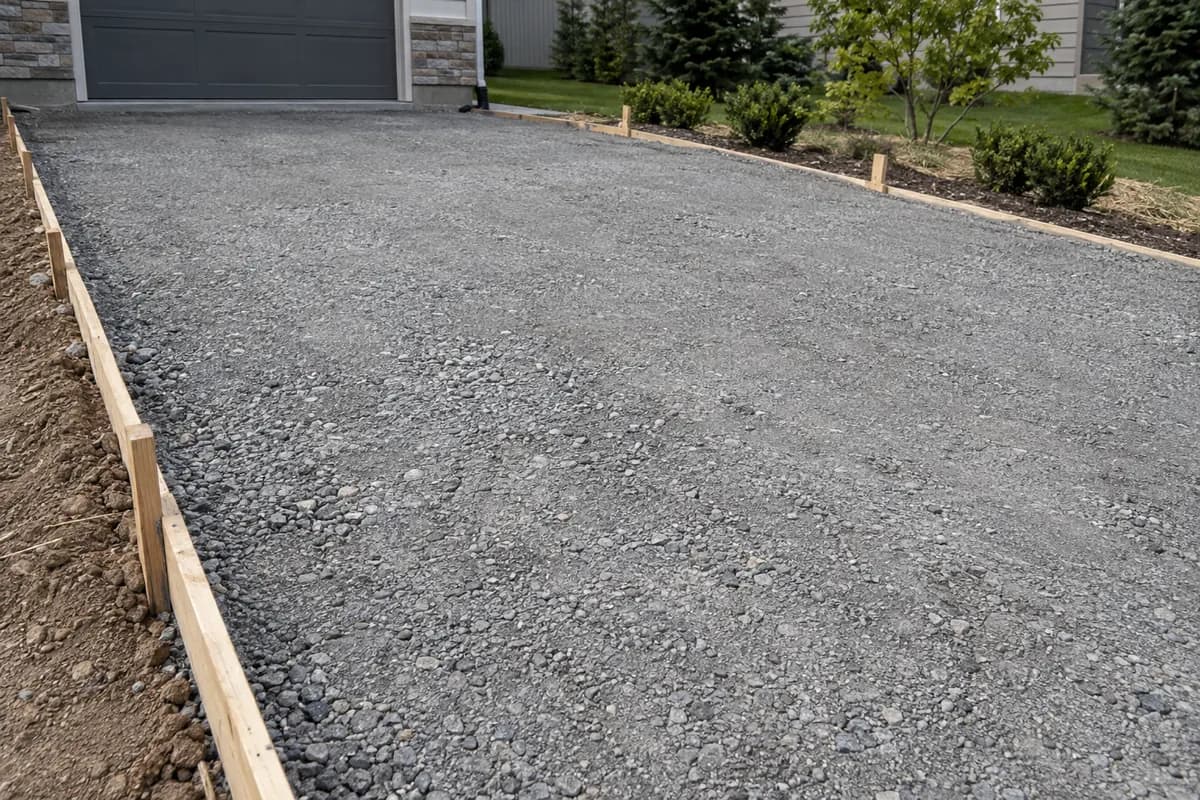
Road Base is gray crushed stone graded 3/4 inch minus, which means every size from 3/4 inch chips down to rock dust. Wet it, roll it, and it packs into a layer close to solid. Gravel Valet delivers it by the ton for the hidden layer under driveways, pavers, sheds and parking pads.
- From
- $415 delivered
- Size
- 3/4 inch minus
- Weight
- 2,800 lb/yd³
- Sold by
- the ton
See local Road Base pricing for your ZIP
Checking your saved delivery area.
- US cities served
- 368
- From, 2 tons delivered
- $415
- Weight
- 2,800 lb/yd³
- Size
- 3/4 inch minus

About Road Base
Road Base is what builders put down before anything you can see. A quarry crushes hard rock and keeps the full run of sizes, from 3/4 inch pieces down through grit to fine dust, instead of washing the small stuff away. The term 3/4 inch minus describes exactly that blend: the largest stones top out at 3/4 inch and everything smaller stays in.[1]
That spread of sizes is why it works. Crushed faces are sharp and rough, so the stones grip each other, while the grit and dust fill the voids between them. Under a roller the whole layer tightens into a dense mat that spreads a wheel load over a wide patch of soil. The color is plain gray, and a cubic yard weighs about 2,800 lb, heavier than clean stone because so few air gaps remain. It is sold by the ton.[1]
Road Base is 3/4 inch minus, gray, about 2,800 lb per cubic yard, sold by the ton with a 2 ton minimum.
Specifications
| Material | Road Base |
|---|---|
| Category | base |
| Typical size | 3/4 inch minus |
| Color | Gray |
| Weight | 2,800 lb/yd³, about 1.40 tons per cubic yard |
| Sold by | the ton |
| Order minimum | 2 tons per delivery |
| Online order steps | half tons, up to 40 per order; more by quote |
Coverage: how much Road Base do you need?
Square feet one ton of Road Base covers at common spread depths. For exact tonnage, use the calculator.
- 116
- sq ft at 2" deep
- Top dressing, beds
- 77
- sq ft at 3" deep
- Paths, patios, drainage
- 58
- sq ft at 4" deep
- Driveways, base layers
Best uses for Road Base
The main job is a driveway base. A packed Road Base layer carries cars and delivery vans without rutting, and a clean stone surface goes on top for looks and drainage. Some rural drives skip the top stone and run on bare packed base, which gives a hard, slightly dusty surface that a box blade can regrade each spring.[1]
Under pavers, flagstone and concrete it gives a flat, firm bed that will not settle unevenly. Shed pads, hot tub pads, playset footings, parking spots for trailers and campers, and the base of a retaining wall all use it. Contractors also lay it as the working surface on a building lot so trucks do not churn the soil into mud. Anywhere the goal is a hard, level floor under something heavy, Road Base is the usual answer.[1]
Repairs are a quieter use. A pothole in a gravel lane, a washed-out corner by a culvert or a sunken spot where a trailer sat all winter can be dug out, filled with Road Base and tamped flat in an afternoon. Because the material packs so tight, a patch made with it tends to stay level long after loose stone would have scattered. Keep a small pile on hand on a farm or a long drive and these fixes take minutes.[1]
How to install Road Base
Strip the topsoil and roots, because organic soil keeps settling for years. Shape the subgrade to its final slope and pack it. On clay or wet ground, roll out a woven geotextile so the stone stays clean and the soil stays below. Then dump the Road Base and spread it in lifts no thicker than your compactor can reach, with a few inches per pass for a plate compactor and more for a roller.[1]
Moisture makes or breaks the job. Dry base will not pack, and soaked base pumps and squeezes. Spray each lift until it holds together when squeezed in a fist, then make several overlapping passes until a boot heel leaves almost no mark. Build in a crown or a cross slope so rain runs off to the sides.[1]
Thickness follows the load. A walkway or paver patio over firm soil uses about 4 inches of packed base, about 1.73 tons per 100 square feet. A driveway for cars usually wants at least 6 inches, about 2.59 tons per 100 square feet, and soft soil or truck traffic calls for a thicker build in more lifts. Thin top-up layers of 2 or 3 inches, about 0.86 and 1.30 tons per 100 square feet, fix low spots on an existing base.[1]
Comparable materials
Driveway Gravel is 3/4 inch clean crushed stone with the fines washed out. It drains freely and stays loose on the surface, which makes it the right top layer over a Road Base foundation. On its own, Driveway Gravel moves under tires on a soft subgrade, and Road Base alone can be dusty in dry weather and slick when wet, so the two work best stacked.[1]
Stone Dust Screenings are almost all fines, the dust and grit left after crushing. They pack smooth and make a fine setting bed under pavers or a path surface, but they lack the larger stones that give Road Base its strength. A common paver build uses a thick Road Base layer for support and a thin bed of Stone Dust Screenings on top for leveling.[1]


Where we source Road Base
Road Base comes from crushing plants at local quarries and pits. Hard rock is blasted or dug, fed through a series of crushers, and the output is screened to cap the top size at 3/4 inch while the smaller sizes stay mixed in. Some yards blend it from separate piles to hit a steady grading. The rock type depends on the region: limestone, granite, trap rock or other hard stone.[1]
Gravel Valet orders from the plant or yard closest to the job. Base stone is heavy and sold in large amounts, so a short haul matters more for it than for almost any other material. The gray shade in a load can run lighter or darker with the local rock, which makes no difference once the layer is buried under the surface course.[1]
Why bulk delivery saves money
A base layer is measured in tons, and nobody builds one from bags. Even a small shed pad can need more stone than a pickup should carry, and a driveway needs several truckloads. Buying Road Base loose means the quarry loads it with a machine, the truck dumps it in one motion, and no labor goes into filling or opening sacks.[1]
Bulk delivery also lets you place the load where the work begins. A driver can tailgate-spread a strip down a new drive so you rake instead of shovel, if the site allows it. Fewer trips, no packaging and less handling all keep the outlay down, and an even pile on the right spot saves hours of moving stone twice.[1]
Ordering Road Base from Gravel Valet
Measure the area and choose the packed depth. The calculator uses this stone's weight of about 2,800 lb per cubic yard to turn square feet and inches into tons. Add some extra for compaction, because a loose layer settles as it packs, and for spots where the subgrade dips.[1]
Enter your ZIP to see the delivered total, pick your tons and check out. Say whether you want one pile or a spread, and point out soft ground, low wires or septic lines the truck must avoid. Our team calls or emails to set the delivery day and confirm how the truck will reach the drop spot.[1]
Have a compactor ready before the load arrives, either rented or borrowed, along with a hose for wetting each lift. A pile of base left in the sun dries out fast, and it packs best when you spread it soon after delivery.[1]
FAQ: Road Base
How thick should Road Base be under a driveway?
A driveway for cars usually wants at least 6 inches of packed Road Base, about 2.59 tons per 100 square feet. Soft or wet soil and heavy trucks call for more, placed in several lifts. Paths and paver patios over firm ground get by with 4 inches, about 1.73 tons per 100 square feet.
Can Road Base be the top surface of a driveway?
Yes, many rural drives run on packed Road Base alone. It makes a hard, flat surface that holds up well, but it can turn dusty in dry spells and a little slick after rain, and fines can track onto shoes. A layer of Driveway Gravel on top drains better and looks cleaner.
What does 3/4 inch minus mean?
It means the largest stones are 3/4 inch and every smaller size is kept in the mix, down to fine dust. The range of sizes is what lets Road Base pack tight. Clean stone of the same top size, with the small pieces washed out, drains well but does not lock into a hard layer.
Do I need fabric under Road Base?
On firm, sandy or gravelly soil you can skip it. On clay, silt or ground that stays wet, a woven geotextile under the base keeps mud from pushing up into the stone and keeps the stone from sinking. It is a small addition that adds years to a driveway on soft ground.
Should Road Base be wet when I compact it?
Yes. Road Base packs best when it is damp through, about wet enough to hold a shape when you squeeze a handful. Dry material stays loose under the compactor, and soaked material squeezes out and pumps. Water each lift with a hose before the passes and again if it dries out.
How heavy is Road Base?
Gravel Valet's Road Base weighs about 2,800 lb per cubic yard. It is sold by the ton, and the calculator uses that weight to work out how many tons your area and depth need. The mix of sizes leaves few air gaps, which is why it is denser than clean, washed stone.
Order Road Base today
Enter your ZIP for the delivered price, or send the job and we quote it by hand.
By state
Road Base by state
- Road Base in Alaska
- Road Base in Alabama
- Road Base in Arkansas
- Road Base in Arizona
- Road Base in California
- Road Base in Colorado
- Road Base in Connecticut
- Road Base in District of Columbia
- Road Base in Florida
- Road Base in Georgia
- Road Base in Hawaii
- Road Base in Iowa
- Road Base in Idaho
- Road Base in Illinois
- Road Base in Indiana
- Road Base in Kansas
- Road Base in Kentucky
- Road Base in Louisiana
- Road Base in Massachusetts
- Road Base in Maryland
- Road Base in Michigan
- Road Base in Minnesota
- Road Base in Missouri
- Road Base in Mississippi
- Road Base in Montana
- Road Base in North Carolina
- Road Base in North Dakota
- Road Base in Nebraska
- Road Base in New Hampshire
- Road Base in New Jersey
- Road Base in New Mexico
- Road Base in Nevada
- Road Base in New York
- Road Base in Ohio
- Road Base in Oklahoma
- Road Base in Oregon
- Road Base in Pennsylvania
- Road Base in Rhode Island
- Road Base in South Carolina
- Road Base in South Dakota
- Road Base in Tennessee
- Road Base in Texas
- Road Base in Utah
- Road Base in Virginia
- Road Base in Washington
- Road Base in Wisconsin