
Use case
Base Course Gravel: Material Guide
Base course is the packed stone layer that carries a patio, a driveway or a shed and spreads its weight into the ground. Get it right and the surface on top stays flat for years. This guide covers the best stone for the layer, what makes a good base, how to build one, how much to order and the mistakes that cause sinking and heaving.
Best materials for base course gravel
Road Base is our first choice for base course. It is a gray crushed stone graded 3/4 inch minus, which means the largest pieces are about 3/4 inch and everything smaller down to fine dust stays in the mix. Those fines are what let it pack into a dense, hard layer under a compactor.[1]
Driveway Gravel belongs in the layer above a base. Its clean, washed pieces give a gravel drive a surface that drains and grips. Spread over compacted Road Base, it makes the classic two-layer drive: a hard pack below and a loose, free-draining top.[1]
Stone Dust Screenings are the finest member of the family. They go on top of a base as a thin setting bed under pavers or flagstone, or as a smooth surface for a garden path. They level well, but they lack the coarse stone to carry heavy loads on their own.[1]
For soft, wet ground or a deep build, some builders start with a layer of larger crushed stone at the bottom and finish with Road Base on top. The larger stone bridges soft spots, and the finer base above it compacts into a smooth working surface.[1]
 From$4152 ton delivered
Road Base
Drainage and Base- Size
- 3/4 inch minus
- Weight
- 2,800 lb/yd³
- Color
- Gray
 From$4262 ton delivered
Driveway Gravel
Driveway and Landscaping- Size
- 3/4 inch clean crushed
- Weight
- 2,700 lb/yd³
- Color
- Gray
 From$4462 ton delivered
Stone Dust Screenings
Drainage and Base- Size
- 1/4 inch and fines
- Weight
- 2,800 lb/yd³
- Color
- Gray
What base course gravel needs in a material
A good base needs a range of particle sizes. The 3/4 inch pieces carry the load, smaller chips fill the spaces between them, and the fines fill the spaces between the chips. When the blend is right, compaction squeezes out the air and leaves a dense layer with almost no room to move.[1]
Angular particles matter too. Crushed stone has fractured faces that lock together under a compactor. Round gravel in the same sizes compacts poorly because the stones roll past each other. A base made of crushed stone stays put under traffic and through freeze and thaw.[1]
Moisture control is the third need. A base should be dense enough to carry weight without holding so much clay that it turns to mush when wet. Road Base is made from crushed rock, so its fines are mostly rock dust, and it keeps its strength when damp.[1]
Weight is a quick sign of density. A cubic yard of Road Base weighs about 2,800 lb, heavier than clean stone of a similar size, because the fines take up space that would otherwise be air.[1]
How to install base course gravel
Mark the area and dig it out deep enough for the full base plus the surface layer. Remove sod, roots and dark topsoil until you reach firm subsoil. Shape the bottom with the same slope you want on the finished surface, so water drains the right way from the start.[1]
Compact the subsoil with a plate compactor. On clay or wet ground, roll out a woven geotextile fabric next. The fabric stops the base from pushing down into the soil and keeps mud from rising into the stone.[1]
Spread the Road Base in lifts no thicker than a few inches. Dampen each lift with a hose so the fines can slide between the larger pieces, then make several passes with the compactor. A lift that is too thick stays loose at the bottom no matter how hard you pack the top.[1]
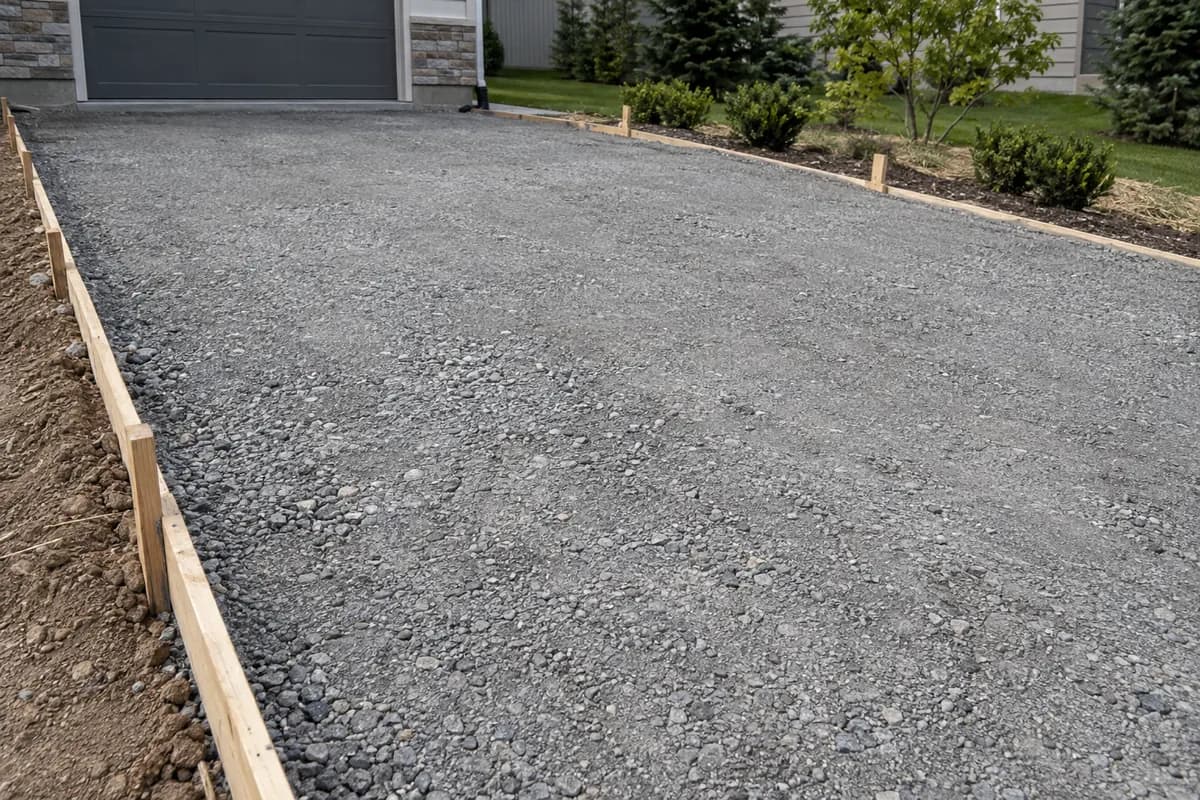
Check the surface with a long straightedge or a string line as you build. Fill low spots and compact again. When the final lift is firm and even, with a uniform gray surface and no loose pockets, the base is ready for pavers, a gravel top, a shed or a slab form.[1]
How much base course gravel do you need
Depth depends on the job. A walkway or a small patio over firm soil can use a thinner base. A patio with heavy furniture, a shed pad or a driveway for cars needs more, and soft or clay soil calls for more still.[1]
At 4 inches compacted depth, 100 square feet takes about 1.73 tons of Road Base. At 6 inches, the same area takes about 2.59 tons. Those two depths cover most patios, shed pads and home driveways.[1]
Thinner layers have a place. At 2 inches, 100 square feet takes about 0.86 tons, which suits a leveling course over an existing base. At 3 inches it takes about 1.30 tons, a sensible depth for a garden path over firm ground.[1]
To get the total, multiply length by width for the area, divide by 100, and multiply by the tonnage for your depth. Road Base loses volume as it is compacted, so order a little more than the math shows, and keep a spare pile for patching.[1]
| Project size | 3 inch depth | 4 inch depth |
|---|---|---|
| 100 sq ft | 0.9 cu yd / 1.3 tons | 1.2 cu yd / 1.7 tons |
| 300 sq ft | 2.8 cu yd / 3.9 tons | 3.7 cu yd / 5.2 tons |
| 600 sq ft | 5.6 cu yd / 7.8 tons | 7.4 cu yd / 10.4 tons |
What base course gravel costs
Road Base is sold by the ton and delivered by dump truck. The delivered total depends on how many tons you order, how far the stone travels from the supplying yard to your site, and what size truck can reach the drop spot.[1]
Larger orders spread the trip over more tons, so the amount per ton tends to drop as the order grows. A small patio order still needs a whole truck trip, which is why combining jobs, such as a shed pad and a path, into one delivery helps.[1]
Base stone is one of the less expensive materials per ton, because crushed rock is produced near most markets. The bigger factor in your total is the depth you choose. Skimping on depth saves a little at the start and can mean rebuilding later.[1]
Enter your ZIP in the box on the site to see the delivered figure for your area, then use the area calculator to turn your measurements into tons.[1]
Delivered, 2 tons: from $415 to $676 depending on the city (366 cities priced). Enter your ZIP for the exact figure.
Base course gravel mistakes to avoid
Using clean stone as a base is the first mistake. Washed gravel drains well but never packs tight, so pavers rock and drives rut. Keep clean stone for drainage and surfaces, and use a base with fines for the structural layer.[1]
Skipping the compactor is the second. Spreading Road Base and walking on it does not pack it. Rent a plate compactor and pack each lift until a boot heel leaves no mark.[1]
Building on topsoil causes slow sinking. Organic soil keeps settling as it decays. Dig down to firm subsoil before the first lift goes in, even if it means a deeper hole.[1]
Ignoring water undoes good work. A base with no slope and no outlet holds water, softens and heaves in freezing weather. Slope the surface away from buildings and give runoff somewhere to go.[1]
Rushing the finish is the last one. Pavers, a shed or a gravel top laid on a base that was never checked for level will show every dip. Take the time to run a string line, fix low spots and compact one final time before the surface goes on.[1]
Coverage
Browse more
FAQ for base course gravel
What is base course gravel?
Base course gravel is the compacted layer of crushed stone under a patio, driveway, walkway or slab. It spreads loads across the soil and gives the surface a firm, level bed. Road Base is the usual choice: crushed stone graded 3/4 inch minus with fines that bind into a dense layer when compacted.
Is road base the same as base course?
In everyday use, yes. Road Base is a crushed stone mix made for the base course layer. Different regions call it crusher run, dense grade aggregate or simply base. The name changes, but the idea stays the same: crushed stone with a range of sizes down to fines that packs hard.
How thick should base gravel be under pavers?
Most paver patios over firm soil use a compacted base of about 4 to 6 inches. Paver driveways and patios on soft or clay soil need more. Lay the base in thin lifts, compact each one, and finish with a thin sand bed before setting the pavers.
Can I use base course gravel as a driveway surface?
You can, and many rural lanes do. A compacted Road Base surface is hard and smooth but can get dusty in dry weather and slick in heavy rain. Most home drives add a top layer of clean Driveway Gravel, which drains and gives tires better grip.
Should base gravel be wet when compacting?
Slightly damp works best. Moisture lets the fines slide into the gaps and lock the larger stones. Dry base stays loose, and soaked base turns soft and pumps up under the compactor. Spray each lift lightly with a hose, compact, and repeat until the surface is firm.