
Best picks
Best Gravel for a Driveway: 2026 Picks
For the top layer of a gravel driveway, our pick is Driveway Gravel: 3/4 inch clean crushed stone in gray. It grips tires, drains after storms and stays where you spread it. Below we explain why it wins, when Road Base or Stone Dust Screenings make more sense, and how much stone a drive needs.
Driveway Gravel
base · size 3/4 inch clean crushed · 2,700 lb/yd³ · sold by the ton

Bottom line: Driveway Gravel for gravel for a driveway
Our top pick: Driveway Gravel
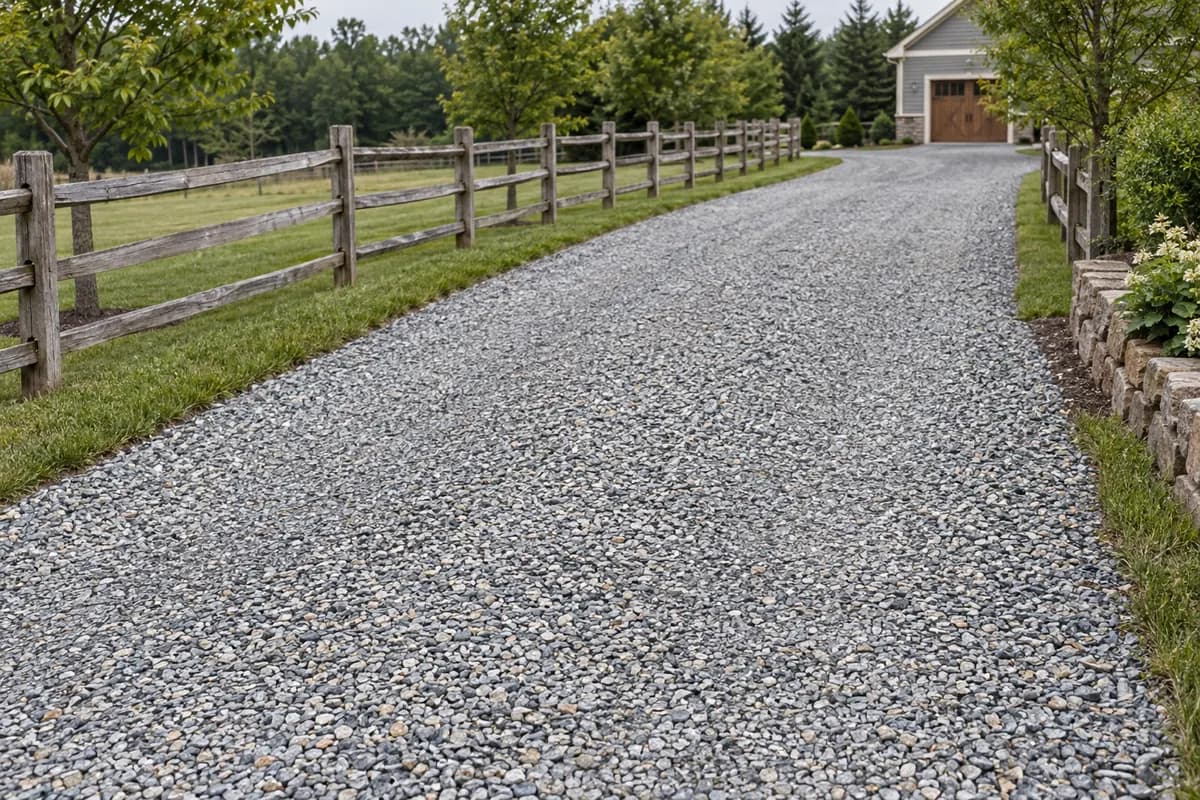
Driveway Gravel is crushed rock screened to a single size of 3/4 inch and washed clean of dust. Every piece has fractured, angular sides. When a car rolls over a layer of it, those sides press against each other and the stones wedge into a tight surface. Round stone such as pea gravel cannot do that, and it slides out from under tires on a slope or a turn.[1]
The washing step matters as much as the crushing. With the fines gone, rain runs down through the stone instead of turning the surface into paste. A drive topped with clean crushed stone dries quickly and stays usable in wet weather, and mud is the most common complaint owners have about other surface mixes.[1]
The color is a plain gray that goes with almost any house, lawn or fence. A cubic yard weighs about 2,700 lb, and the stone is sold by the ton. That weight is one reason it stays put: heavy, angular pieces resist the scatter that light stone suffers under spinning wheels.[1]
Why Driveway Gravel fits a driveway
A driveway asks three things of its surface. It must carry weight without rutting, shed water without washing out, and give tires enough grip to start, stop and turn. The 3/4 inch size handles each of these well. Smaller stone packs but holds water, and larger stone drains but feels rough underfoot and can bounce out from under a tire.[1]
The interlock of crushed faces spreads each wheel load across many stones, so the base below sees a gentler push. That keeps the base intact for longer and slows the forming of potholes. On a gentle slope, the locked surface resists the downhill creep that rounder stone shows after a few seasons of braking cars.[1]
Upkeep is simple. Snowplows and turning tires push some stone to the edges over a year, and a pass with a rake or a drag in spring pulls it back to the middle. A light top up every few years keeps the gray surface even. Nothing in the stone breaks down or rots, so the drive does not soften with age as long as soil and leaves stay off it. Blow leaves off in fall and pull weeds while they are small, because rotting matter between the stones is what slowly turns an old drive soft.[1]
Drainage around the stone matters as much as drainage through it. Shape the drive with a crown so the middle stands a little higher than the edges, and give the water a place to go at the sides, such as a shallow swale or a trench of drain stone. Clean crushed stone lets rain reach the base quickly, and the crown then moves it off to the sides before it can soften the ground. A drive built this way can shrug off a downpour that would leave a soil track rutted for weeks.[1]
Worth considering
Road Base is the right stone for the layer under the surface, and on some rural lanes it is the whole driveway. It is crushed stone that keeps its fines, so it compacts into a dense, hard pack. That makes it a strong foundation for clean stone on top. As a surface on its own it can turn dusty in dry spells and slick in heavy rain, so it wins mainly on farm roads, construction entrances and long lanes where a smooth, hard ride matters more than drainage.[1]
Stone Dust Screenings are the fine end of the crusher, mostly grit and powder. They pack smooth and firm, which is why they are the usual bed under pavers and a good surface for garden paths. On a driveway they wear into dust and ruts under cars. Screenings win in two spots: as a thin binding dressing over a loose drive top, and as the base for a paver or flagstone parking pad.[1]
Some owners also look at the clean stone by itself, with no base. That can work on firm, sandy ground that drains on its own, but on clay or soft soil the stone sinks over time. A packed base of Road Base under the Driveway Gravel is the safer plan almost everywhere.[1]


How much to order
Start with the area. Measure the length and the width of the drive, including turnarounds and parking spots, and multiply for square feet. The area calculator will turn that into tons, or you can work it out from the coverage figures below.[1]
For a top course over a sound, packed base, 2 inches of Driveway Gravel takes about 0.83 tons per 100 square feet, and 3 inches takes about 1.25 tons. Most drives with a good base stay in that range. A thicker loose layer than that tends to roll and shift under tires, so the depth belongs in the base instead.[1]
Where the drive sits on firm, well drained ground with no separate base, plan on more clean stone. A 4 inch layer uses about 1.67 tons per 100 square feet, and a 6 inch layer about 2.50 tons. Lay deep stone in two passes and pack each one with a plate compactor or a roller. Order a little extra for low spots and for the first spring top up.[1]
Base and surface are usually two separate orders on the same job. The base goes down first and gets packed, then the clean stone arrives for the top. If you are only refreshing an old drive, the base is already there, and the order is just the surface layer. Walk the drive after a rain before you measure. Puddles and ruts show where the base has failed, and those spots may need fresh Road Base packed in before the new gray top goes on.[1]
| Project size | 3 inch depth | 4 inch depth |
|---|---|---|
| 100 sq ft | 0.9 cu yd / 1.3 tons | 1.2 cu yd / 1.7 tons |
| 300 sq ft | 2.8 cu yd / 3.8 tons | 3.7 cu yd / 5.0 tons |
| 600 sq ft | 5.6 cu yd / 7.5 tons | 7.4 cu yd / 10.0 tons |
Top picks side by side
| Material | Spec | Fit and price |
|---|---|---|
| Driveway GravelTop pick | 3/4 inch clean crushed, gray, 2,700 lb/yd³, by the ton | from $426 delivered, 2 tons |
| Road Base | 3/4 inch minus, gray, 2,800 lb/yd³, by the ton | from $415 delivered, 2 tons |
| Stone Dust Screenings | 1/4 inch and fines, gray, 2,800 lb/yd³, by the ton | from $446 delivered, 2 tons |
Verdict
For nearly every gravel driveway, Driveway Gravel is the best surface stone. The 3/4 inch clean crushed size locks under tires, drains after a storm and looks tidy in plain gray. Pair it with a packed base of Road Base, keep the top course thin and rake it back to the center once a year.[1]
Pick Road Base alone for a farm lane or a work road where a hard ride matters most and puddles are rare. Pick Stone Dust Screenings for a paver pad or a path, never for the main driving surface. For a home drive that should stay firm and dry for years, clean crushed stone over a solid base is the pairing we recommend.[1]
Get a delivered quote for Driveway Gravel
Tell us your project and we price Driveway Gravel delivered to your ZIP, no obligation.
Frequently Asked Questions
What size gravel is best for a driveway?
For the surface, 3/4 inch clean crushed stone is the best all round size. It is large enough to drain and stay put under tires and small enough to feel smooth to walk and drive on. Driveway Gravel is screened and washed to exactly that size.
Do I need a base under driveway gravel?
On most ground, yes. A compacted layer of Road Base carries the weight of cars and stops the surface stone from sinking into soil. Only firm, sandy ground that drains on its own can go without one, and even there a base makes the drive last longer.
Is pea gravel good for a driveway?
It is a poor choice for the driving surface. Pea gravel is round, so the stones roll against each other instead of locking. Cars sink and slide in it, and it scatters onto the lawn. Angular crushed stone such as Driveway Gravel holds together far better under tires.
How deep should driveway gravel be?
Over a good base, 2 to 3 inches of surface stone is enough. At 3 inches Driveway Gravel takes about 1.25 tons per 100 square feet. Deeper loose stone shifts under tires, so put the depth into the base layer and keep the clean stone on top thin.
Why is clean crushed stone better than gravel with fines?
Stone with fines packs hard, which is why it makes a good base. On the surface, though, the fines hold water and turn to mud or dust. Clean crushed stone drains straight through, so the surface stays firm and dry, and the angular faces still lock for grip.
How often does a gravel driveway need new stone?
Rake stone back from the edges each spring. A thin fresh layer every few years keeps the surface even. At 2 inches, Driveway Gravel uses about 0.83 tons per 100 square feet, so a light top up is a small order compared with the first build.