
Best picks
Best Aggregate for a French Drain: 2026 Picks
Sand, soil and mixed gravel all hold water in a French drain. Open aggregate lets it go. After weighing the options, we put Drain Rock first: washed gray stone from 3/4 to 1-1/2 inches that keeps its voids open under fabric and soil. This guide explains how each layer of the drain uses it, when two other crushed stones beat it, and how to size an order.
Drain Rock
drainage · size 3/4 to 1-1/2 inches · 2,700 lb/yd³ · sold by the ton

Bottom line: Drain Rock for aggregate for a french drain
Our top pick: Drain Rock
Aggregate is any loose mineral fill, from fine sand to large crushed rock. Inside a drain, the useful kind is the kind with nothing small in it. Drain Rock fits that description. Its pieces fall between 3/4 and 1-1/2 inches, and the dust and chips that would plug the gaps are screened away before the stone ever leaves the yard.[1]
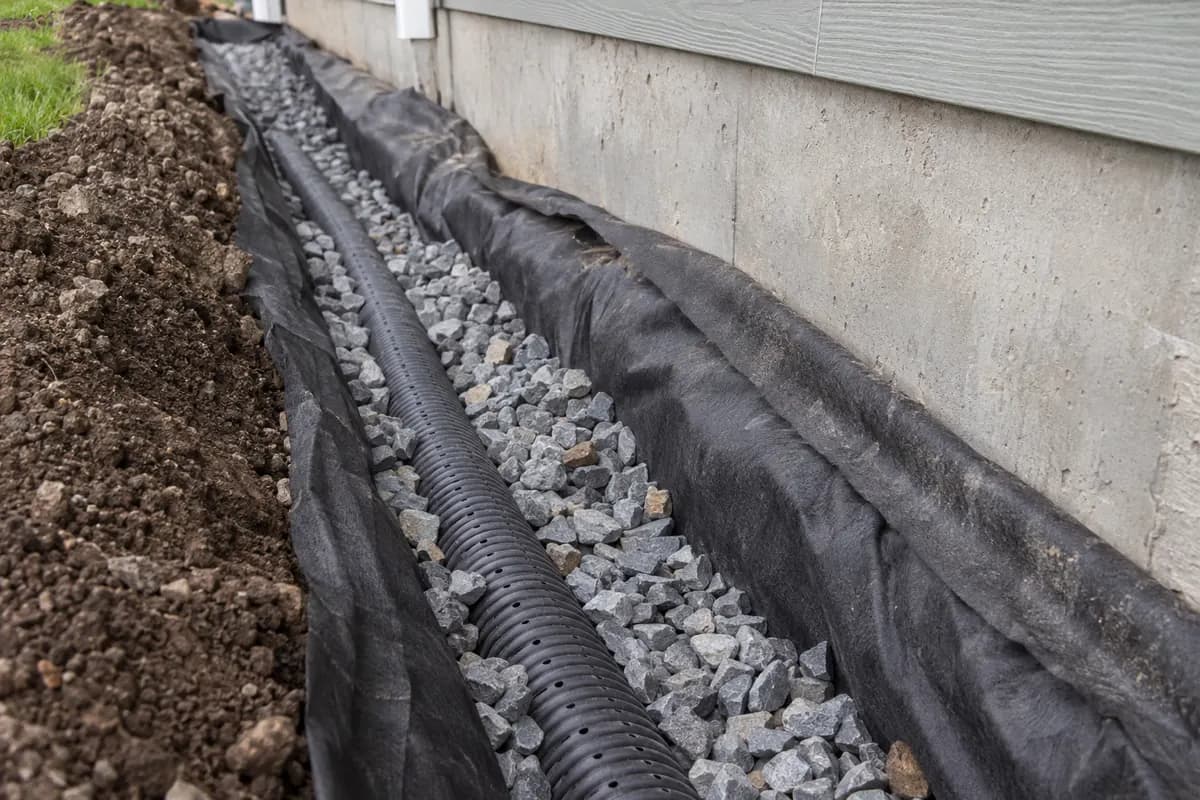
Think of the finished drain as a buried channel built from air pockets. Each stone touches its neighbors at a few points and leaves the rest of its surface surrounded by open space. Groundwater seeping in from the trench walls drops into that space and follows gravity along the bottom. The bigger and cleaner the pieces, the more open space there is to carry it.[1]
Drain Rock is gray, heavy and sold by the ton. A cubic yard comes to about 2,700 lb. That mass keeps the fill from shifting when soaked soil pushes against the trench sides, and it means a small order still arrives as a compact pile that fits beside most work areas.[1]
Why Drain Rock suits a French drain
A French drain is built in layers, and the aggregate shows up in three of them. A thin bed goes on the trench floor so the pipe sits on stone instead of mud. The surround fills the space beside and over the pipe. The cap brings the fill up toward the surface. One clean stone in all three keeps the order simple and the water path continuous from top to bottom.[1]
In the bed, the size range of 3/4 to 1-1/2 inches gives the pipe firm footing. The holes in a perforated pipe face downward in many installs, and the open stone beneath them lets water rise into the pipe from below. Sand or fine gravel in that spot would pack around the holes and slow the inflow.[1]
In the surround, the job changes to protection. Soil above a buried drain presses down, and foot traffic or a garden cart adds more weight now and then. Interlocked crushed pieces spread that load out so it never lands directly on the pipe wall. A crushed or kinked pipe is the most common reason an old drain stops working, and a good stone surround prevents it.[1]
In the cap, the gray stone either meets the fabric fold under the turf or stays exposed as an open inlet. An exposed cap catches runoff from a patio edge or a downspout splash zone and sends it straight down to the pipe. Over the years, leaves and grit gather in the top band of an open cap. Lift that band with a rake every few seasons and the stone below keeps working.[1]
Worth considering
3/4" Crushed Stone is a clean, single-size gray stone with sharp faces. It drains well and compacts slightly better than the wider Drain Rock range, which helps in a trench that runs along a walkway or a driveway edge where the surface must stay firm. Pick it when the drain shares space with traffic and you want the top to feel solid underfoot.[1]
#4 Crushed Stone is the heavyweight option. Its pieces are much larger, so the voids between them are huge and the fill moves big volumes of water. That makes it a strong fit for a dry well at the end of a long drain, or for a curtain drain on a hillside that sheds a lot of runoff. In a narrow home trench the big stones are awkward to place around a pipe, so most people keep it for the collection pit.[1]
A common plan mixes the two ideas. Drain Rock fills the trench itself, and a pit of #4 Crushed Stone at the low end gives the water a roomy place to collect and soak away. The finer stone does the steady work along the run, and the coarse stone handles the surge at the outlet.[1]
 From$4242 ton delivered
#57 Crushed Stone
Gravel and Crushed Stone- Size
- 3/4 to 1 inch
- Weight
- 2,700 lb/yd³
- Color
- Gray
 From$4372 ton delivered
#67 Stone
Gravel and Crushed Stone- Size
- 3/4 inch and under
- Weight
- 2,700 lb/yd³
- Color
- Gray
 From$4252 ton delivered
#89 Crushed Stone
Gravel and Crushed Stone- Size
- 3/8 inch
- Weight
- 2,700 lb/yd³
- Color
- Gray
How much to order
Sizing an aggregate order comes down to two numbers: how much floor the trench covers and how deep the stone goes. For the floor, multiply the trench length by its width in feet. A run 100 feet long and a foot wide covers 100 square feet, and a shorter or narrower run scales down from there.[1]
For depth, use the coverage figures for Drain Rock. Each 100 square feet of floor takes about 0.83 tons for a 2 inch layer and about 1.25 tons for 3 inches. A 4 inch layer needs about 1.67 tons, and a 6 inch layer needs about 2.50 tons. Stack those layers to reach the full depth of your trench.[1]
Here is how the stacking works in practice. Picture a trench with a 2 inch bed under the pipe and a 6 inch cover of stone above it. Over 100 square feet of floor, that is about 0.83 tons for the bed plus about 2.50 tons for the cover. Add the stone that fills the space beside the pipe and you have a working order.[1]
If a dry well sits at the end of the run, size it on its own. Measure the floor of the pit, choose its depth and use the same method with the coverage figures for the stone you put in it. Count the trench and the pit as two lines on the order so neither one comes up short on the day you fill it.[1]
Delivery planning saves effort on a drain job. Ask for the stone to be dropped as close to the trench line as the ground allows, ideally on a tarp or on a patch of lawn you plan to dig up anyway. Gray stone left on grass for a day does no harm, but a week under a heavy pile will leave a yellow patch. Fill the trench in the same order you dug it, starting at the high end and working down toward the outlet.[1]
| Project size | 3 inch depth | 4 inch depth |
|---|---|---|
| 100 sq ft | 0.9 cu yd / 1.3 tons | 1.2 cu yd / 1.7 tons |
| 300 sq ft | 2.8 cu yd / 3.8 tons | 3.7 cu yd / 5.0 tons |
| 600 sq ft | 5.6 cu yd / 7.5 tons | 7.4 cu yd / 10.0 tons |
Top picks side by side
| Material | Spec | Fit and price |
|---|---|---|
| Drain RockTop pick | 3/4 to 1-1/2 inches, gray, 2,700 lb/yd³, by the ton | from $425 delivered, 2 tons |
| #57 Crushed Stone | 3/4 to 1 inch, gray, 2,700 lb/yd³, by the ton | from $424 delivered, 2 tons |
| #67 Stone | 3/4 inch and under, gray, 2,700 lb/yd³, by the ton | from $437 delivered, 2 tons |
| #89 Crushed Stone | 3/8 inch, gray, 2,700 lb/yd³, by the ton | from $425 delivered, 2 tons |
Verdict
For the aggregate inside a French drain, Drain Rock is the one we would choose first. It beds the pipe, guards it from loads and carries water from end to end with gaps that silt has a hard time filling. The gray stone also makes a neat open inlet where runoff needs a way in.[1]
Switch to 3/4" Crushed Stone where the drain runs under a path or along a drive edge and the top must stay firm. Add #4 Crushed Stone for a dry well or a hillside curtain drain that collects heavy flows. Leave sand, soil and mixed fill out of the trench entirely, because they hold the water you are trying to move.[1]
Get a delivered quote for Drain Rock
Tell us your project and we price Drain Rock delivered to your ZIP, no obligation.
Frequently Asked Questions
What is the best aggregate for a French drain?
Clean, open stone with no fine material. Drain Rock, graded from 3/4 to 1-1/2 inches with the dust screened out, leaves wide gaps for water and keeps them open for years. Mixed gravel and sand hold water and clog, so they make poor drain fill.
Can I use sand in a French drain?
Keep sand out of the trench. Its grains are tiny, so the spaces between them are tiny too, and water moves through it slowly. Sand also washes into the pipe holes. Use open stone such as Drain Rock for the bed, the surround and the cap.
Is crushed stone or round gravel better in a drain?
Crushed stone holds a pipe better. Its sharp faces lock together, so the fill stays put under soil and foot traffic. Round gravel drains well but rolls and settles. Drain Rock and 3/4" Crushed Stone are both angular, clean choices for a working drain.
What goes at the end of a French drain?
The water needs a place to go: a lower part of the yard, a swale or a dry well. A dry well is a pit filled with coarse stone such as #4 Crushed Stone, which gives the water room to collect and slowly soak into the ground.
How much aggregate does a 100 square foot trench floor need?
It depends on depth. Drain Rock takes about 0.83 tons for 2 inches, about 1.67 tons for 4 inches and about 2.50 tons for 6 inches over 100 square feet. Add each layer, bed, surround and cap, to get the full order.
Does French drain stone need to be washed?
Washed or well screened stone is best. Dust left on unwashed stone rinses down to the trench floor during the first storms and can coat the fabric and the pipe holes. Clean Drain Rock starts open and stays that way much longer.