
Sand · Tan to gray
Concrete Sand Delivered by the Ton
Concrete Sand is a coarse, washed sand with sharp grains of mixed size. It gives a concrete mix its body, makes a firm bed under pavers and drains better than finer sands. Gravel Valet delivers it by the ton for slabs, patios, pool bases and trench work.
- From
- $415 delivered
- Size
- Coarse
- Weight
- 2,700 lb/yd³
- Sold by
- the ton
See local Concrete Sand pricing for your ZIP
Checking your saved delivery area.
- US cities served
- 368
- From, 2 tons delivered
- $415
- Weight
- 2,700 lb/yd³
- Size
- Coarse

About Concrete Sand
Ready-mix plants buy more of this sand than of any other kind, which is how it got its name. The grains are Coarse, with a range from small pebbly bits down to fine grit, and the washing strips out most of the clay and silt. Rubbed between two fingers it feels rough and scratchy. Those angular, mixed grains wedge against one another, which gives the sand strength in concrete and stability as a bedding layer.[1]
Color runs Tan to gray, depending on the rock it came from, and it looks darker straight off a wash plant than after a day in the sun. Expect roughly 2,700 lb in each cubic yard. Gravel Valet sells Concrete Sand by the ton. The coarse texture leaves more open space between grains than a fine sand does, so water moves through a layer of it with less resistance.[1]
Sand graded for concrete follows a rough recipe: enough coarse grains to give the mix a skeleton, and enough fine grains to fill the spaces between them. Too much fine material makes a weak, sticky mix that cracks as it dries. Too little leaves a harsh mix that is hard to finish. A good load of Concrete Sand sits in the middle, which is also why it beds pavers so well.[1]
Concrete Sand is Coarse, tan to gray, about 2,700 lb per cubic yard, sold by the ton with a 2 ton minimum.
Specifications
| Material | Concrete Sand |
|---|---|
| Category | sand |
| Typical size | Coarse |
| Color | Tan to gray |
| Weight | 2,700 lb/yd³, about 1.35 tons per cubic yard |
| Sold by | the ton |
| Order minimum | 2 tons per delivery |
| Online order steps | half tons, up to 40 per order; more by quote |
Coverage: how much Concrete Sand do you need?
Square feet one ton of Concrete Sand covers at common spread depths. For exact tonnage, use the calculator.
- 120
- sq ft at 2" deep
- Top dressing, beds
- 80
- sq ft at 3" deep
- Paths, patios, drainage
- 60
- sq ft at 4" deep
- Driveways, base layers
Best uses for Concrete Sand
Mixing concrete by hand or in a small mixer is the namesake job. Combined with cement, gravel and water, it fills the spaces between stones and helps the mix cure hard. Fence post footings, small slabs, steps and pads poured at home all use it.[1]
Paver bedding is the second big use. Over a compacted stone base, a thin, screeded layer of Concrete Sand gives each paver a firm seat that still lets you tap it level. Because the sand drains, water that seeps through the joints can move down into the base instead of sitting under the pavers. Pool installers spread it under above-ground pool liners, and plumbers and utility crews use it to bed pipe in a trench so rocks do not press on the line.[1]
Other jobs include topping a horse arena, mixing into heavy clay garden soil to loosen it, and sanding icy walks for traction in winter. The coarse grains feel rough under bare feet, so for a sandbox most people pick a finer, softer sand.[1]
How to install Concrete Sand
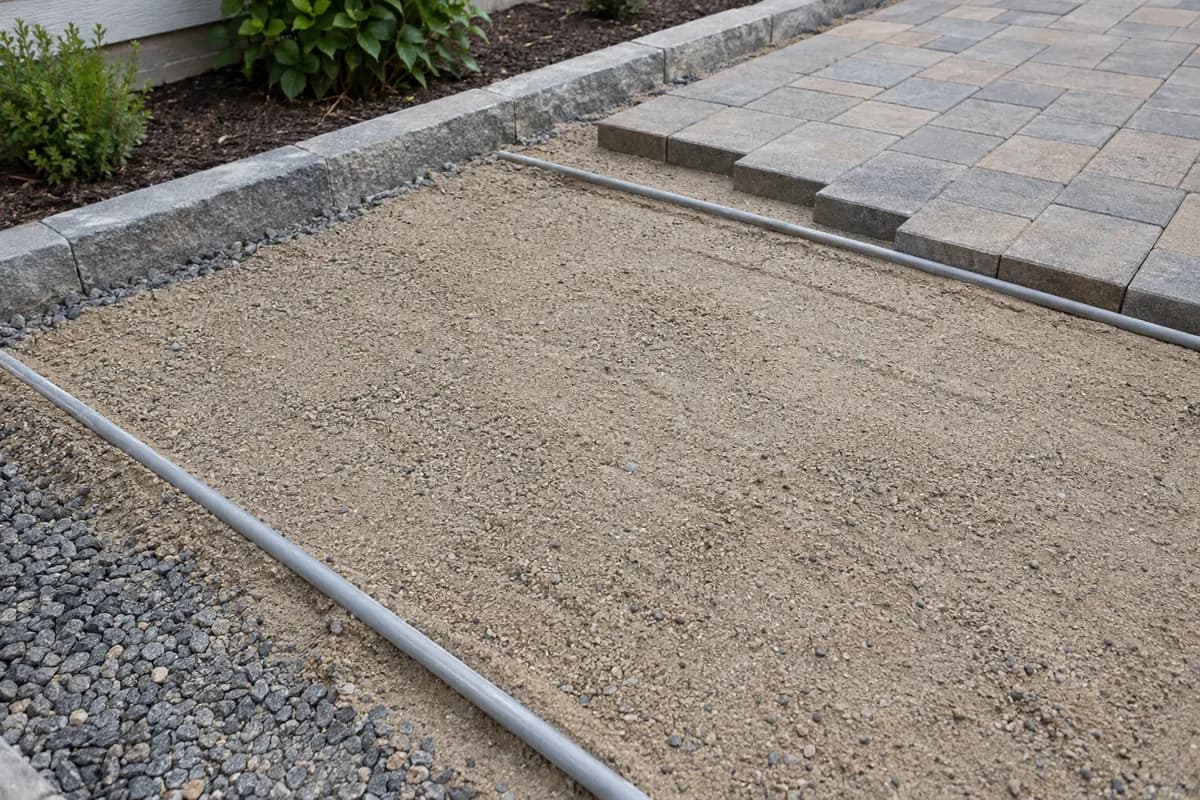
Under pavers, sand goes on last, over a stone base that is already graded and compacted. Lay two straight pipes or rails on the base, fill between them with sand, and drag a board across the rails to strike a flat, even bed about 1 inch thick. Pull the rails, fill their grooves by hand, and stay off the screeded sand while you set the pavers from the finished side.[1]
A pool base calls for a deeper, wider pad. Clear and level the ground, frame the circle, and spread a 2 inch layer, which takes about 0.83 tons per 100 square feet. Some installers build to 3 inches, about 1.25 tons per 100 square feet, to smooth out a lumpy yard. Wet and tamp the pad, then check it with a long level in several directions before the liner goes down.[1]
For pipe bedding, lay sand along the trench floor, set the pipe, and pack more sand around and over it before the trench is backfilled. A 4 inch layer covers about 100 square feet per 1.67 tons, and a 6 inch layer about 100 square feet per 2.50 tons. Tamp the sand at the sides of the pipe by hand so there are no hollow spots.[1]
Comparable materials
Mason Sand is finer and softer. It makes smooth mortar and fills tight paver joints, while Concrete Sand makes stronger concrete and a better paver bed. Many patio jobs use both: the coarse sand underneath and the fine sand swept into the joints on top.[1]
Fill Sand is unscreened and holds more fines and the odd pebble, so it works for filling holes and raising grades but not for a mix or a bed where the grain matters. Playground Sand is washed and fine, made for digging hands and soft landings. Stone Dust Screenings compete with Concrete Sand for the paver bed. Screenings lock tighter, while Concrete Sand drains better and screeds more easily.[1]



Where we source Concrete Sand
Most Concrete Sand is natural sand dug from old river and glacial deposits. Pits run the raw sand through a wash plant, where water and screws carry away clay and silt and screens pull out the oversize stones. In areas with little natural sand, quarries make a crushed version from rock, then wash it the same way. Either kind can meet the same grading.[1]
Gravel Valet orders from pits and yards near each delivery address, many of which also supply local ready-mix plants. The source rock sets the color, which is why loads range Tan to gray from one region to the next. The grain size stays Coarse wherever it comes from.[1]
Natural pit sand tends to have rounder grains worn by water, while crushed sand from a quarry has sharper, more angular grains. Home concrete and paver beds take either one well. Crushed sand can feel a little grittier and pack a bit tighter, and natural sand can screed a bit more smoothly.[1]
Why bulk delivery saves money
A patio bed, a pool pad or a trench of pipe bedding uses far more sand than the bags on a store pallet hold. Buying by the bag also means loading, unloading and opening each one. A bulk delivery by the ton replaces all of that with one drop.[1]
At roughly 2,700 lb per cubic yard, sand is too heavy to haul in quantity in a family car. Renting a truck or trailer adds its own fees and time. One dump truck brings the full amount, and getting enough for the bed and any concrete in one order keeps the job moving without a second run to the yard.[1]
Ordering Concrete Sand from Gravel Valet
Find the square feet of the area you are bedding or padding and pick the depth. The calculator gives the tons. If you are also mixing concrete, add the sand that mix calls for. Enter your ZIP to see the delivered total for your address and order by the ton.[1]
Point the truck to a firm, flat spot clear of wires and branches, close to the work but off any septic field. A tarp under the pile keeps the sand free of grass and dirt. If the pile will sit for a few days, cover it so rain does not wash the Coarse grains into the lawn.[1]
If one order covers both a concrete pour and a paver bed, keep part of the pile clean and dry for the mix. Sand that has been rained on carries extra water into the mixer, so cut back the water you add to keep the batch from turning soupy. A tarp over the pile solves most of this.[1]
FAQ: Concrete Sand
Is Concrete Sand good for pavers
Yes. It is the standard choice for the thin bed under pavers, set about 1 inch thick over a compacted stone base. Its coarse, sharp grains hold the pavers firm while letting water drain down. For the joints between pavers, many installers sweep in a finer sand or a polymeric joint sand afterward.
Can I use Concrete Sand under an above-ground pool
Yes, it is a common pool base. Spread and level a 2 or 3 inch pad, wet it and tamp it smooth, and check it with a long level. Its coarse grains hold their shape under the weight of the water better than a fine sand, which can shift.
What is the difference between Concrete Sand and Mason Sand
Concrete Sand is coarse and sharp, which gives concrete strength and makes a firm paver bed. Mason Sand is fine and smooth, which suits mortar, paver joints and sandboxes. If the sand will carry load, use Concrete Sand. If it needs to spread thin or feel soft, use Mason Sand.
Does Concrete Sand drain well
It drains better than fine sands because its larger grains leave more open space. That makes it a good bed under pavers and around buried pipe. It is still sand, though, so for a French drain or behind a retaining wall a clean stone such as Drain Rock moves water much faster.
Can I mix Concrete Sand into clay soil
Coarse sand can loosen heavy clay when mixed in with a generous share of compost. A thin layer of sand alone on top of clay does little, and a small amount mixed in can make the soil denser. Work in sand and Compost together and deep, or use Garden Soil for new beds.
Order Concrete Sand today
Enter your ZIP for the delivered price, or send the job and we quote it by hand.
By state
Concrete Sand by state
- Concrete Sand in Alaska
- Concrete Sand in Alabama
- Concrete Sand in Arkansas
- Concrete Sand in Arizona
- Concrete Sand in California
- Concrete Sand in Colorado
- Concrete Sand in Connecticut
- Concrete Sand in District of Columbia
- Concrete Sand in Florida
- Concrete Sand in Georgia
- Concrete Sand in Hawaii
- Concrete Sand in Iowa
- Concrete Sand in Idaho
- Concrete Sand in Illinois
- Concrete Sand in Indiana
- Concrete Sand in Kansas
- Concrete Sand in Kentucky
- Concrete Sand in Louisiana
- Concrete Sand in Massachusetts
- Concrete Sand in Maryland
- Concrete Sand in Michigan
- Concrete Sand in Minnesota
- Concrete Sand in Missouri
- Concrete Sand in Mississippi
- Concrete Sand in Montana
- Concrete Sand in North Carolina
- Concrete Sand in North Dakota
- Concrete Sand in Nebraska
- Concrete Sand in New Hampshire
- Concrete Sand in New Jersey
- Concrete Sand in New Mexico
- Concrete Sand in Nevada
- Concrete Sand in New York
- Concrete Sand in Ohio
- Concrete Sand in Oklahoma
- Concrete Sand in Oregon
- Concrete Sand in Pennsylvania
- Concrete Sand in Rhode Island
- Concrete Sand in South Carolina
- Concrete Sand in South Dakota
- Concrete Sand in Tennessee
- Concrete Sand in Texas
- Concrete Sand in Utah
- Concrete Sand in Virginia
- Concrete Sand in Washington
- Concrete Sand in Wisconsin