
Mulch and Wood · Natural
Wood Chips Delivered in Bulk
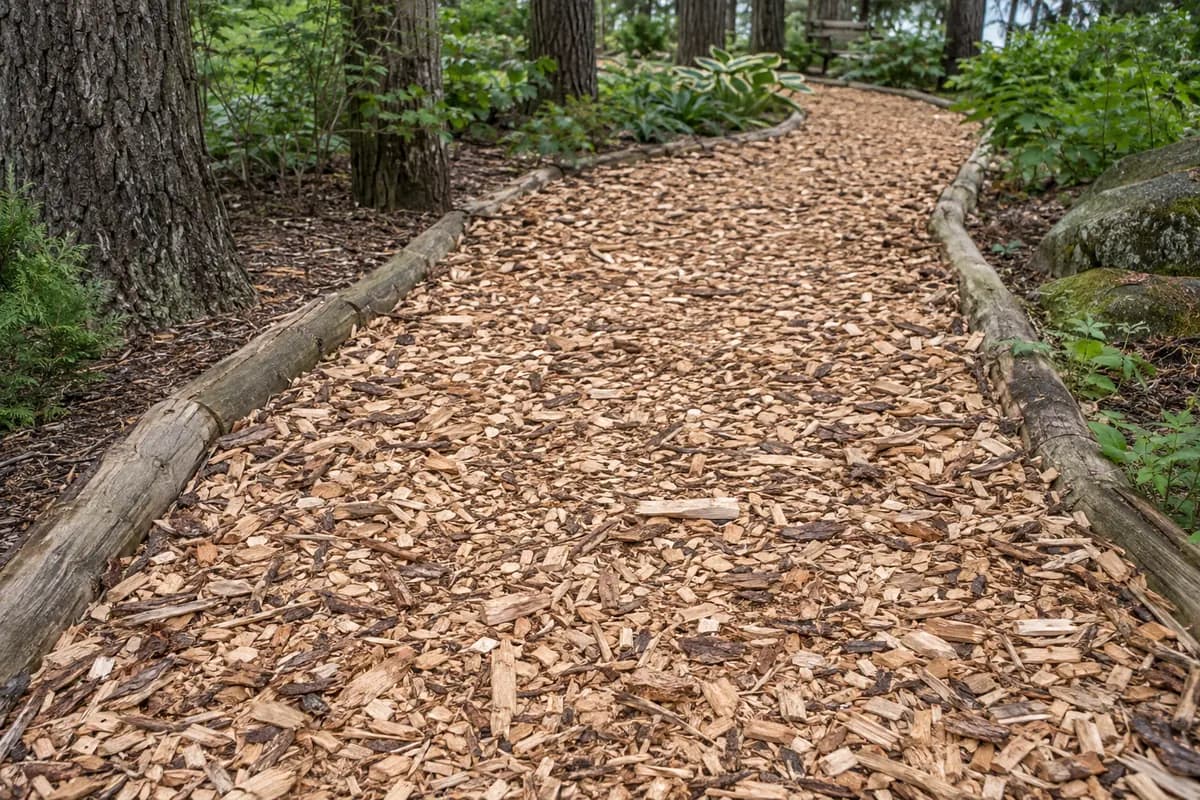
Wood Chips are chunky pieces of natural wood, from 1 to 3 inches across, with no dye added. They make a soft, springy surface underfoot and break down slowly, so a single layer lasts for seasons. Gravel Valet delivers them by the cubic yard for garden paths, play areas, tree rings and the wilder corners of a property.
- From
- $572 delivered
- Size
- 1 to 3 inches
- Weight
- 700 lb/yd³
- Sold by
- the yard
See local Wood Chips pricing for your ZIP
Checking your saved delivery area.
- US cities served
- 368
- From, 2 yd delivered
- $572
- Weight
- 700 lb/yd³
- Size
- 1 to 3 inches

About Wood Chips
Wood Chips come from a chipper. Branches and logs are fed past spinning knives that slice them into flat, blocky pieces. The result is far coarser than shredded mulch. Most pieces measure 1 to 3 inches across and have clean cut faces with no long, stringy fibers.[1]
The color is natural, the shade of fresh cut wood. A new layer starts pale tan to blond and weathers over a few months to a soft silver gray in the sun. Because nothing is added, the chips age the way a fallen log does, which gives paths and woodland beds an unforced, natural look.[1]
A cubic yard weighs around 700 lb, the lightest material in our mulch range. The large pieces leave air gaps between them, which is part of why the pile is so light. Wood Chips are sold by the yard, since the volume tells you how much ground the order will cover.[1]
Wood Chips is 1 to 3 inches, natural, about 700 lb per cubic yard, sold by the cubic yard with a 2 cubic yard minimum.
Specifications
| Material | Wood Chips |
|---|---|
| Category | mulch |
| Typical size | 1 to 3 inches |
| Color | Natural |
| Weight | 700 lb/yd³, about 0.35 tons per cubic yard |
| Sold by | the yard |
| Order minimum | 2 cubic yards per delivery |
| Online order steps | half yards, up to 40 per order; more by quote |
Coverage: how much Wood Chips do you need?
Square feet one cubic yard of Wood Chips covers at common spread depths. For exact yardage, use the calculator.
- 162
- sq ft at 2" deep
- Top dressing, beds
- 108
- sq ft at 3" deep
- Paths, patios, drainage
- 81
- sq ft at 4" deep
- Driveways, base layers
Best uses for Wood Chips
Paths are the classic job. A chip trail through a vegetable garden, between raised beds or across a wooded lot stays firm enough to walk on, drains fast after rain and keeps mud off your boots. Unlike fine mulch, the large pieces do not stick to shoes and track into the house.[1]
Play areas under swings, slides and climbing frames are another common use. A deep, loose layer of chips gives a softer landing than packed soil or grass worn to dirt. The chunks shift under impact and spring back, and a rake brings the surface level again after a busy afternoon.[1]
Trees benefit too. A wide ring of chips around a young or mature tree holds moisture over the roots, smothers competing grass and keeps mowers away from the bark. As the chips break down at the bottom of the layer, they feed the soil in much the same way that leaf litter feeds a forest floor.[1]
Other jobs include covering bare ground behind a shed, filling the space under a deck, mulching around berry bushes and fruit trees and lining the floor of a dog run where grass will not grow.[1]
How to install Wood Chips
Mark the area and clear it of grass and weeds. For a path, dig the soil down slightly so the chips sit in a shallow bed and do not spill onto the lawn. Edging boards, steel strips or a row of stones along each side help hold the chips where you want them.[1]
A layer of landscape fabric under a path slows weeds and keeps the chips from mixing into the soil, which makes the surface last longer. Skip the fabric around trees and shrubs, where you want the chips to break down and enrich the ground over time.[1]
Depth depends on the job. A tree ring or a light cover over garden soil needs only 2 to 3 inches. At 2 inches that is about 0.62 cubic yards per 100 square feet, and at 3 inches about 0.93 cubic yards. A garden path works well at 4 inches, about 1.23 cubic yards per 100 square feet, which gives a firm walking surface and stops weeds.[1]
Play areas take the deepest layer. At 6 inches Wood Chips use about 1.85 cubic yards per 100 square feet, and many families go deeper under the tallest equipment. Rake the chips evenly and top them up as they pack down and break down over the seasons. Keep a small gap between the chips and any tree trunk.[1]
Comparable materials
Black Shredded Mulch, Brown Shredded Mulch and Red Mulch are finer, double shredded and dyed. They give front beds a neat, uniform finish and hold their color for a season. Chips are coarser and plainer, but they last longer on the ground and handle foot traffic far better.[1]
The choice usually comes down to where the material goes. In a showpiece bed by the front door, a dyed shredded mulch looks more finished. On a path, under a swing set or around trees at the back of the lot, Wood Chips do the job with less upkeep. Many yards use both, each in its own spot.[1]
One more difference is how the materials sit on slopes. Shredded strands knit into a mat that holds on a gentle bank, while loose chips can roll downhill. On steep ground, edging or a shredded mulch is the better option.[1]
 From$4672 yd delivered
Black Shredded Mulch
Mulch and Wood- Size
- Double shredded
- Weight
- 800 lb/yd³
- Color
- Black
 From$4642 yd delivered
Brown Shredded Mulch
Mulch and Wood- Size
- Double shredded
- Weight
- 800 lb/yd³
- Color
- Brown
 From$4702 yd delivered
Red Mulch
Mulch and Wood- Size
- Double shredded
- Weight
- 800 lb/yd³
- Color
- Red
Where we source Wood Chips
Gravel Valet gets Wood Chips from mulch yards, tree service yards and landscape suppliers near the delivery address. Tree crews chip limbs and trunks on the job and haul them to these yards, where the chips are screened to remove leaves, dirt and long sticks before they are sold.[1]
The species in a load depend on the trees that grow in the region, so the color and grain can differ from one area to another. One yard's chips may be mostly oak and maple, another's more pine or mixed hardwood. All of them start in that same natural tone and weather to gray in the sun.[1]
Why bulk delivery saves money
Wood Chips are bulky and light, which makes bags a poor deal. A sack holds only a small amount, and a single path or play area can swallow a long row of them. Bulk chips go from the yard straight to your driveway with no bags or pallets in between.[1]
Big jobs need big volumes. A deep layer under a play set covers a lot of ground, and buying it by the cubic yard is the only practical way to get that much material on site in one day.[1]
Because chips last longer than finer mulch, a bulk order also stretches further over the years. You top up less often, and each top up is a smaller load than the first.[1]
Ordering Wood Chips from Gravel Valet
Measure the path, ring or play area and work out the square feet. Choose the depth for the job and check the coverage figures above, or use the area calculator to get the cubic yards. For play areas, round up so the layer stays deep as the chips settle.[1]
Choose a drop spot the truck can reach on solid ground, as near the work as you can. A pile of chips is light and will not stain paving, but a loaded truck still needs firm footing. Have a wheelbarrow, a pitchfork and a wide rake ready on delivery day.[1]
Enter your ZIP in the order box to see the delivered amount for your area. Gravel Valet confirms the delivery date with you before the chips leave the yard.[1]
FAQ: Wood Chips
Are Wood Chips good for a play area?
Yes. A deep, loose layer gives a softer landing than bare dirt or worn grass. Plan on at least 6 inches, about 1.85 cubic yards per 100 square feet, and more under tall equipment. Rake the chips back into place often, since kids push them away from the busiest spots.
How long do Wood Chips last?
Longer than shredded mulch. The large, blocky pieces break down slowly, so a path or tree ring keeps its cover for several seasons. The bottom of the layer slowly turns to soil, which is good for trees and shrubs. Top up the surface whenever the layer looks thin.
Do Wood Chips attract termites?
Chips are wood, so it makes sense to keep them away from the house. Leave a strip of bare soil or stone between any wood mulch and the foundation, and do not pile chips against siding or wooden steps. Out in the yard, on paths and around trees, they pose little concern.
Should I put fabric under Wood Chips?
Under a path, yes. Landscape fabric slows weeds and keeps the chips from sinking into the soil, so the walking surface lasts. Around trees and shrubs, leave the fabric out. There you want the chips to break down slowly and feed the roots.
Are Wood Chips dyed?
No. Wood Chips are left in their natural color, pale when fresh and weathering to a soft gray in the sun. If you want a colored finish, Black Shredded Mulch, Brown Shredded Mulch and Red Mulch are dyed hardwood options for beds.
How heavy is a yard of Wood Chips?
About 700 lb per cubic yard, which makes chips the lightest material we deliver in the mulch range. One person can spread a load with a pitchfork and a wheelbarrow. The pile is bulky for its weight, so plan the drop spot near the area you are covering.
Order Wood Chips today
Enter your ZIP for the delivered price, or send the job and we quote it by hand.
By state
Wood Chips by state
- Wood Chips in Alaska
- Wood Chips in Alabama
- Wood Chips in Arkansas
- Wood Chips in Arizona
- Wood Chips in California
- Wood Chips in Colorado
- Wood Chips in Connecticut
- Wood Chips in District of Columbia
- Wood Chips in Florida
- Wood Chips in Georgia
- Wood Chips in Hawaii
- Wood Chips in Iowa
- Wood Chips in Idaho
- Wood Chips in Illinois
- Wood Chips in Indiana
- Wood Chips in Kansas
- Wood Chips in Kentucky
- Wood Chips in Louisiana
- Wood Chips in Massachusetts
- Wood Chips in Maryland
- Wood Chips in Michigan
- Wood Chips in Minnesota
- Wood Chips in Missouri
- Wood Chips in Mississippi
- Wood Chips in Montana
- Wood Chips in North Carolina
- Wood Chips in North Dakota
- Wood Chips in Nebraska
- Wood Chips in New Hampshire
- Wood Chips in New Jersey
- Wood Chips in New Mexico
- Wood Chips in Nevada
- Wood Chips in New York
- Wood Chips in Ohio
- Wood Chips in Oklahoma
- Wood Chips in Oregon
- Wood Chips in Pennsylvania
- Wood Chips in Rhode Island
- Wood Chips in South Carolina
- Wood Chips in South Dakota
- Wood Chips in Tennessee
- Wood Chips in Texas
- Wood Chips in Utah
- Wood Chips in Virginia
- Wood Chips in Washington
- Wood Chips in Wisconsin