
Driveway and Landscaping · Gold to tan
Decomposed Granite Delivered in Bulk
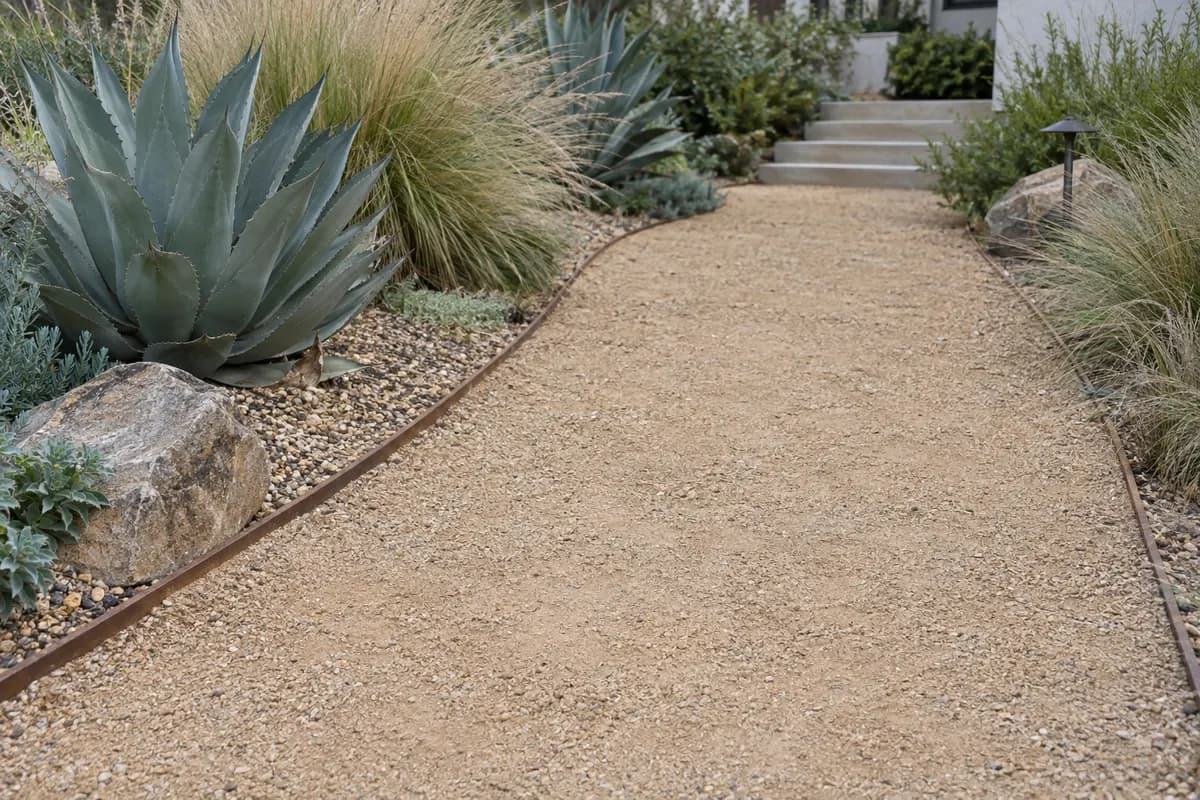
Decomposed Granite is granite that weather has broken down into grit, 1/4 inch and fines, in warm gold to tan shades. Wet it and pack it, and it sets into a firm surface that looks like a packed earth trail. Gravel Valet delivers it loose, by the ton, for paths, patios and garden floors.
- From
- $470 delivered
- Size
- 1/4 inch and fines
- Weight
- 2,500 lb/yd³
- Sold by
- the ton
See local Decomposed Granite pricing for your ZIP
Checking your saved delivery area.
- US cities served
- 368
- From, 2 tons delivered
- $470
- Weight
- 2,500 lb/yd³
- Size
- 1/4 inch and fines

About Decomposed Granite
Granite is a hard rock, but it is made of separate mineral grains locked together. Over thousands of seasons, water, heat and frost pry those grains apart, and the rock crumbles in place into a coarse grit. Quarries dig that crumbled layer and screen it. What arrives is Decomposed Granite at 1/4 inch and fines: sand-sized and smaller grains mixed with tiny flakes and a share of rock dust.[1]
The fines are the whole point. When the material is damp and pressed, the dust fills the spaces between the larger grains and binds the layer into a crust that a wheelbarrow can roll across. The color runs gold to tan, softer than crushed gray stone and close to the look of a desert trail. A cubic yard weighs about 2,500 lb, and it is sold by the ton.[1]
A packed layer still loosens a little at the surface. Foot traffic loosens a thin skin of grit over the months, and that loose film is normal. Raking it back, wetting it and tamping it again restores the surface, so a Decomposed Granite walk ages like a trail that needs an occasional grooming.[1]
Decomposed Granite is 1/4 inch and fines, gold to tan, about 2,500 lb per cubic yard, sold by the ton with a 2 ton minimum.
Specifications
| Material | Decomposed Granite |
|---|---|
| Category | decorative |
| Typical size | 1/4 inch and fines |
| Color | Gold to tan |
| Weight | 2,500 lb/yd³, about 1.25 tons per cubic yard |
| Sold by | the ton |
| Order minimum | 2 tons per delivery |
| Online order steps | half tons, up to 40 per order; more by quote |
Coverage: how much Decomposed Granite do you need?
Square feet one ton of Decomposed Granite covers at common spread depths. For exact tonnage, use the calculator.
- 130
- sq ft at 2" deep
- Top dressing, beds
- 86
- sq ft at 3" deep
- Paths, patios, drainage
- 65
- sq ft at 4" deep
- Driveways, base layers
Best uses for Decomposed Granite
Garden paths are the first job most people buy it for. A packed Decomposed Granite walk feels smooth and slightly soft, it is easy on bare feet, and it bends around beds in curves that would take a saw to cut in pavers. Patios and seating areas come next, since a table and chairs sit level on a firm layer.[1]
Decomposed Granite makes a tidy ring around trees and shrubs, where it keeps the trimmer off the trunk and still lets rain reach the roots. Many people use it to fill the joints between large flagstones, under a bench, beside a fire pit, in a bocce lane or as the floor of a dry garden with low-water plants. The gold to tan color pairs well with green foliage and with warm stone walls.[1]
Skip it for steep slopes, for spots where a downspout pours straight onto it and for anything that carries heavy trucks. Fast water carries the fines away, and the surface softens if it stays wet for long. On those spots a coarser stone works better.[1]
How to install Decomposed Granite
Dig the path or patio out deep enough for a stable base and the surface layer together. Firm the soil, and on soft or clay ground roll out a landscape fabric to keep the layers apart. A layer of compacted crushed base under the Decomposed Granite helps a lot on paths with steady foot traffic, since it stops the soil from pushing up through the surface. Set a sturdy edge first: steel, stone or treated timber. Loose grit spreads into the lawn without one.[1]
Spread the Decomposed Granite in thin lifts rather than one deep pour. Rake each lift level, mist it with a hose until it is damp through but not muddy, and run a plate compactor or a hand tamper over it. Repeat until you reach the finished height. A 2 inch layer takes about 0.77 tons per 100 square feet, and a 3 inch layer about 1.16 tons, which suits a walking path over a good base.[1]
Patios and spots with more traffic get a 4 inch layer at about 1.54 tons per 100 square feet. A 6 inch fill, about 2.31 tons per 100 square feet, is for places with no separate base at all. Crown the center or slope the surface slightly so rain drains off the edge instead of standing in puddles, and let the packed layer dry for a day or two before heavy use.[1]
Comparable materials
Pea Gravel and Walkway Gravel are both 3/8 inch stone, so they stay loose and crunch underfoot. They drain faster than Decomposed Granite and never get muddy, but chair legs sink into them and stones migrate onto the lawn. Choose one of them when you want a casual, loose look and quick drainage, and choose Decomposed Granite when you want a surface that packs firm and looks like earth.[1]
River Rock is the decorative partner. Its smooth 1 to 3 inch stones never pack, which makes it a poor walking surface but a good border, drainage strip or creek bed beside a Decomposed Granite path. Edging a tan path with a band of River Rock catches runoff before it can wash the fines away, and the contrast in texture frames the walk.[1]
 From$4162 ton delivered
Pea Gravel
Driveway and Landscaping- Size
- 3/8 inch
- Weight
- 2,600 lb/yd³
- Color
- Mixed tan and brown
 From$4582 ton delivered
River Rock
Driveway and Landscaping- Size
- 1 to 3 inches
- Weight
- 2,600 lb/yd³
- Color
- Mixed earth tones
 From$4242 ton delivered
Walkway Gravel
Driveway and Landscaping- Size
- 3/8 inch
- Weight
- 2,600 lb/yd³
- Color
- Mixed
Where we source Decomposed Granite
Decomposed Granite comes from places where granite sits near the surface and has weathered in place for ages. Local quarries and pits dig that softened layer, crush any larger lumps and screen the result to 1/4 inch and fines. Some yards keep it in open bins, others blend it from crushed granite and screened dust.[1]
Gravel Valet fills each order from a yard close to the job, so the material travels a short way. Granite deposits differ, and the gold to tan color of a load leans toward whatever the nearby rock holds: a deeper honey gold in one area, a paler tan in another. If you are matching an existing path, tell us before you order, and we will check what the closest yard has.[1]
Why bulk delivery saves money
Decomposed Granite in sacks is heavy for its size, and a path of any length eats through a car's worth of bags in a few minutes of spreading. Each bag means another trip, another lift and another torn sack in the bin. A loose load arrives in one drop, by the ton, right where the work starts.[1]
Loose material also comes without packaging, palleting or a store markup on every bag. You order the amount the project needs, add a little for compaction, and spread from one pile. For a patio, a long walk or a tree ring across a yard, a single bulk delivery replaces a weekend of hauling and is the thriftier way to get the job done.[1]
Ordering Decomposed Granite from Gravel Valet
Measure the area and decide the finished depth after compaction. The calculator turns length, width and depth into tons from the weight of about 2,500 lb per cubic yard. Packing shrinks a loose layer, so order a little more than the bare math gives, especially for a patio laid in several lifts.[1]
Enter your ZIP to see the delivered total, choose your tons and check out. Pick a firm drop spot near the work, and if rain is coming, a tarp over the pile keeps the fines from washing off before you spread them. Our team contacts you to confirm the delivery day and any access details for the truck.[1]
FAQ: Decomposed Granite
How deep should a Decomposed Granite path be?
A garden path over a compacted base works well with 2 to 3 inches of packed Decomposed Granite. At 2 inches it takes about 0.77 tons per 100 square feet, and at 3 inches about 1.16 tons. Patios and busier areas get 4 inches. Build it in thin lifts, wetting and tamping each one, rather than in one thick layer.
Does Decomposed Granite get muddy?
A well-packed layer sheds most rain and dries quickly. It can soften if water stands on it or pours onto it from a roof or a slope. Crown the surface or tilt it slightly so water runs off, keep downspouts aimed elsewhere, and edge the path firmly. Those steps keep it firm through wet weeks.
Will Decomposed Granite stick to my shoes?
Fresh, loose grit can track onto floors for the first days, and a damp surface can stick to soles. Once the layer is fully packed and dry, little comes up. A doormat at the door and a band of coarser stone where the path meets a patio help catch the rest.
What is the difference between Decomposed Granite and Pea Gravel?
Decomposed Granite is 1/4 inch and fines, and the fine dust lets it pack into a firm crust. Pea Gravel is rounded 3/8 inch stone with no fines, so it stays loose, drains fast and crunches underfoot. Use Decomposed Granite for a firm walk or patio and Pea Gravel for a loose, casual surface.
Do weeds grow through Decomposed Granite?
Weeds can sprout in any surface where seeds blow in and settle. Fabric under the base stops roots from below, and a dense, packed layer gives seeds less room to take hold than loose stone does. Pull the few that appear while they are small, and rake off leaves before they break down into soil.
How much does a cubic yard of Decomposed Granite weigh?
Gravel Valet's Decomposed Granite weighs about 2,500 lb per cubic yard and is sold by the ton. The calculator uses that weight to turn your area and depth into tons. Order a little extra, because packing the material in lifts makes it settle below its loose height.
Order Decomposed Granite today
Enter your ZIP for the delivered price, or send the job and we quote it by hand.
By state
Decomposed Granite by state
- Decomposed Granite in Alaska
- Decomposed Granite in Alabama
- Decomposed Granite in Arkansas
- Decomposed Granite in Arizona
- Decomposed Granite in California
- Decomposed Granite in Colorado
- Decomposed Granite in Connecticut
- Decomposed Granite in District of Columbia
- Decomposed Granite in Florida
- Decomposed Granite in Georgia
- Decomposed Granite in Hawaii
- Decomposed Granite in Iowa
- Decomposed Granite in Idaho
- Decomposed Granite in Illinois
- Decomposed Granite in Indiana
- Decomposed Granite in Kansas
- Decomposed Granite in Kentucky
- Decomposed Granite in Louisiana
- Decomposed Granite in Massachusetts
- Decomposed Granite in Maryland
- Decomposed Granite in Michigan
- Decomposed Granite in Minnesota
- Decomposed Granite in Missouri
- Decomposed Granite in Mississippi
- Decomposed Granite in Montana
- Decomposed Granite in North Carolina
- Decomposed Granite in North Dakota
- Decomposed Granite in Nebraska
- Decomposed Granite in New Hampshire
- Decomposed Granite in New Jersey
- Decomposed Granite in New Mexico
- Decomposed Granite in Nevada
- Decomposed Granite in New York
- Decomposed Granite in Ohio
- Decomposed Granite in Oklahoma
- Decomposed Granite in Oregon
- Decomposed Granite in Pennsylvania
- Decomposed Granite in Rhode Island
- Decomposed Granite in South Carolina
- Decomposed Granite in South Dakota
- Decomposed Granite in Tennessee
- Decomposed Granite in Texas
- Decomposed Granite in Utah
- Decomposed Granite in Virginia
- Decomposed Granite in Washington
- Decomposed Granite in Wisconsin