
Driveway and Landscaping · Light gray
Crushed Concrete Base Delivered by the Ton
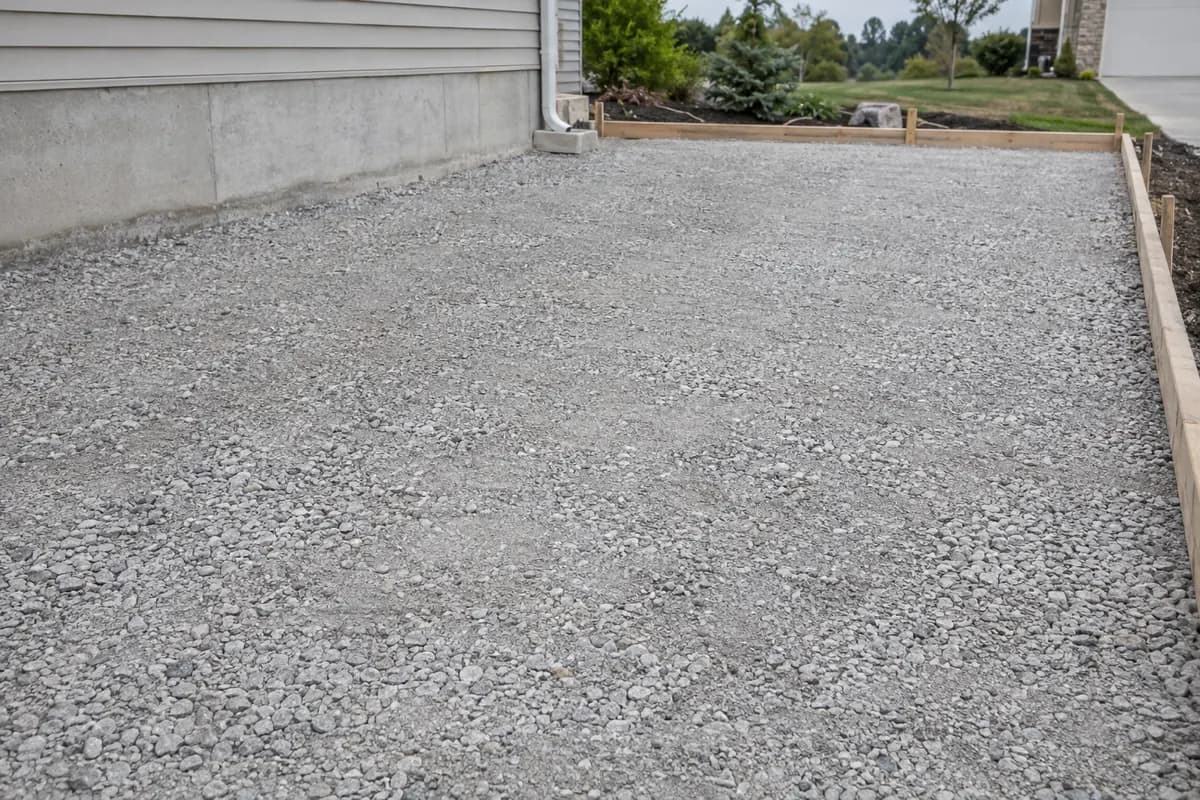
Crushed Concrete is old sidewalk, slab and foundation broken down and screened into a 3/4 inch minus base. The sharp edges and dusty fines lock together under a compactor, which makes it a strong layer to build on. Gravel Valet delivers it by the ton for slab prep, paver bases, shed pads and gravel drives.
- From
- $413 delivered
- Size
- 3/4 inch minus
- Weight
- 2,600 lb/yd³
- Sold by
- the ton
See local Crushed Concrete pricing for your ZIP
Checking your saved delivery area.
- US cities served
- 368
- From, 2 tons delivered
- $413
- Weight
- 2,600 lb/yd³
- Size
- 3/4 inch minus

About Crushed Concrete
Demolition crews pull up driveways, curbs, patios and building footings, and recycling yards feed that rubble through a crusher. Magnets lift out the steel bar, and screens sort what is left. The result is a gritty, angular blend with a top size of 3/4 inch with smaller bits and dust mixed through it. That spread of sizes is what makes it a base material. Small pieces fill the voids between big ones, so a compacted layer has little empty space and does not shift.[1]
The color is Light gray, close to the shade of an old sidewalk, with now and then a fleck of the stone that was cast into the original concrete. A cubic yard weighs about 2,600 lb, a touch lighter than many quarried stones, and Gravel Valet sells it by the ton. Fresh crushed concrete has a faint chalky dust that settles once it is wetted and rolled.[1]
Crushed Concrete is 3/4 inch minus, light gray, about 2,600 lb per cubic yard, sold by the ton with a 2 ton minimum.
Specifications
| Material | Crushed Concrete |
|---|---|
| Category | recycled |
| Typical size | 3/4 inch minus |
| Color | Light gray |
| Weight | 2,600 lb/yd³, about 1.30 tons per cubic yard |
| Sold by | the ton |
| Order minimum | 2 tons per delivery |
| Online order steps | half tons, up to 40 per order; more by quote |
Coverage: how much Crushed Concrete do you need?
Square feet one ton of Crushed Concrete covers at common spread depths. For exact tonnage, use the calculator.
- 125
- sq ft at 2" deep
- Top dressing, beds
- 83
- sq ft at 3" deep
- Paths, patios, drainage
- 62
- sq ft at 4" deep
- Driveways, base layers
Best uses for Crushed Concrete
The best job for this material is the layer nobody sees. Under a poured patio, a garage slab or a walkway of pavers, a compacted bed of Crushed Concrete gives a flat, stiff platform that resists settling. Shed pads, hot tub pads and the footprint of a playset work the same way. Contractors also use it to firm up a muddy construction entrance so trucks do not churn the site into ruts.[1]
As a driveway surface it packs hard and stays put better than round stone, and the 3/4 inch minus grade leaves few loose pieces on top. Farm roads, shop yards, overflow parking and the strip beside a fence where a trailer sits are all fair game. Keep it out of planting beds and away from the roots of acid-loving shrubs, since cement fines can raise the alkalinity of the soil they wash into. Crushed Concrete makes a poor drainage stone, because the fines that help it compact slow the flow of water through the layer.[1]
How to install Crushed Concrete
Dig out grass, roots and soft soil until you reach firm ground. Shape the floor so it slopes away from any building and carries runoff where you want it. On clay or soggy soil, lay a woven geotextile first so the base does not push down into the mud over time. Set forms or edging if the base will sit under a slab or pavers.[1]
Spread the material in lifts and compact each lift with a plate compactor while it is damp. A thin leveling layer of 2 inches takes about 0.80 tons per 100 square feet. A 3 inch lift, about 1.20 tons per 100 square feet, is a good single pass under a light walkway. Most patio and shed bases call for 4 inches, which uses about 1.60 tons per 100 square feet.[1]
Driveways and pads that carry vehicles should go to 6 inches or deeper, built as two lifts. At that depth plan on about 2.41 tons per 100 square feet. Run the compactor in overlapping passes until a boot heel leaves almost no print. Check the surface with a long straightedge and fill any dips before the next layer goes on.[1]
On a slope, work from the low side up so each lift ties into the one below. Wet the material well in dry, hot weather, because dry fines will not bind and the surface can stay dusty and loose.[1]
Comparable materials
Road Base is the quarried twin of this product. It is crushed natural stone with fines, it compacts the same way, and it has a more even color and fewer odd pieces. Crushed Concrete does the same base work with recycled rubble, and many builders treat the two as interchangeable under slabs and pavers. Choose Road Base when a job spec names virgin stone or when a uniform look matters on an exposed surface.[1]
Asphalt Millings are the other recycled option. They are Black and carry an old binder that softens and sticks, so a millings drive slowly knits into a single mat with less dust. Crushed Concrete stays a loose compacted gravel that is easy to regrade and patch. Millings win as a finished drive surface, and concrete wins as the hidden base under something else. For drainage work, a clean stone such as #57 Crushed Stone or Drain Rock beats either one.[1]
 From$4162 ton delivered
Asphalt Millings
Driveway and Landscaping- Size
- 1 inch minus
- Weight
- 2,900 lb/yd³
- Color
- Black
 From$4242 ton delivered
#57 Crushed Stone
Gravel and Crushed Stone- Size
- 3/4 to 1 inch
- Weight
- 2,700 lb/yd³
- Color
- Gray
 From$4372 ton delivered
#67 Stone
Gravel and Crushed Stone- Size
- 3/4 inch and under
- Weight
- 2,700 lb/yd³
- Color
- Gray
 From$4252 ton delivered
#89 Crushed Stone
Gravel and Crushed Stone- Size
- 3/8 inch
- Weight
- 2,700 lb/yd³
- Color
- Gray
 From$4452 ton delivered
#4 Crushed Stone
Gravel and Crushed Stone- Size
- 1-1/2 to 2-1/2 inches
- Weight
- 2,700 lb/yd³
- Color
- Gray
 From$4272 ton delivered
3/4" Crushed Stone
Gravel and Crushed Stone- Size
- 3/4 inch
- Weight
- 2,700 lb/yd³
- Color
- Gray
Where we source Crushed Concrete
Nearly every region has concrete recycling yards, many of them next to a landfill, a demolition contractor's lot or a ready-mix plant. Old concrete arrives by the truckload, sits in a rubble pile, and goes through a jaw crusher and a set of screens. Overhead magnets pull out rebar and wire mesh. The yard stockpiles the screened 3/4 inch minus product and loads it out by the ton.[1]
Gravel Valet fills each order from a recycler near the delivery address. Good yards keep wood, brick, plastic and asphalt out of the concrete pile, so the load is mostly clean Light gray material. Because the source is whatever got torn out nearby, the exact grit and the flecks of stone inside it vary a little from one yard to another, while the size range stays the same.[1]
Why bulk delivery saves money
A base course takes a lot of material, and few people want to lift it twice. Hauling it yourself means borrowing a truck, loading by hand or paying a yard to load you, and making trip after trip. One bulk delivery drops the whole amount in a single visit, as close to the work as the truck can safely reach.[1]
Recycled base also tends to be one of the easier materials on the budget, because the yard starts with rubble rather than blasting rock out of a quarry face. At about 2,600 lb per cubic yard it is a little lighter than many quarried stones, so each ton covers slightly more ground. Buying the whole job by the ton, in one order, avoids a second delivery when the first pile runs short halfway through the compacting.[1]
Ordering Crushed Concrete from Gravel Valet
Work out the square footage of the pad or drive and pick a depth. The calculator does the math in tons, and the coverage figures above let you check it. Enter your ZIP to see the delivered total for your area, then choose the tonnage. Crushed Concrete loses some thickness as it compacts, so order a little over the bare number.[1]
Pick a level, firm drop spot that a dump truck can reach without crossing a lawn after rain, a septic tank or a buried line. Leave room overhead for the bed to lift. If the base goes in a backyard, a drop near the gate with a short wheelbarrow run beats a drop at the curb. Add any access notes to your order, and have the plate compactor ready so the 3/4 inch minus base gets wetted and rolled soon after it arrives.[1]
FAQ: Crushed Concrete
Is Crushed Concrete as good as quarried base
For most home jobs it does the same work. A well graded recycled base compacts into a dense layer under slabs, pavers and drives, much like Road Base. It can hold a stray bit of brick or asphalt and its color is less even. Choose quarried stone when a contract or an engineer names virgin aggregate.
Can I use Crushed Concrete for a driveway
Yes. It packs hard and resists rutting once compacted, and the 3/4 inch minus grade leaves a fairly smooth top. Build at least 4 inches on firm soil and 6 inches where trucks park. Give the drive a crown so water runs off the sides. Expect some light dust in dry spells until rain and traffic settle the fines.
Does Crushed Concrete drain well
Slowly. The fines that let it compact into a strong base also slow the movement of water through it. That is fine under a slab or a drive with a good crown. For a French drain, a dry well or the gravel behind a retaining wall, use a clean stone such as #57 Crushed Stone or Drain Rock instead.
Is Crushed Concrete safe near plants
Cement dust and fines are alkaline, and runoff from a fresh pile can raise the pH of soil next to it. Keep it out of vegetable beds and away from shrubs that like acid soil. Under a patio or a drive, where the base is buried, it causes no trouble for the lawn beside it.
How much Crushed Concrete do I need for a shed pad
Measure the pad, add a little on each side so the base extends past the shed, and find the square feet. A 4 inch base takes about 1.60 tons per 100 square feet. If the ground is soft or the shed is large, go to 6 inches, about 2.41 tons per 100 square feet, and compact in two lifts.
Will there be rebar or trash in the load
Recycling yards run magnets over the crushed material to pull out steel, and screens remove large chunks. A load is mostly clean gray concrete in a 3/4 inch minus range. A stray bit of wire or brick can turn up now and then, and you can pick it out as you rake.
Order Crushed Concrete today
Enter your ZIP for the delivered price, or send the job and we quote it by hand.
By state
Crushed Concrete by state
- Crushed Concrete in Alaska
- Crushed Concrete in Alabama
- Crushed Concrete in Arkansas
- Crushed Concrete in Arizona
- Crushed Concrete in California
- Crushed Concrete in Colorado
- Crushed Concrete in Connecticut
- Crushed Concrete in District of Columbia
- Crushed Concrete in Florida
- Crushed Concrete in Georgia
- Crushed Concrete in Hawaii
- Crushed Concrete in Iowa
- Crushed Concrete in Idaho
- Crushed Concrete in Illinois
- Crushed Concrete in Indiana
- Crushed Concrete in Kansas
- Crushed Concrete in Kentucky
- Crushed Concrete in Louisiana
- Crushed Concrete in Massachusetts
- Crushed Concrete in Maryland
- Crushed Concrete in Michigan
- Crushed Concrete in Minnesota
- Crushed Concrete in Missouri
- Crushed Concrete in Mississippi
- Crushed Concrete in Montana
- Crushed Concrete in North Carolina
- Crushed Concrete in North Dakota
- Crushed Concrete in Nebraska
- Crushed Concrete in New Hampshire
- Crushed Concrete in New Jersey
- Crushed Concrete in New Mexico
- Crushed Concrete in Nevada
- Crushed Concrete in New York
- Crushed Concrete in Ohio
- Crushed Concrete in Oklahoma
- Crushed Concrete in Oregon
- Crushed Concrete in Pennsylvania
- Crushed Concrete in Rhode Island
- Crushed Concrete in South Carolina
- Crushed Concrete in South Dakota
- Crushed Concrete in Tennessee
- Crushed Concrete in Texas
- Crushed Concrete in Utah
- Crushed Concrete in Virginia
- Crushed Concrete in Washington
- Crushed Concrete in Wisconsin