
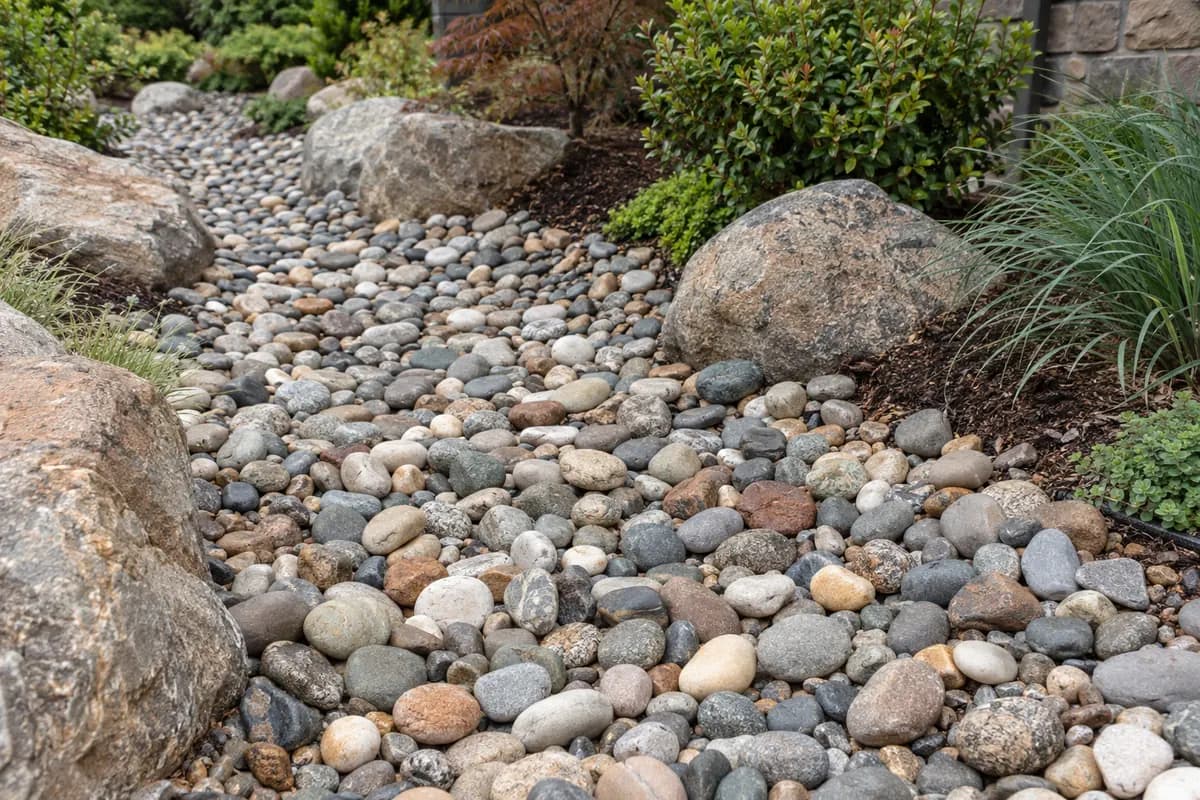
Driveway and Landscaping · Mixed earth tones
River Rock Delivered in Bulk
River Rock is smooth, rounded stone from 1 to 3 inches in mixed earth tones. Moving water wore its edges down long before it reached anyone's yard, so a fresh bed of it looks settled on day one. Gravel Valet sells it by the ton and brings it in bulk for creek beds, borders and wet spots.
- From
- $458 delivered
- Size
- 1 to 3 inches
- Weight
- 2,600 lb/yd³
- Sold by
- the ton
See local River Rock pricing for your ZIP
Checking your saved delivery area.
- US cities served
- 368
- From, 2 tons delivered
- $458
- Weight
- 2,600 lb/yd³
- Size
- 1 to 3 inches

About River Rock
River Rock is gravel that a river or an old glacial stream tumbled until every corner wore away. The stones in this grade run from 1 to 3 inches across, so a scoop holds pieces the size of a grape next to pieces that fill a palm. The mixed earth tones come from many rock types traveling together: tan sandstone, gray granite, rusty quartzite and the odd dark basalt pebble. No two loads match exactly, and that small variation is part of the appeal.[1]
A cubic yard of River Rock weighs about 2,600 lb, and Gravel Valet sells it by the ton. Round stones touch each other at only a few points, so a layer keeps wide open gaps between pieces. Water drops through those gaps fast. The same shape means the stones roll under a boot or a tire, which is the one trait to plan around before you pick it for a job.[1]
River Rock is 1 to 3 inches, mixed earth tones, about 2,600 lb per cubic yard, sold by the ton with a 2 ton minimum.
Specifications
| Material | River Rock |
|---|---|
| Category | decorative |
| Typical size | 1 to 3 inches |
| Color | Mixed earth tones |
| Weight | 2,600 lb/yd³, about 1.30 tons per cubic yard |
| Sold by | the ton |
| Order minimum | 2 tons per delivery |
| Online order steps | half tons, up to 40 per order; more by quote |
Coverage: how much River Rock do you need?
Square feet one ton of River Rock covers at common spread depths. For exact tonnage, use the calculator.
- 125
- sq ft at 2" deep
- Top dressing, beds
- 83
- sq ft at 3" deep
- Paths, patios, drainage
- 62
- sq ft at 4" deep
- Driveways, base layers
Best uses for River Rock
The classic use is a dry creek bed: a shallow, winding channel lined with River Rock that carries storm water across a yard and looks like a streambed the rest of the year. Foundation borders are a close second. A band of stone along the house keeps mud from splashing onto siding, gives roof runoff a place to land and stays put through years of rain where bark would float off.[1]
Downspout outlets, the ground under a deck, the strip between a fence and a lawn, and the edge of a pond all suit it well. The 1 to 3 inch size is big enough that wind and hoses do not scatter it and small enough to spread with a rake. It works poorly on a path you walk every day or on a parking area, because rounded stones shift underfoot and never form a firm surface.[1]
Low-water gardens are another good fit. River Rock can stand in for lawn in a corner that is hard to mow, ring a tree so the trimmer never touches the bark, or fill the gaps between large flat stones in a stepping path. In a rain garden it armors the inlet, where runoff from a roof or a driveway first pours in and would otherwise dig a hole.[1]
- River Rock Around a House FoundationMaterial guide and pricing
- River Rock DrivewayMaterial guide and pricing
- River Rock Dry Creek BedMaterial guide and pricing
- River Rock EdgingMaterial guide and pricing
- River Rock Flower BedMaterial guide and pricing
- River Rock LandscapingMaterial guide and pricing
- River Rock PathwayMaterial guide and pricing
How to install River Rock
Mark the bed with a hose or paint, then dig out the sod and a few inches of soil so the finished stone sits level with the lawn or a touch lower. Rake the floor smooth and slope it gently away from any building. Lay a woven landscape fabric over the soil and overlap the seams. The fabric keeps the stones from sinking into mud and slows weeds coming up from below.[1]
Set a steel, stone or plastic edge along any border that meets grass. Then dump the River Rock in small piles and rake it out. For most borders a 2 inch layer hides the fabric, and that depth takes about 0.80 tons per 100 square feet. A 3 inch layer, about 1.20 tons per 100 square feet, gives fuller cover with fewer bare spots.[1]
Creek beds want more stone. Lining the channel 4 inches deep uses about 1.60 tons per 100 square feet, and a 6 inch bed uses about 2.41 tons per 100 square feet. Push the larger stones to the banks and the bends, where moving water pushes hardest, and let the smaller ones fill the center. A few boulders at the edges make the channel look like it formed on its own.[1]
Comparable materials
Pea Gravel is the closest cousin. It is also smooth and rounded, but at 3/8 inch it is far smaller, so it feels softer underfoot and suits play areas and casual patios. Pick Pea Gravel for a seating spot and River Rock for a border or a channel, where the bigger stones stay put in moving water.[1]
Decomposed Granite goes the other way. Its fine grit packs down into a firm, tan surface that you can walk or set a chair on, which River Rock never does. Walkway Gravel sits between the two: small enough to walk on, coarse enough to drain. A common plan pairs them, with a Walkway Gravel or Decomposed Granite path running beside a River Rock bed so each material does the job it suits.[1]
 From$4162 ton delivered
Pea Gravel
Driveway and Landscaping- Size
- 3/8 inch
- Weight
- 2,600 lb/yd³
- Color
- Mixed tan and brown
 From$4702 ton delivered
Decomposed Granite
Driveway and Landscaping- Size
- 1/4 inch and fines
- Weight
- 2,500 lb/yd³
- Color
- Gold to tan
 From$4242 ton delivered
Walkway Gravel
Driveway and Landscaping- Size
- 3/8 inch
- Weight
- 2,600 lb/yd³
- Color
- Mixed
Where we source River Rock
River Rock comes from natural gravel deposits laid down by rivers and melting ice. Sand and gravel pits dig these old beds, then wash the stone to strip off clay and silt and run it over screens to pull out the 1 to 3 inch range. Washing is what gives the stones their clean, bright look in a fresh bed.[1]
Gravel Valet fills each order from local pits and stone yards near the delivery address. Short hauls keep the truck time down. The mix of colors in a load follows the rock that the nearby deposit holds, so the mixed earth tones in one region can lean warmer or grayer than in another. If color matters for a design, ask us before you order and we will tell you what the local stone looks like.[1]
Why bulk delivery saves money
Bagged decorative stone from a garden center comes in small sacks, and a single creek bed can need a stack of them taller than a person. Each sack has to be loaded, driven home, carried, slit open and emptied, and the plastic ends up in the trash. Bulk River Rock arrives as one pile, dumped where you want it, and the unit is the ton.[1]
Buying loose stone also skips the packaging, the store shelf and the extra handling built into every bag. You get the whole project in one trip instead of many, and you spread the pile straight from the driveway with a wheelbarrow. For any bed bigger than a small planter, bulk is the easier and thriftier way to buy rock.[1]
Ordering River Rock from Gravel Valet
Measure the length and width of each bed and pick a depth. Enter those numbers in the calculator, and it turns square feet and inches into tons using this stone's weight of about 2,600 lb per cubic yard. Round up a little, since creek beds with curves and banks always take more stone than a flat drawing suggests.[1]
Enter your ZIP to see the delivered total for your address, choose the tons you need and check out. Tell us where to drop the load: a driveway apron, a gravel pad or a spot on firm ground the truck can reach. Keep the pile off soft lawn after heavy rain, and leave room for the truck bed to tip up. Our team confirms the delivery day with you by phone or email.[1]
FAQ: River Rock
How much River Rock do I need for a dry creek bed?
Measure the channel's length and its average width, including the sloped banks. Most creek beds look right at 4 to 6 inches of stone. At 4 inches River Rock covers 100 square feet with about 1.60 tons, and at 6 inches the same area takes about 2.41 tons. Add a little extra for curves and for larger stones placed on the bends.
Do I need landscape fabric under River Rock?
Fabric is worth it in almost every bed. It keeps the stones from working down into soft soil, which would leave the bed thin after a few seasons, and it slows weeds from below. Use a woven fabric that lets water pass through. Leave it out only in beds where you plan to add new plants every year.
Can I walk or park on River Rock?
River Rock is a poor choice for a daily path or a parking pad. The stones are rounded and 1 to 3 inches across, so they roll underfoot and shift under tires. For a walking surface choose Walkway Gravel, Pea Gravel or Decomposed Granite, and keep River Rock for borders, channels and the ground around plants.
What color is River Rock?
Gravel Valet's River Rock comes in mixed earth tones: tan, cream, gray, rust and a few darker stones in each load. The blend comes from the local gravel deposit, so one region's stone can look warmer or grayer than another's. Wet stone looks darker and richer than dry stone, so expect the bed to change with the weather.
How deep should River Rock be around a house?
A border along a foundation looks full at 2 to 3 inches. At 2 inches the stone needs about 0.80 tons per 100 square feet, and at 3 inches about 1.20 tons. Slope the soil under it away from the wall so water drains outward, and keep the top of the stone below any siding or weep holes.
How do I keep River Rock clean?
Leaves and grit settle into the gaps over time. Blow or rake leaves off in the fall before they rot into soil, and pull any weeds while they are small. Every few years, rake the stones up, hose off the dirt and top up thin spots with a fresh layer so the colors stay bright.
Order River Rock today
Enter your ZIP for the delivered price, or send the job and we quote it by hand.
By state
River Rock by state
- River Rock in Alaska
- River Rock in Alabama
- River Rock in Arkansas
- River Rock in Arizona
- River Rock in California
- River Rock in Colorado
- River Rock in Connecticut
- River Rock in District of Columbia
- River Rock in Florida
- River Rock in Georgia
- River Rock in Hawaii
- River Rock in Iowa
- River Rock in Idaho
- River Rock in Illinois
- River Rock in Indiana
- River Rock in Kansas
- River Rock in Kentucky
- River Rock in Louisiana
- River Rock in Massachusetts
- River Rock in Maryland
- River Rock in Michigan
- River Rock in Minnesota
- River Rock in Missouri
- River Rock in Mississippi
- River Rock in Montana
- River Rock in North Carolina
- River Rock in North Dakota
- River Rock in Nebraska
- River Rock in New Hampshire
- River Rock in New Jersey
- River Rock in New Mexico
- River Rock in Nevada
- River Rock in New York
- River Rock in Ohio
- River Rock in Oklahoma
- River Rock in Oregon
- River Rock in Pennsylvania
- River Rock in Rhode Island
- River Rock in South Carolina
- River Rock in South Dakota
- River Rock in Tennessee
- River Rock in Texas
- River Rock in Utah
- River Rock in Virginia
- River Rock in Washington
- River Rock in Wisconsin