
Project guide
River Rock Flower Bed Ideas for Low Care Color
Flowers look brighter against stone. A bed covered in River Rock frames blooms with a natural, earthy backdrop that never needs a fresh layer each spring. It suits sunny beds of perennials, bulbs, grasses and drought tolerant plants. This guide covers which flowers do well with stone, how to plan the bed, how deep to lay the rock and how many tons to order.
Why River Rock works for a flower bed
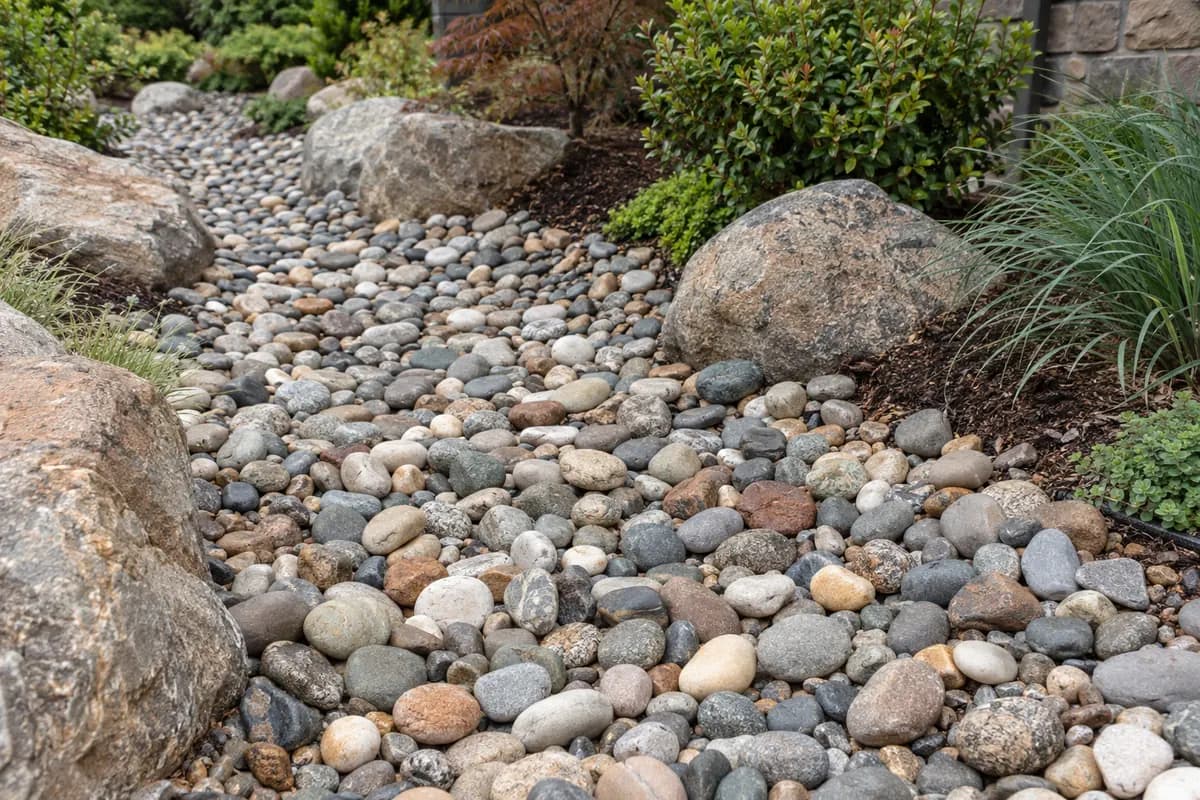
The mixed earth tone of River Rock makes flower colors stand out. Reds, purples, yellows and whites all pop against browns, tans and grays, and the stone looks good in winter when most flowers are gone.[1]
It stays where you put it. At about 2,600 lb per cubic yard, River Rock does not float away in a storm, blow off in the wind or get kicked onto the lawn by birds hunting for insects, which all happen to bark mulch.[1]
Water reaches the roots. Stones of 1 to 3 inches leave open gaps, so rain and drip lines soak into the soil instead of running off. The stones also shade the soil and slow evaporation on hot days.[1]
Stone also keeps blooms clean. Heavy rain on bare soil splashes mud onto low petals and leaves, and the splash can carry soil fungus with it. A layer of rock breaks the drops before they reach the dirt.[1]
It lasts. Bark and wood chips break down and need topping up each year. A River Rock cover stays put for many years with only light care, which frees the gardener to spend time on the flowers.[1]
Design and sizing choices for a river rock flower bed
Choose flowers that like stone. Perennials such as coneflower, salvia, yarrow, lavender and sedum, along with ornamental grasses and spring bulbs, thrive in the warm, well drained conditions stone creates. Plants that want rich, damp soil and a yearly feed of compost, such as many annuals and roses, do better under mulch.[1]
Match stone size to bed size. In a small bed by a front door, stones near 1 inch keep the look fine and let low flowers show. In a large island bed or a slope, stones toward 3 inches hold better and match the scale of the space.[1]
Add a few accent stones. Larger boulders set among the flowers give height and structure in winter. Pick boulders whose earth tones match the River Rock so the bed looks of one piece.[1]
Leave room for change. Bulbs and perennials spread and get divided. Plan open circles of soil around each clump so you can work the soil without lifting the stone each time.[1]
Pea Gravel is the finer choice for beds with many small plants packed close together. Its small pebbles slip between stems more easily than larger River Rock. Decomposed Granite suits a bed laid out like a dry garden with widely spaced plants.[1]
Depth, base and quantity for a river rock flower bed
Prepare the soil before any stone goes on. Loosen it, work in compost, plant the flowers and water them in. Once the stone is down, improving the soil is much harder.[1]
Use landscape fabric only where plants stay put, such as around shrubs and long-lived perennials. In beds where bulbs come up or you add plants often, skip the fabric so stems can push through and you can dig freely.[1]
A 2 inch layer of smaller River Rock over fabric covers the soil and blocks weeds. That takes about 0.80 tons for every 100 square feet of bed.[1]
With no fabric, or with larger stones, a 3 inch layer gives better weed control and hides the soil between pieces. That takes about 1.20 tons per 100 square feet.[1]
Thicker layers are rarely right in a flower bed. A 4 inch layer, about 1.60 tons per 100 square feet, buries low plants. A 6 inch layer takes about 2.41 tons per 100 square feet and belongs only in a drainage trench at the edge of the bed.[1]
Measure the bed as simple shapes, add the areas, divide by 100 and multiply by the tons for your depth. River Rock is sold by the ton. The flowers take up some of the area, but the stones settle, so order for the full bed and round up.[1]
Installation steps
Clear grass and weeds from the bed, roots and all. Edge the bed with a flat spade or set a border strip so the stone stays in and the lawn stays out.[1]
Plant the flowers first and water them well. If you use fabric, lay it now, cutting an X at each plant and folding the flaps under, leaving a ring of open soil around each crown.[1]
Spread the River Rock by hand near the flowers and with a rake in open spaces. Keep stones a short way back from stems so they do not press on the crowns. Hose the stones to wash off dust and bring out their earth tones.[1]
Add boulders and accent stones last, setting each one partly into the soil so it looks like it has always been there.[1]
Maintenance and common mistakes
Piling stone on top of the crowns of perennials is the most common mistake. Stones pressed against stems hold heat and damp, and plants can rot or fail to come up. Keep a small open ring around each plant.[1]
Using plastic film under the rock is the next. It blocks water and air from the roots. Use a woven fabric or no barrier at all.[1]
Letting leaves and dead flower heads rot on the stone builds a layer of soil where weeds sprout. Clean the bed in spring and fall with a leaf blower or a soft rake.[1]
Watering with a sprinkler wastes much of the water on hot stone. A soaker hose or drip line laid under the rock, close to each plant, puts water straight at the roots and keeps the stone surface dry and free of algae.[1]
Feeding the soil is harder under stone, so top dress with compost around each plant in spring, pulling the stones back first and returning them after.[1]
Cost and ordering
River Rock is sold by the ton and delivered by dump truck. The total depends on the tonnage, the distance from the yard that supplies it and how close the truck can tip to the bed.[1]
Larger stones need a deeper layer to cover the soil, so a bed of the biggest rock in the range takes more tons than the same bed covered in smaller stone.[1]
A single flower bed is a small order. Measuring all the beds around the house and ordering them together, along with any edging or path stone, makes the best use of one delivery.[1]
Type your ZIP into the box on the site to see the delivered figure for River Rock, then enter your bed size in the calculator for the tons.[1]
Delivered, 2 tons: from $458 to $1,374 depending on the city (366 cities priced). Enter your ZIP for the exact figure.
River Rock for this project

How much river rock do you need?
Measure the area, pick the depth for this project, and the calculator converts it to cubic yards and tons for your delivered price.
Projects
Related project guides
Browse
Browse more
Frequently Asked Questions
Is river rock good for flower beds?
River Rock suits sunny beds of perennials, grasses, bulbs and drought tolerant flowers. The 1 to 3 inch stones let water through, keep the soil cool and moist and never need replacing. For annuals, roses and plants that want rich, damp soil, bark mulch is the better cover because it feeds the soil as it breaks down.
What flowers grow well with river rock?
Coneflower, salvia, yarrow, lavender, sedum, ornamental grasses and spring bulbs all do well in stone beds. They like warm, well drained soil and need little feeding, which matches the conditions River Rock creates. Flowers that want rich, damp ground are happier under bark.
How deep should river rock be in a flower bed?
A layer about 2 inches deep over fabric works for most flower beds and takes about 0.80 tons per 100 square feet. Without fabric, go a little deeper, about 3 inches, so the stone blocks light from weed seeds.
Should I put landscape fabric under river rock in a flower bed?
Use fabric around long-lived perennials and shrubs that stay in place. Skip it in beds with bulbs or plants you move often, since stems need to come up and you need to dig. Avoid solid plastic film in all cases, because it starves roots of water and air.
Does river rock make flower beds too hot?
Stone warms in the sun and gives back heat in the evening, which most sun loving flowers enjoy. The mixed earth tone of River Rock stays cooler than black rock. For shade plants and flowers that want cool roots, bark mulch is the better choice.