
Project guide
River Rock Pathway Ideas for Garden Walks and Side Yards
A river rock pathway turns a side yard or a garden route into something that looks like a dry stream running through the planting. Rounded stone is lovely to look at but rolls under a shoe, so a good river rock walk is planned around how people will step on it. This guide covers layouts that stay comfortable, the base and depth that hold the stone, how many tons to order and how to keep the walk tidy.
Why River Rock works for a pathway
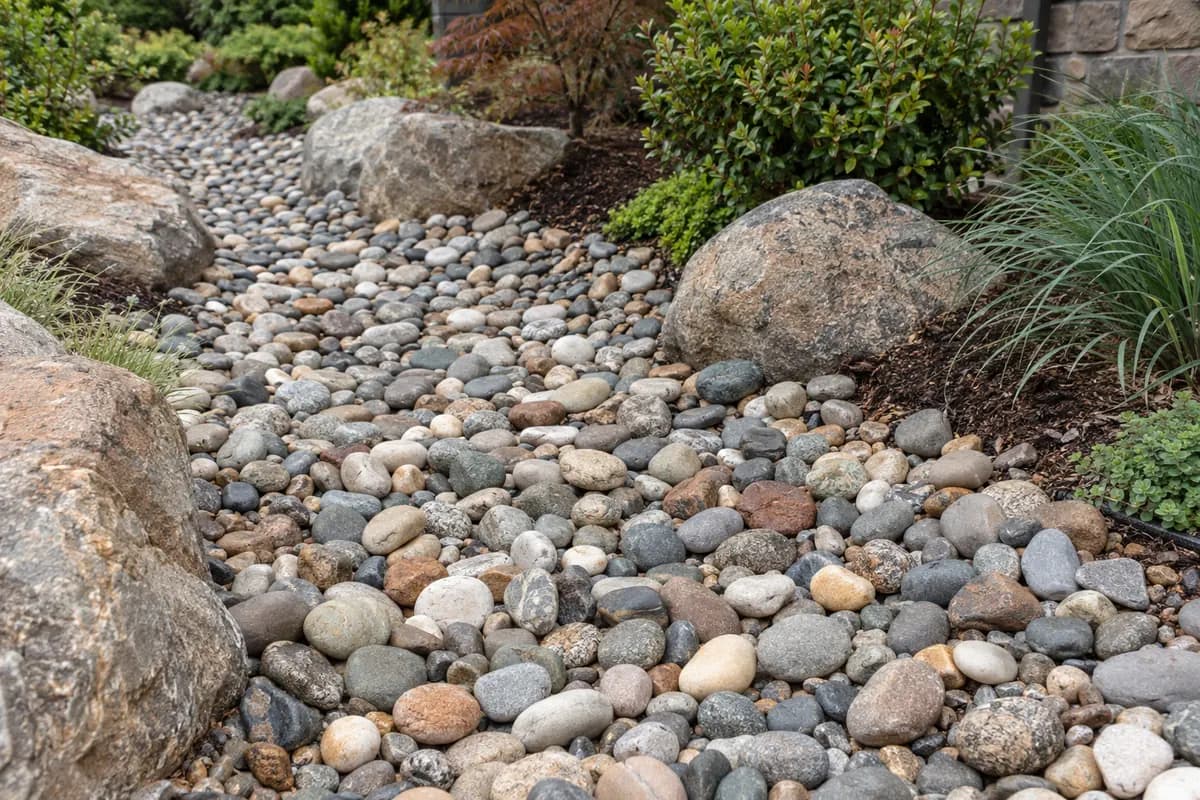
River Rock brings color and texture that plain crushed stone cannot match. Each load mixes earth tones of tan, rust, cream and gray, and the stones range from 1 to 3 inches across. Set along a curving route, that blend looks like a creek bed that happens to lead to the back gate.[1]
The rounded pieces drain fast. Rain falls through the wide gaps between the stones and soaks into the ground, so a River Rock walk does not hold puddles after a storm. A side yard squeezed between two houses stays damp, and an open stone path dries much sooner than packed soil or turf.[1]
The stone is heavy and stays in place. At about 2,600 lb per cubic yard, River Rock does not wash off in runoff or scatter when a dog runs through. A path laid along a downspout or across a low spot keeps its line where lighter mulch would float away.[1]
Round stones near 3 inches shift and tilt under a heel, so a walk made only of loose River Rock is better for an occasional stroll than for a daily route with groceries. The fix is to give feet something flat to land on, which the layouts below explain.[1]
Design and sizing choices for a river rock pathway
The most practical layout sets flat stepping stones in a bed of River Rock. Flagstone, concrete pavers or large flat fieldstones carry the foot traffic, and the rounded stone fills the gaps between them. Space the steppers to match a relaxed stride so nobody has to hop or shuffle.[1]
For a path people walk every day, choose the smaller stones near 1 inch for the field between the steppers. Smaller pieces fill tight joints and sit flatter. Save the larger stones near 3 inches for the borders, where nobody steps and their size adds weight to the edge.[1]
Match the stepper color to the stone. The mixed earth tones of River Rock suit tan or gray flagstone and weathered concrete. A bright white paver looks stark beside them, and a dark one can look like a hole in the path.[1]
Keep the route wide enough for its use. A garden walk can be narrow and winding. A side yard path that carries trash bins or a wheelbarrow needs a wider, straighter line, with steppers large enough for a wheel to roll over.[1]
Curves suit round stones. A gentle bend around a tree or bed looks natural and slows people down to enjoy the planting. Sharp corners collect loose stone and get cut by feet taking the short way.[1]
Depth, base and quantity for a river rock pathway
Around stepping stones, a 2 inch layer of River Rock will do, since the steppers take up much of the area. That depth takes about 0.80 tons for every 100 square feet of open ground between them.[1]
A path of loose stone with no steppers needs 3 inches to hide the base and fabric. Plan on about 1.20 tons per 100 square feet. Rake it level and expect a little settling in the first few weeks.[1]
Where the walk crosses a soggy patch or carries runoff from a roof, a 4 inch bed gives water more room to pass through. That takes about 1.60 tons per 100 square feet.[1]
A 6 inch fill is only for a path that doubles as a drainage swale. It needs about 2.41 tons per 100 square feet.[1]
Under the stone, a firm base keeps the walk from turning soft. Dig out the topsoil, tamp the subgrade and lay a thin layer of compacted crushed base where the soil is clay or stays wet. The heavy River Rock then rests on solid ground instead of sinking.[1]
To order, multiply the path length by its width for square feet, subtract the area the steppers cover, divide by 100 and multiply by the tons for your depth. River Rock is sold by the ton. Round up to cover the edges, and use the area calculator on the site to check your sum.[1]
Installation steps
Lay out the route with stakes and string or a garden hose. Walk it with a wheelbarrow if it needs to carry one. Set the stepping stones on the ground in their planned spots and walk on them before you dig.[1]
Dig the path bed to the depth of the stone plus any base, keeping the bottom level across its width. Pile the soil on a tarp so it does not end up in the lawn.[1]
Install edging along both sides. Steel or aluminum strips bend easily around curves, while a row of larger stones or setts gives a heavier look. The edge should stand a little above the finished stone.[1]
Spread and tamp the crushed base where needed, then roll out woven fabric and pin it. Overlap the seams so stone cannot work through.[1]
Bed each stepper in a little sand or fine base on top of the fabric, and tap it level with a rubber mallet. The tops should sit just above the finished River Rock, so the foot lands on the stepper and not the stone.[1]
Pour the River Rock between the steppers and rake it level. Work the smaller pieces into the joints by hand. Hose the path down to rinse the dust and bring out the earth tones.[1]
Maintenance and common mistakes
A River Rock walk needs a few minutes now and then. Rake stones back into the joints after heavy use, blow off leaves before they rot in the gaps and pull weeds while they are small.[1]
Rinse the path once or twice a year. Dust from foot traffic and soil from nearby beds dull the color, and water brings it back.[1]
The biggest mistake is building a loose walk of large round stone with nothing flat to step on. It feels like walking on marbles and nobody uses it. Add steppers or choose a firmer surface for a busy route.[1]
Skipping the edge is next. Without it the stones roll into the lawn and the mower throws them. Another common error is laying the path below the grade of the beds, which turns it into a muddy channel in every storm.[1]
Do not lay a heavy River Rock walk right against a house wall without a slope away from the foundation. The stone itself drains, but the ground under it must still shed water away from the house.[1]
Cost and ordering
River Rock is sold by the ton and delivered by dump truck. The delivered total depends on the tons you need, the distance from the yard that loads the truck and how close the driver can get to your path.[1]
Stepping stone layouts use less River Rock than solid stone paths. At 2 inches between the steppers, the ton count drops well below a full loose fill, which keeps the order smaller.[1]
Plan the delivery spot with the path in mind. A drop near the start of the route saves many wheelbarrow trips. Enter your ZIP on the site to see the delivered total for your area, then order online or ask for a quote on a larger job.[1]
Delivered, 2 tons: from $458 to $1,374 depending on the city (366 cities priced). Enter your ZIP for the exact figure.
River Rock for this project

How much river rock do you need?
Measure the area, pick the depth for this project, and the calculator converts it to cubic yards and tons for your delivered price.
Projects
Related project guides
Browse
Browse more
Frequently Asked Questions
Is River Rock comfortable to walk on
Loose River Rock between 1 and 3 inches shifts underfoot, so it is better as a fill between flat stepping stones than as the walking surface. Choose the smaller stones for the path field and set steppers where feet land. With that layout the path feels firm and still shows off the rounded stone.
How deep should a River Rock path be?
Between steppers, 2 inches of River Rock will do, about 0.80 tons per 100 square feet. A path of loose stone with no steppers needs about 3 inches, or 1.20 tons per 100 square feet, to hide the fabric and stay even. Add a compacted base under the stone where the soil is soft.
What goes under a River Rock pathway?
Start with firm, tamped soil. On clay or wet ground, add a thin compacted layer of crushed base. Then lay woven landscape fabric and pin it at the seams. The fabric keeps the rounded stone from sinking and slows weeds from below, while letting rain drain through.
Can I use River Rock for a side yard path with trash bins?
Yes, if the bins roll over something flat. Set wide pavers or flagstones along the wheel line and fill the gaps with the smaller River Rock. Loose round stone alone traps wheels. Keep the route straight and wide enough for the bin, and edge both sides to hold the stone.
How do I stop River Rock from spreading onto the lawn?
Install edging along both sides of the path and set it a little higher than the finished stone. Metal edging bends around curves, while a row of large stones adds weight to the border. Rake stray stones back after mowing and top up any thin areas in the middle of the path.