
Project guide
River Rock Edging Ideas for Beds, Paths and Lawn Borders
An edge is the line that tells the eye where the lawn stops and the garden starts. A border of River Rock draws that line in stone. It stops grass from creeping into beds, keeps mulch off the lawn, gives the mower a clean pass and drains water away from paths. This guide covers the styles that work, how wide and deep to make the border and how many tons it takes.
Why River Rock works for edging
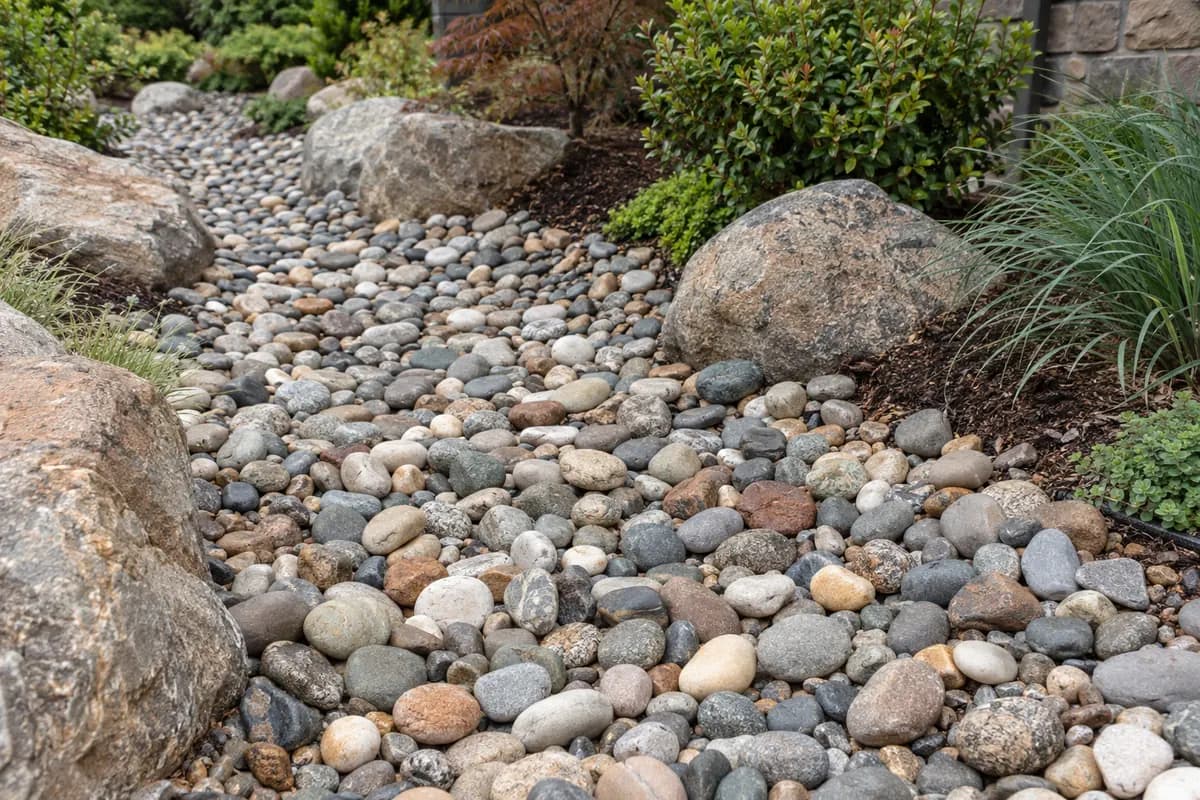
Stones of 1 to 3 inches are large enough to stay where they are set and small enough to curve around a bed without gaps. A border of rounded stone can follow any shape, from a tight circle around a tree to a long sweep beside a drive.[1]
Weight keeps the line. At about 2,600 lb per cubic yard, River Rock is not moved by sprinklers, rain or a leaf blower. A mulch border creeps onto the lawn after every storm, but a stone border stays where it was laid.[1]
A mixed earth tone works next to both lawn and planting. The browns, tans and grays sit between the green of grass and the dark of bed soil or bark, so the border separates the two without shouting.[1]
Rock edging does not rot, warp or split the way timber edging does after years in wet soil. Once set, the stones keep their shape and color through freeze, sun and rain.[1]
A stone strip also does work beyond looks. It catches splash from beds, keeps soil off paths after watering and gives runoff from paths and patios a place to drain.[1]
Design and sizing choices for river rock edging
A narrow ribbon of stone is the simplest style. A strip a little wider than a hand, set between a steel or plastic edge and the bed, gives a crisp, modern line. Stones near 1 inch suit this style because they pack into a thin band without gaps.[1]
A wide border looks more natural. A strip of stone as wide as a shovel blade or more, with a few larger stones placed along it, reads like a gravel bank. Stones across the full 1 to 3 inch range look best here.[1]
Along a path, the border can be wide enough to take the drip from a roof or the run-off from the path itself. Here it doubles as a drain, so make the strip a little lower than the path surface so water flows into it.[1]
Mix with other stones for contrast. A tread of Walkway Gravel or Decomposed Granite with a River Rock edge on each side gives a path a defined shape. The earth tone of the River Rock stands out a little against the finer surface.[1]
Around trees, a ring of stone keeps the mower and trimmer away from the bark. Keep the stone a short way from the trunk itself so the base of the tree stays dry and open to air.[1]
Depth, base and quantity for river rock edging
Edging starts with a solid edge. Set a steel, aluminum or heavy plastic strip, a row of pavers or a line of large stones on the lawn side of the border. The edge stops grass roots from spreading and keeps the stones from rolling into the lawn.[1]
A ribbon of small stones laid 2 inches deep over fabric takes about 0.80 tons for every 100 square feet. A ribbon border is narrow, so 100 square feet covers a long run of edging.[1]
A wider border with stones across the full size range needs about 3 inches to hide the fabric. That takes about 1.20 tons per 100 square feet.[1]
Where the border also drains a path or a roof edge, a 4 inch bed handles more water and takes about 1.60 tons per 100 square feet. A trench 6 inches deep under a downspout, about 2.41 tons per 100 square feet, turns a stretch of edging into a small drain.[1]
To size the order, measure the length of the border and multiply by its width to get square feet. Divide by 100 and multiply by the tons for your depth. River Rock is sold by the ton, and edging orders are small, so round up and keep the extra for fixing thin spots.[1]
Installation steps
Lay out the line with a garden hose and look at it from the house and the street before you dig. Smooth curves look better than many small wiggles.[1]
Cut along the lawn side with a flat spade, straight down, and remove the sod in a strip as wide as the border. Dig the strip a little below the lawn so the finished stone sits just under the level of the grass and the mower can pass over the edge.[1]
Install the edging along the lawn side, tapping it in so the top sits just above the soil. Lay fabric in the strip and tuck it under the edge and against the bed.[1]
Fill the strip with River Rock and rake it level. Place a few larger stones by hand to vary the line. Hose the border down when you are done to clear dust from the stones and show their full color.[1]
Maintenance and common mistakes
Skipping the edge strip is the most common mistake. Without it, grass grows into the stone and stones roll into the lawn, where the mower throws them. The rock border needs its own edge.[1]
Laying the stone higher than the lawn is the next. A border that stands proud catches the mower blade. Keep the top of the stone a little below the grass.[1]
Laying stone on bare soil without fabric lets weeds and grass grow up through the border and lets the stones sink into mud.[1]
Choosing one stone size for every border can look flat over a long run. Mix in a few larger pieces at corners and curves so the line has some rhythm.[1]
Edging needs light care. Blow leaves and clippings off the stone before they rot. Pull weeds that sprout on top while they are small. Every few years, top up thin spots with a few shovels of stone.[1]
Cost and ordering
River Rock is sold by the ton and delivered by dump truck. The total depends on how many tons you order, the distance from the supplying yard and how close the truck can tip.[1]
Edging is a light order by tonnage, so the delivery itself makes up a large share of the bill. Combining edging with stone for a path, a bed or a drainage strip in one load makes the trip worth more.[1]
A narrow ribbon of small stone uses far fewer tons than a wide, deep natural border, so pick the style before you measure.[1]
Enter your ZIP in the box on the site to see the delivered figure for River Rock, and use the calculator with your border length and width to check the tons.[1]
Delivered, 2 tons: from $458 to $1,374 depending on the city (366 cities priced). Enter your ZIP for the exact figure.
River Rock for this project

How much river rock do you need?
Measure the area, pick the depth for this project, and the calculator converts it to cubic yards and tons for your delivered price.
Projects
Related project guides
Browse
Browse more
Frequently Asked Questions
What size river rock is best for edging?
Stones near 1 inch suit a narrow, crisp ribbon along a steel or plastic edge. For a wider, natural looking border, use stones across the full 1 to 3 inch range with a few larger rocks placed by hand. Larger stones are easier to see from a distance.
How wide should river rock edging be?
A ribbon border can be a little wider than your hand. A natural border looks best at the width of a shovel blade or more. Where the edging also drains a path or roof edge, make it wide enough to catch the water.
Do I need edging under river rock edging?
Yes. A steel, aluminum or heavy plastic strip, a row of pavers or a line of large stones on the lawn side stops grass roots from creeping in and keeps the stones out of the mower's path. Without it, the stone border loses its line within a season.
How deep should a river rock border be?
A narrow border of small stones needs about 2 inches over fabric, which takes about 0.80 tons per 100 square feet. Wider borders with larger stones need a little more depth to hide the fabric between the pieces.
How do I keep grass out of river rock edging?
Use a deep edge strip on the lawn side, lay fabric under the stone and pull any grass runners as soon as they appear. Trim the lawn edge regularly with a string trimmer so runners do not reach the stone.