
Project guide
River Rock Around a House Foundation for Drainage and Curb Appeal
The strip of ground along a house takes roof runoff, splash from the gutters and the damp that collects in shade. Soil and bark there stay wet, invite insects and stain the siding. A band of River Rock keeps that strip dry and clean and gives the house a neat border. This guide covers how wide and deep to make the band, how to grade under it and how many tons to order.
Why River Rock works for a house foundation
Smooth stones of 1 to 3 inches leave large open gaps between them. Roof water that lands on the band drops through those gaps at once instead of pooling against the wall, and the surface dries quickly after a storm.[1]
Rock does not hold moisture against the house the way mulch does. Bark beds right against siding stay damp for days and give termites, ants and rot a home. A stone strip keeps the bottom of the wall in open air.[1]
The weight keeps it in place under a gutter. River Rock weighs about 2,600 lb per cubic yard, so water pouring off a roof edge or out of a downspout does not scatter it. Light pebbles and bark wash out and leave bare trenches under the drip line.[1]
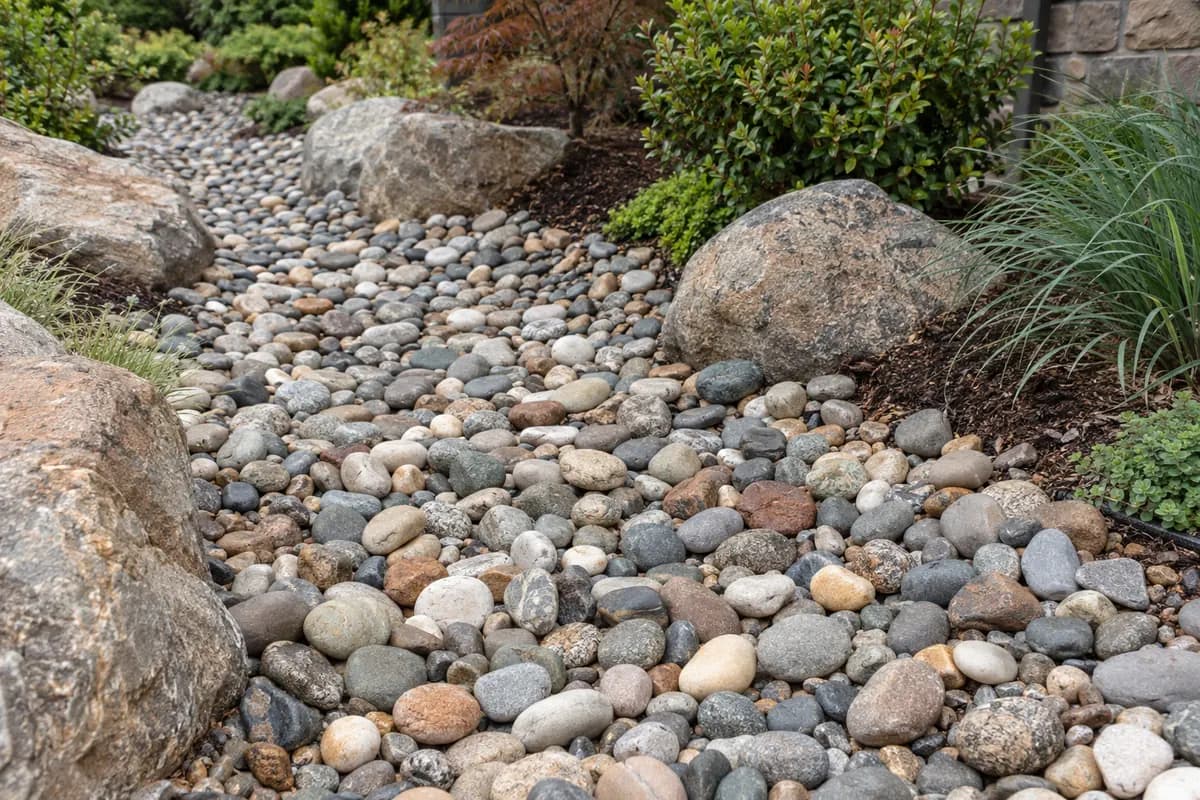
A mixed earth tone suits almost any siding. The browns, tans and grays in River Rock pick up colors from brick, stone veneer, painted wood and stucco, so the band looks planned rather than added later.[1]
Larger, rounded stones also stop splash. Rain that hits bare soil throws mud onto the lower siding and the foundation coating. Stones break the drops up, so the wall stays clean and the paint lasts longer.[1]
Design and sizing choices for a house foundation border
Make the band wide enough to catch the drip line. Water leaving the roof edge lands a short way out from the wall, and the stone strip should reach a little past that line. A strip only a hand or two wide rarely does the job. A wider strip, close to the width of the roof overhang plus a little more, catches the full flow.[1]
Pick the stone size by what lands on it. Stones toward the 3 inch end of the range sit firmly under heavy gutter overflow and downspouts. Smaller stones near 1 inch look finer beside a front entry and are easier to walk on when you need to reach a window or a hose bib.[1]
Mix the band with plantings if you like. Low shrubs set a little out from the wall break up a long stretch of stone, and the earth tone of the rock frames green leaves well. Keep plants far enough from the wall that their roots and leaves stay off the siding.[1]
Decide how to finish the outer edge. A steel or plastic edge gives a crisp line against the lawn. A row of larger stones or pavers suits a more natural yard. Either way, the edge should stand slightly above the stone so the mower does not throw it.[1]
Pea Gravel is the finer option for a narrow strip on a walkway side. It drains as well, but its small pebbles move more under splash and wash out under downspouts unless the outlets end on a splash block.[1]
Depth, base and quantity for a house foundation border
A 2 inch layer of River Rock covers fabric along the foundation when the stones are on the small side of the range. For each 100 square feet of band, that takes about 0.80 tons.[1]
With stones nearer 3 inches, plan on a 3 inch layer so the fabric stays hidden between the larger pieces. That depth takes about 1.20 tons per 100 square feet.[1]
Under downspouts and valleys where water pours in volume, a deeper bed of 4 inches holds up better. That takes about 1.60 tons per 100 square feet. A 6 inch fill, about 2.41 tons per 100 square feet, is for a dry well or a trench at the end of a downspout, not the whole band.[1]
The base under the rock matters most. The soil should slope away from the house on a gentle fall over the full width of the band, so water that passes through the stone keeps moving outward. Lay woven landscape fabric over that graded soil to keep stones from sinking and slow weeds.[1]
To size the order, measure the length of each wall that gets a band and multiply by the width. Add the strips together, divide by 100 and multiply by the tons for your depth. River Rock is sold by the ton, so round up.[1]
Installation steps
Start by cleaning the gutters and checking the downspouts. A band of stone cannot fix a gutter that overflows along its whole length. Point each downspout onto a splash block or into a pipe that carries water well past the band.[1]
Strip the sod, old mulch and roots from the strip along the wall. Grade the soil so it falls away from the house, packing it firm near the wall. Low spots next to the foundation should be filled with soil, not stone, so the slope runs outward.[1]
Roll out the fabric along the wall, tucking its inner edge up against the foundation a little way. Overlap the seams generously and pin them. Cut openings for any shrubs that stay in place.[1]
Set the outer edging, then place the River Rock with a shovel or by hand. Rake it level, adding more stone under downspouts. Hose the band down when you finish to rinse dust off the stones and show their full earth tone colors.[1]
Maintenance and common mistakes
The most frequent mistake is grading toward the house. Stone laid in a low trench against the wall collects water right where it does the most harm. The soil under the rock must fall away from the foundation before any stone goes down.[1]
Piling rock above the siding line or the weep holes in brick is the next. Stones heaped up the wall trap moisture and give insects a hidden path in. Keep the top of the stone below the bottom edge of the siding.[1]
Plastic film under the rock seems like a good barrier, but it sends water sliding toward the wall and holds it there. Woven fabric lets water soak in and away.[1]
Leaves, needles and grass clippings that settle into the rock rot down and grow weeds. A leaf blower in spring and fall clears the band. Pull weeds while they are small, and top up stones that have sunk after a few years.[1]
Cost and ordering
River Rock is sold by the ton and arrives by dump truck. Your total depends on the tonnage, the distance from the supplying yard and how close the truck can tip to the house.[1]
Bands around a whole house add up. Measure every wall that gets stone before you order, so one load covers the job instead of two trips.[1]
The stone size you choose changes the depth you need. Larger stones need a deeper bed to hide the fabric, so a band of the biggest rock in the range takes more tons than the same strip of smaller stone.[1]
Enter your ZIP in the box on the site to see the delivered figure for River Rock, and use the calculator with your band length and width to work out the tons.[1]
Delivered, 2 tons: from $458 to $1,374 depending on the city (366 cities priced). Enter your ZIP for the exact figure.
River Rock for this project

How much river rock do you need?
Measure the area, pick the depth for this project, and the calculator converts it to cubic yards and tons for your delivered price.
Projects
Related project guides
Browse
Browse more
Frequently Asked Questions
Is river rock good next to a house foundation?
River Rock works well along a foundation when the soil under it slopes away from the house. The 1 to 3 inch stones let roof water drain straight through, they do not rot or hold damp against the siding, and they stop mud from splashing onto the wall. Laid in a low trench against the house, any stone holds water there instead.
How wide should river rock be around a house?
Make the band wide enough to reach a little past the line where water drips from the roof edge. A wider strip catches all the runoff and keeps splash off the siding. Narrow bands look tidy but leave the drip line falling on soil or lawn.
Should I put landscape fabric under river rock by the foundation?
Yes. Woven fabric over graded soil keeps the stones from sinking into the dirt and slows weeds coming up from below. Avoid solid plastic film, because it sends water sliding toward the wall and traps moisture under the rock, which is the opposite of what the band is for.
How deep should river rock be along a foundation?
About 3 inches covers fabric well with stones in the 1 to 3 inch range. That takes about 1.20 tons per 100 square feet. Use a deeper bed under downspouts where water lands hard.
Does river rock around a house attract bugs?
Rock dries out fast and gives insects far less shelter than bark or wood mulch, which hold moisture and break down into food. Keep the stone below the siding and clear leaves out of it, and the band stays an unfriendly place for pests.