
Gravel and Crushed Stone · Gray to tan
1-1/2" Crushed Gravel for Farm Roads, Drives and Drainage
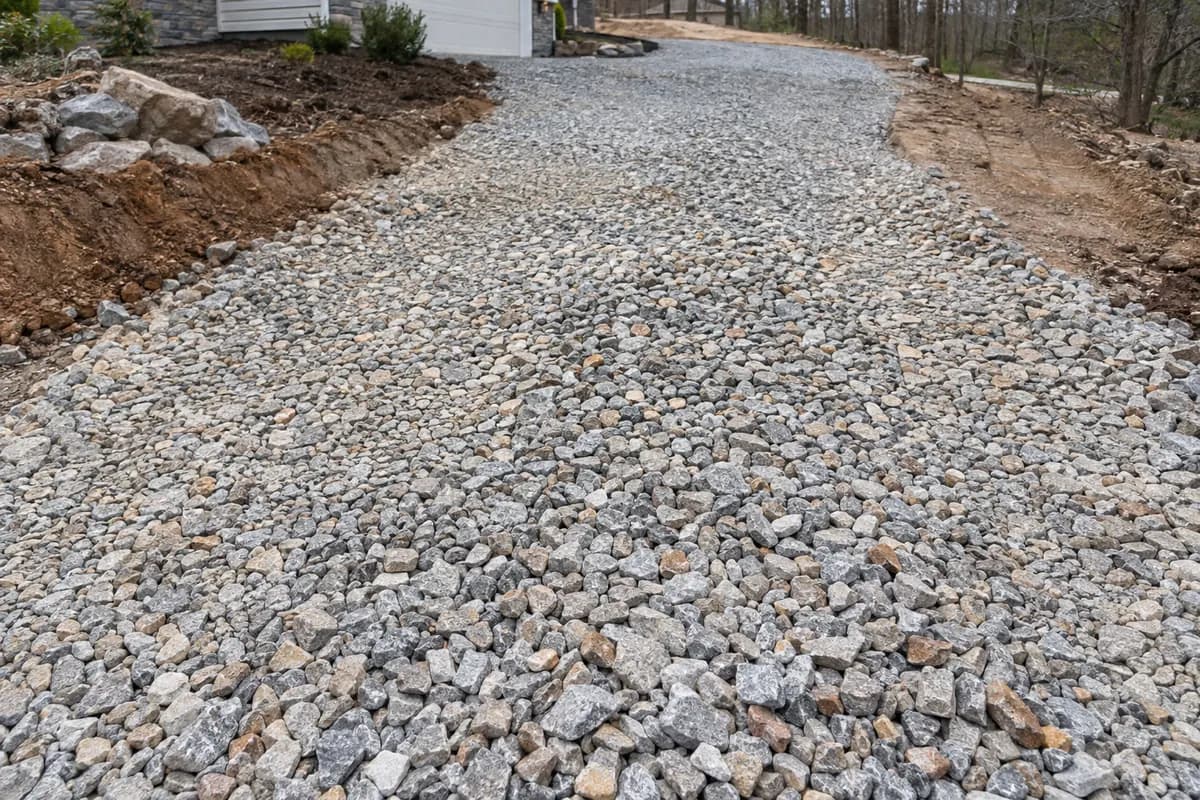
1-1/2" Crushed Gravel is coarse, broken stone about 1-1/2 inch across, in colors from gray to tan. Its chunky pieces bridge soft ground, lock under heavy tires and leave wide gaps for water. Gravel Valet delivers it by the ton for rural drives, farm lanes, field gates and drainage trenches that need more muscle than a fine stone.
- From
- $424 delivered
- Size
- 1-1/2 inch
- Weight
- 2,700 lb/yd³
- Sold by
- the ton
See local 1-1/2" Crushed Gravel pricing for your ZIP
Checking your saved delivery area.
- US cities served
- 368
- From, 2 tons delivered
- $424
- Weight
- 2,700 lb/yd³
- Size
- 1-1/2 inch

About 1-1/2" Crushed Gravel
Pieces of this gravel measure about 1-1/2 inch, roughly the size of a walnut, and every one has been crushed, so the faces are flat and the edges rough. Many loads are a blend of gray to tan, since the gravel comes from mixed rock deposits or from quarries where the bedrock shifts in color.[1]
Gravel Valet sells it by the ton. A cubic yard weighs about 2,700 lb, and much of a layer's volume is open space between the large pieces. That void space is a strength: water drains straight down, and the coarse stones resist being pressed into the ground by tractors and trucks.[1]
Size matters on soft ground. Small stone gets pushed into mud by a heavy wheel, while a coarse piece spreads that force across a wider patch of soil. That is why rural property owners keep coming back to this grade when a lane turns soft every spring.[1]
1-1/2" Crushed Gravel is 1-1/2 inch, gray to tan, about 2,700 lb per cubic yard, sold by the ton with a 2 ton minimum.
Specifications
| Material | 1-1/2" Crushed Gravel |
|---|---|
| Category | crushed stone |
| Typical size | 1-1/2 inch |
| Color | Gray to tan |
| Weight | 2,700 lb/yd³, about 1.35 tons per cubic yard |
| Sold by | the ton |
| Order minimum | 2 tons per delivery |
| Online order steps | half tons, up to 40 per order; more by quote |
Coverage: how much 1-1/2" Crushed Gravel do you need?
Square feet one ton of 1-1/2" Crushed Gravel covers at common spread depths. For exact tonnage, use the calculator.
- 120
- sq ft at 2" deep
- Top dressing, beds
- 80
- sq ft at 3" deep
- Paths, patios, drainage
- 60
- sq ft at 4" deep
- Driveways, base layers
Best uses for 1-1/2" Crushed Gravel
Soft driveways are the first match. A drive that ruts every wet season needs a coarser stone, and more fine gravel will not fix it, and this grade gives it backbone. Laid over fabric, it lifts wheels above the mud and drains out after a storm.[1]
Farm roads, field entrances and the apron in front of a barn or equipment shed take a beating from tractors and livestock trailers. The large stones stand up to that traffic, and the gray to tan color blends with dirt lanes and pasture edges.[1]
Drainage trenches and curtain drains use it to move a lot of water. The wide gaps carry runoff quickly, so a trench of this gravel along a slope can intercept water before it reaches a building or a drive. Coarse gravel lines ditches too, and it steadies the ground around culverts and gates.[1]
How to install 1-1/2" Crushed Gravel
Grade the lane first so water has somewhere to go, with a crown in the middle and shallow ditches or swales at the sides. Remove soft organic soil from wet spots and fill holes with compacted fill. On clay or loam that turns to mud, roll out a woven geotextile across the full width.[1]
Filling ruts or patching a worn lane may need only a 2 inch layer, about 0.83 tons per 100 square feet. A 3 inch layer, about 1.25 tons per 100 square feet, firms up a path for a garden tractor or a utility vehicle.[1]
New farm roads and soft drives need real depth. A 4 inch layer uses about 1.67 tons per 100 square feet, and a 6 inch layer uses about 2.50 tons per 100 square feet. Spread with a box blade or loader bucket and compact with the heaviest machine you have, driving back and forth until the stones settle.[1]
In a drainage trench, line the trench with fabric, fill it with gravel around a perforated pipe or on its own, and fold the fabric over the top. Cap the trench with soil and sod, or leave the stone exposed so surface water can enter directly.[1]
Check the lane after the first heavy rain. Low spots where water stands show where the crown or the side ditches need work. A few passes with a box blade and a little extra stone in those spots now save a lot of repair work in the seasons ahead.[1]
Comparable materials
#4 Crushed Stone is the next step up in size and is better for construction entrances and the heaviest base layers. #57 Crushed Stone and 3/4" Crushed Stone are smaller and make a smoother driving surface, and they go on top of a coarse layer like this one.[1]
#67 Stone packs tighter for walkways and slab beds. #89 Crushed Stone is a fine chip for pipes and pavers. Pick 1-1/2" Crushed Gravel when the ground is soft, the traffic is heavy or the drainage load is large, then top it with a smaller grade where you want a comfortable ride.[1]
Rounded gravel of a similar size is sometimes offered for drives, but it does not lock and tends to wander under wheels. Crushed pieces stay put. For any lane with turning traffic or a slope, the crushed form is the one to order.[1]
 From$4242 ton delivered
#57 Crushed Stone
Gravel and Crushed Stone- Size
- 3/4 to 1 inch
- Weight
- 2,700 lb/yd³
- Color
- Gray
 From$4372 ton delivered
#67 Stone
Gravel and Crushed Stone- Size
- 3/4 inch and under
- Weight
- 2,700 lb/yd³
- Color
- Gray
 From$4252 ton delivered
#89 Crushed Stone
Gravel and Crushed Stone- Size
- 3/8 inch
- Weight
- 2,700 lb/yd³
- Color
- Gray
 From$4452 ton delivered
#4 Crushed Stone
Gravel and Crushed Stone- Size
- 1-1/2 to 2-1/2 inches
- Weight
- 2,700 lb/yd³
- Color
- Gray
 From$4272 ton delivered
3/4" Crushed Stone
Gravel and Crushed Stone- Size
- 3/4 inch
- Weight
- 2,700 lb/yd³
- Color
- Gray
 From$4272 ton delivered
3/8" Crushed Stone
Gravel and Crushed Stone- Size
- 3/8 inch
- Weight
- 2,700 lb/yd³
- Color
- Gray
Where we source 1-1/2" Crushed Gravel
Coarse crushed gravel comes from sand and gravel pits and from hard rock quarries. In pits, natural gravel is dug, fed through a crusher to break rounded cobbles into angular pieces, then screened. In quarries, blasted rock follows the same crush and screen path. The gray to tan mix reflects the many rock types in a natural deposit.[1]
Gravel Valet fills each order from pits and yards near the delivery address. Coarse rock is heavy, so a local source keeps the haul practical and the color close to what nearby lanes already show. Each load crosses a scale so the tonnage matches your order.[1]
Crushing natural gravel matters for this job. Rounded cobbles from a pit roll and shift, but once the crusher splits them, the broken faces grip each other the way quarried rock does. That is why a load shows some smooth sides mixed with fresh, rough breaks.[1]
Why bulk delivery saves money
Rural projects run on tons, not bags. A farm lane or a long drive can need several truckloads, and bulk delivery by the ton is the only sensible way to move that much stone. One order puts the full amount at the gate, and the tractor does the rest.[1]
With a weight of about 2,700 lb per cubic yard, every trip matters. Full truckloads make each mile count, and getting the whole amount at once lets you grade and compact the lane in one pass while the equipment is out.[1]
A firm lane also saves wear on everything that drives it. Trucks, tractors and trailers bounce less on a solid stone road, and mud stays off the equipment. Putting enough coarse gravel down in one bulk order is the step that makes the lane hold up through wet seasons.[1]
Ordering 1-1/2" Crushed Gravel from Gravel Valet
Measure the length and width of the lane or trench, decide on depth and run the numbers through the area calculator to get tons. Your ZIP in the order box tells you whether we reach the property. Add the tons, choose a day and tell the driver where to dump.[1]
On long lanes, ask the driver to spread the load by tailgating, letting stone out of the bed slowly while the truck rolls forward. That saves hours of moving piles. For a 6 inch farm road at about 2.50 tons per 100 square feet, plan several drop points along the route and make sure the ground can carry a loaded truck.[1]
FAQ: 1-1/2" Crushed Gravel
Is 1-1/2" Crushed Gravel good for a muddy driveway?
Coarse gravel fixes most muddy drives. The big stones bridge soft soil and carry wheels above the mud, especially when laid over a woven fabric. Compact it well, then add a layer of a smaller stone on top if you want a smoother surface for cars and walking.
What color is 1-1/2" Crushed Gravel?
Gray to tan. The mix depends on the rock the local pit or quarry works, so one load may be mostly gray with tan pieces and another warmer in tone. The color suits rural settings and blends with dirt lanes, pastures and wooded drives.
Can 1-1/2" Crushed Gravel be used in a French drain?
Yes, especially where the drain must carry a lot of water. The large gaps let water flow quickly toward the pipe or along the trench. Wrap it in filter fabric so soil does not fill the voids over time, and slope the trench toward a safe outlet.
How much 1-1/2" Crushed Gravel do I need for a farm road?
For a new lane, plan on 4 to 6 inches. That is about 1.67 tons per 100 square feet at 4 inches and 2.50 tons per 100 square feet at 6 inches. Multiply length by width in feet, divide by 100 and multiply by the figure for your depth.
Will 1-1/2" Crushed Gravel scatter under tires?
Coarse stone moves less than fine stone because each piece is heavier and locks with its neighbors after compaction. Loose stones on top can kick up under fast tires, so a smaller grade over it, or a lower speed on the lane, keeps the surface tidy.
Order 1-1/2" Crushed Gravel today
Enter your ZIP for the delivered price, or send the job and we quote it by hand.
By state
1-1/2" Crushed Gravel by state
- 1-1/2" Crushed Gravel in Alaska
- 1-1/2" Crushed Gravel in Alabama
- 1-1/2" Crushed Gravel in Arkansas
- 1-1/2" Crushed Gravel in Arizona
- 1-1/2" Crushed Gravel in California
- 1-1/2" Crushed Gravel in Colorado
- 1-1/2" Crushed Gravel in Connecticut
- 1-1/2" Crushed Gravel in District of Columbia
- 1-1/2" Crushed Gravel in Florida
- 1-1/2" Crushed Gravel in Georgia
- 1-1/2" Crushed Gravel in Hawaii
- 1-1/2" Crushed Gravel in Iowa
- 1-1/2" Crushed Gravel in Idaho
- 1-1/2" Crushed Gravel in Illinois
- 1-1/2" Crushed Gravel in Indiana
- 1-1/2" Crushed Gravel in Kansas
- 1-1/2" Crushed Gravel in Kentucky
- 1-1/2" Crushed Gravel in Louisiana
- 1-1/2" Crushed Gravel in Massachusetts
- 1-1/2" Crushed Gravel in Maryland
- 1-1/2" Crushed Gravel in Michigan
- 1-1/2" Crushed Gravel in Minnesota
- 1-1/2" Crushed Gravel in Missouri
- 1-1/2" Crushed Gravel in Mississippi
- 1-1/2" Crushed Gravel in Montana
- 1-1/2" Crushed Gravel in North Carolina
- 1-1/2" Crushed Gravel in North Dakota
- 1-1/2" Crushed Gravel in Nebraska
- 1-1/2" Crushed Gravel in New Hampshire
- 1-1/2" Crushed Gravel in New Jersey
- 1-1/2" Crushed Gravel in New Mexico
- 1-1/2" Crushed Gravel in Nevada
- 1-1/2" Crushed Gravel in New York
- 1-1/2" Crushed Gravel in Ohio
- 1-1/2" Crushed Gravel in Oklahoma
- 1-1/2" Crushed Gravel in Oregon
- 1-1/2" Crushed Gravel in Pennsylvania
- 1-1/2" Crushed Gravel in Rhode Island
- 1-1/2" Crushed Gravel in South Carolina
- 1-1/2" Crushed Gravel in South Dakota
- 1-1/2" Crushed Gravel in Tennessee
- 1-1/2" Crushed Gravel in Texas
- 1-1/2" Crushed Gravel in Utah
- 1-1/2" Crushed Gravel in Virginia
- 1-1/2" Crushed Gravel in Washington
- 1-1/2" Crushed Gravel in Wisconsin