
Project guide
River Rock Landscaping Ideas for Beds, Borders and Slopes
River rock gives a yard the look of a streambed without the water. The smooth, rounded stones frame planting beds, cover bare ground under trees and calm the strip along a foundation where mulch keeps washing away. This guide covers where the stone fits, how to size and lay it, how many tons a bed needs and how to keep it looking fresh.
Why River Rock works for landscaping
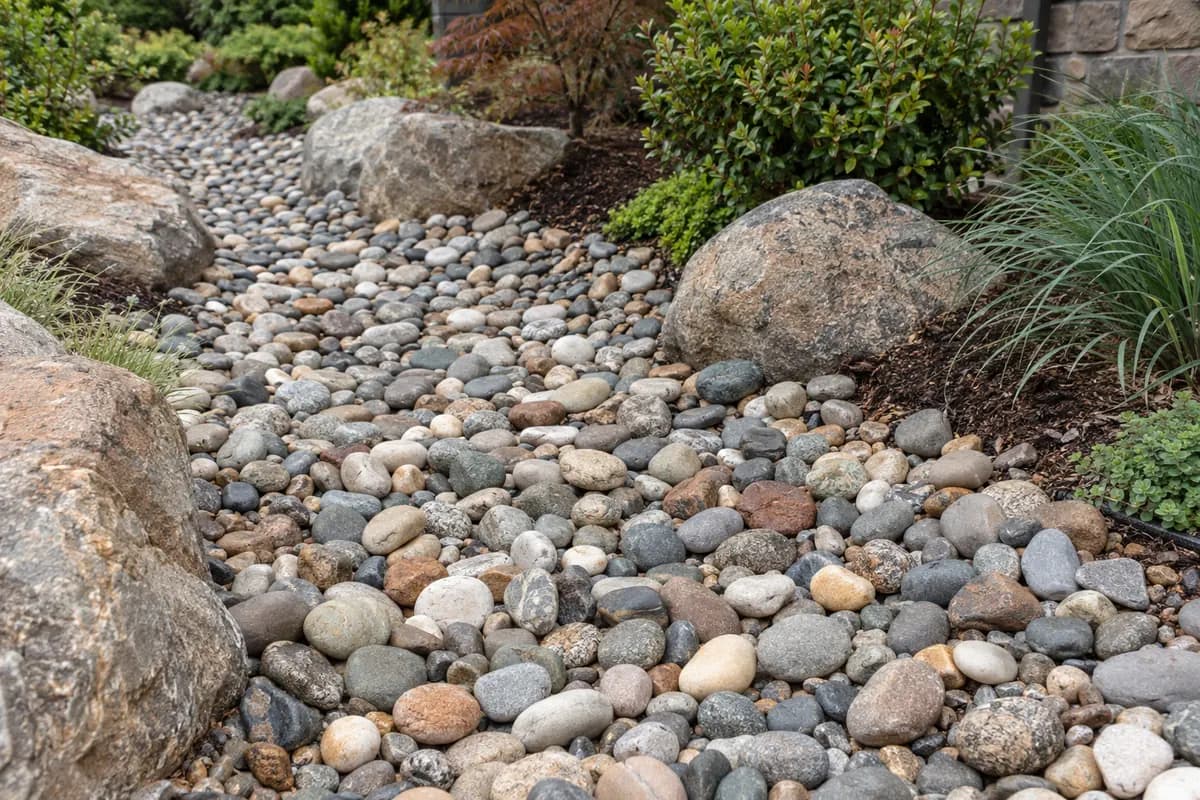
River Rock is tumbled stone between 1 and 3 inches across, worn round by moving water long before it reached a yard. The color runs through mixed earth tones, so a single load holds tan, rust, gray and darker pieces side by side. That blend sits comfortably beside brick, wood siding, green lawn and flowering shrubs, and it rarely clashes with the house.[1]
A cubic yard of River Rock weighs about 2,600 lb, and stones that size do not float, blow or wash away in a heavy storm. Bark mulch beside a downspout can end up on the lawn after one hard rain. River Rock stays where you set it, which makes it a good fit for the wet, windy and sloped corners of a property.[1]
The round shape matters as much as the weight. Rounded stones leave wide gaps between them, so rain drops straight through to the soil instead of pooling on top. Beds stay drier at the surface, which means fewer slugs and less rot at the base of shrubs. The same gaps let air reach the roots of trees planted in the bed.[1]
Stone also does not break down. Wood mulch fades and rots within a season or two and needs topping up, while a River Rock bed keeps its tone for years. The earth tones darken when wet and lighten in sun, so the bed changes a little with the weather without ever looking worn.[1]
Design and sizing choices for river rock landscaping
Start with the job each area must do. A strip under a roof edge needs stone that can take falling water, and the larger pieces near 3 inches handle that well. A flower bed with small perennials looks better with a lighter scatter of stone between the plants, where the smaller pieces near 1 inch let the plants stand out.[1]
Think about scale. A wide lawn border or an island bed around a large tree can carry a broad band of River Rock, and the mixed earth tones read as a natural feature from the street. A narrow bed next to a walk looks crowded if the stone runs right to the plants, so leave a ring of soil or a few inches of mulch around each stem.[1]
Mix in larger boulders for height. A bed of rounded stone with two or three big rocks set off center looks planned. One boulder in the middle of a flat circle looks dropped there. Bury each boulder about a third of its depth so it sits in the ground rather than on it.[1]
Pair the stone with the right neighbors. Gray stone in the blend picks up concrete and slate, while the warmer tan and rust pieces work with brick and cedar. Planting with silver, purple or deep green foliage makes the stone glow. Plain green ground covers can look flat against it, so try a sample bag in the bed before you order the full load.[1]
Use edging that matches the stone. River Rock rolls if nothing holds it, so a steel strip, a row of setts or a raised lip of soil keeps it from creeping into the lawn. Curved lines suit the round stones better than sharp corners do.[1]
Depth, base and quantity for river rock landscaping
For a bed of smaller stones over firm ground, 2 inches is enough to hide the soil. That depth takes about 0.80 tons for each 100 square feet. A thin bed like this works between shrubs, where the plants themselves cover most of the ground.[1]
Most open beds look best at 3 inches, about 1.20 tons per 100 square feet. At that depth the stones overlap two or three deep and no fabric shows through, even where larger pieces near 3 inches leave wide gaps.[1]
Under downspouts, along a drip line or on a gentle slope, go to 4 inches. That takes about 1.60 tons per 100 square feet. The extra depth gives falling water room to spread and keeps the stone from thinning out where runoff hits hardest.[1]
A depth of 6 inches is rare in a garden. It takes about 2.41 tons per 100 square feet and suits a deep swale or a low spot that carries storm water across the yard.[1]
To size the order, measure each bed, multiply length by width for square feet, divide by 100 and multiply by the tons for your depth. Odd shapes can be split into rectangles and circles and added up. River Rock is sold by the ton, so round up, since a short bed is harder to fix than a few spare stones. The calculator on the site does the same math.[1]
The base under the stone is simple. Clear the weeds, grade the soil so water drains away from the house, and lay a woven landscape fabric. The fabric keeps rounded stones from sinking into soft soil.[1]
Installation steps
Mark the beds with a hose or spray paint and live with the outline for a day or two. Adjust curves until they look right from the windows and the street. Then cut the edge with a flat spade.[1]
Strip grass and weeds from inside the line, roots and all. Dig the soil down far enough that the finished stone will sit level with the lawn or a touch lower, so a mower can pass along the edge without throwing stones.[1]
Set the edging and check the grade. Soil next to the foundation should slope away from the wall. Rake out low spots where water would sit.[1]
Lay the fabric with generous overlaps and pin it down. Cut an X at each plant, fold the flaps under and leave room for the stem to grow. Plant before the stone goes down, since digging through River Rock is slow work.[1]
Have the load dropped as close to the beds as the truck can safely reach. At about 2,600 lb per cubic yard, every ton moved by wheelbarrow is a lot of trips, so a good drop spot saves a day of work. A tarp under the pile keeps stones out of the grass.[1]
Spread the stone with a shovel and finish by hand. Turn the flatter pieces face up and tuck the larger ones toward the back of the bed. Rinse the bed with a hose to clear dust and show the true earth tones.[1]
Maintenance and common mistakes
River Rock needs little care. Leaves and seeds land in the gaps between the stones. A leaf blower on a low setting clears dry debris in a few minutes. Pull any weeds that root in the dust on top while they are small.[1]
Every year or two, rake the bed and rinse it. Dust and plant litter dull the earth tones, and a rinse brings them back. Where soil has washed in from a nearby bed, lift the stones, clean them in a bucket and reset them.[1]
The most common mistake is skipping the fabric. Without it, rounded stones sink into the soil within a few seasons and weeds push up between them. Another is laying stone too thin, so bare fabric shows in patches.[1]
Planting too close is a third mistake. Stones packed tight against stems hold heat in summer and can scorch tender plants. Leave a small ring of bare soil or mulch around each stem.[1]
Avoid piling heavy stone against wood siding or the sill of a door. Keep the top of the bed below any wood, and leave a clear gap so water does not wick into the house.[1]
Cost and ordering
River Rock is sold by the ton and arrives in a dump truck. The delivered total depends on how many tons you order, how far the truck travels from the yard that loads it and how easy your drop spot is to reach.[1]
Depth drives the size of the order more than anything else. A bed at 3 inches needs half again as much stone as the same bed at 2 inches, so pick the depth before you sum the tons.[1]
One full load usually beats two half loads. If you plan a second bed or a dry creek later in the year, consider ordering for both at once. Enter your ZIP on the site to see the delivered total for your address, then check out online or request a quote for a larger job.[1]
Delivered, 2 tons: from $458 to $1,374 depending on the city (366 cities priced). Enter your ZIP for the exact figure.
River Rock for this project

How much river rock do you need?
Measure the area, pick the depth for this project, and the calculator converts it to cubic yards and tons for your delivered price.
Projects
Related project guides
Browse
Browse more
Frequently Asked Questions
How much River Rock do I need for a flower bed?
Measure the bed in square feet and divide by 100. At 3 inches deep, which suits most beds, each 100 square feet takes about 1.20 tons of River Rock. A bed twice that size needs twice the stone. Round up a little so you can fill thin spots after the stone settles.
Should I put landscape fabric under River Rock?
Yes, in almost every bed. Woven fabric keeps the rounded stones from sinking into the soil and slows weeds that grow up from below. It lets water through. Weeds can still sprout in dust that settles on top, so a quick pass with a blower or a few minutes of hand pulling keeps the bed clean.
What size River Rock is best for landscaping?
River Rock runs from about 1 to 3 inches. The smaller stones suit flower beds and borders, where they sit between plants without crowding them. The larger stones handle falling water under downspouts and along drip lines. A mixed load covers both jobs and looks natural in most yards.
Will River Rock get hot in the sun?
Stone holds heat, and a bed of River Rock in full sun warms more than bare soil or mulch would. The mixed earth tones absorb less heat than the darkest stone, but plants that dislike heat at the base do better with a small ring of mulch around the stem. Shade beds stay cool.
Can River Rock go on a slope?
River Rock handles a gentle slope well, especially at 4 inches deep, which takes about 1.60 tons per 100 square feet. On a steeper bank the round stones can roll downhill, so cut small terraces or set a few large boulders across the slope to hold the smaller stone in place.
How long does a River Rock bed last?
The stone itself does not rot or fade, so a bed can last as long as the yard does. The fabric under it wears out in time, and dust and leaves build up between the stones. A rinse every year or two and a top up where stone has thinned keep it looking new.