
Project guide
River Rock Driveway Ideas for Borders, Aprons and Low Traffic Drives
River Rock gives a drive a soft, natural look that crushed gravel cannot match. Round stone also rolls under tires, so it needs the right job and the right base under it. Used as a top dressing on a firm base, along the edges or on a drive that sees light use, it can last for years. This guide shows where it works, how to build under it and how much to order.
Why River Rock works for a driveway
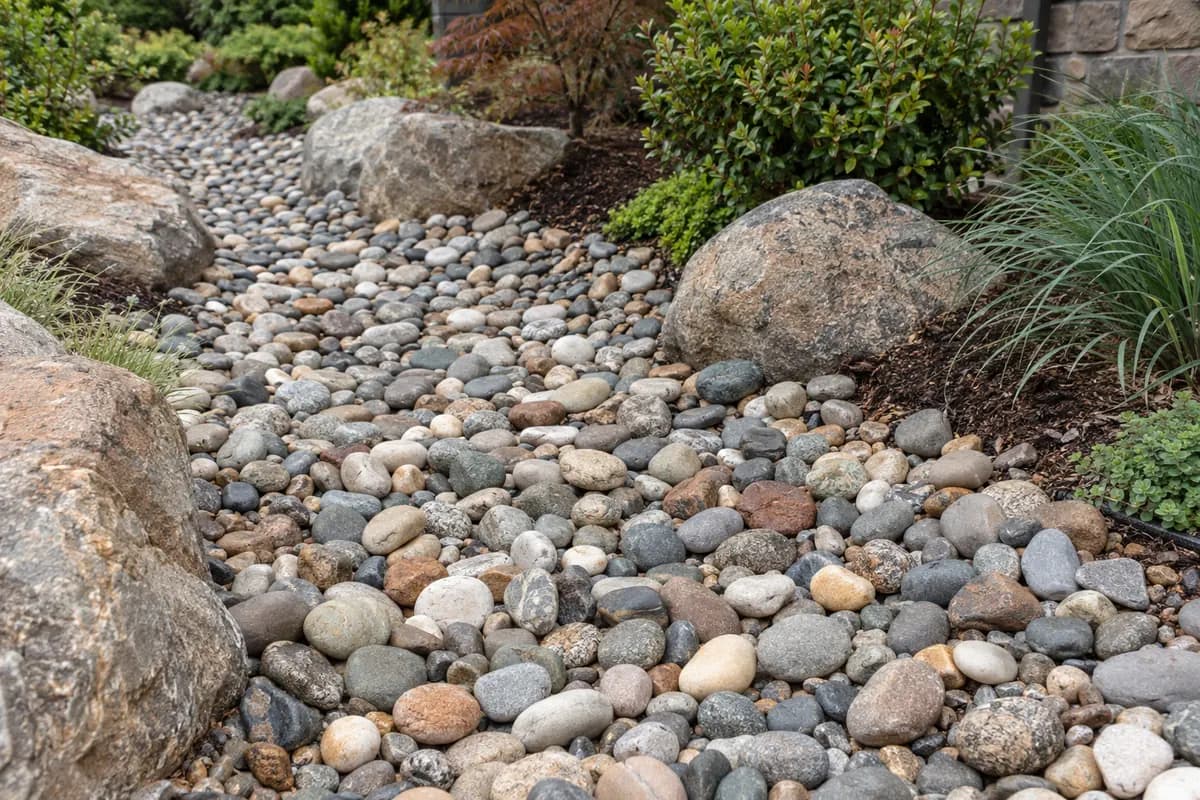
Looks are the main reason. A drive surfaced in mixed earth tones blends with lawns, beds and wooded lots in a way gray crushed stone does not. On a long country lane or a short drive in front of a cottage, the rounded stones give the approach a finished, landscaped feel.[1]
Drainage is the second. Stones of 1 to 3 inches leave big gaps that rain passes through, so a River Rock surface does not hold puddles. That helps on a drive with no curb or gutter, where water has to soak in on the spot.[1]
The stones are heavy enough to stay on the drive in a storm. At about 2,600 lb per cubic yard, River Rock does not wash out the way pea pebbles can on a slope, and the larger pieces resist being thrown by tires.[1]
There is a trade-off to plan for. Round stones do not lock together. Under a turning wheel they roll and shift, so a drive made of River Rock alone, with no firm layer below, ruts and spreads. The answer is to use it as a thin surface on a compacted base, or to use it where wheels do not turn sharply.[1]
Design and sizing choices for a river rock driveway
The strongest design keeps River Rock out of the wheel tracks. Build the drive itself from a crushed stone that locks, such as Walkway Gravel or a compacted base, and use River Rock for wide borders, the island in a circular drive or the strips between two concrete tire tracks.[1]
For a drive that is all River Rock, pick the small end of the range. Stones near 1 inch sit flatter and move less under tires than stones near 3 inches, which can roll like balls under a turning car. Keep the larger stones for edges and drainage swales beside the drive.[1]
A ribbon drive is a good fit. Two paved or crushed stone tracks carry the wheels, and the center strip and both shoulders get River Rock. The mixed earth tone softens the paved strips and the stone in the middle never takes a tire.[1]
Plan the turning areas carefully. Where cars back up and swing around, round stone gets pushed into piles. Use a locked surface there, or a stabilizing grid of plastic cells filled with stone, which holds each piece in a pocket so it cannot roll.[1]
Decomposed Granite and Pea Gravel are the other decorative drive surfaces. Decomposed Granite packs firm but can wash on slopes. Pea Gravel is smaller and rounder than River Rock and shifts even more under tires, so it suits only a short, flat parking pad.[1]
Depth, base and quantity for a river rock driveway
The base does the structural work. Under a drive that carries cars, dig out soft soil, lay fabric on the subgrade and build a thick, compacted layer of crushed stone that locks. River Rock goes on top only after that base is hard and level.[1]
On top of a firm base, a thin top layer of River Rock rolls the least. A 2 inch layer takes about 0.80 tons for every 100 square feet. Use stones near the small end of the size range for that thin dressing.[1]
A 3 inch layer suits borders, islands and shoulders where no tires go. It hides the base and fabric between larger stones and takes about 1.20 tons per 100 square feet.[1]
Thicker layers on a driving surface make things worse, because a deep bed of round stone acts like loose sand under a wheel. Keep 4 inch beds, about 1.60 tons per 100 square feet, for drainage swales beside the drive. A 6 inch fill takes about 2.41 tons per 100 square feet and belongs in a trench drain, not under the car.[1]
Measure the length and width of each surface that gets River Rock, multiply, divide by 100, and multiply by the tons for the depth of that part. River Rock is sold by the ton, so add the parts and round up.[1]
Installation steps
Mark the drive and its borders with stakes and string. Strip turf, roots and topsoil down to firm ground, and shape the subgrade with a crown or a cross slope so water runs off to the sides.[1]
Roll woven fabric over the subgrade. Spread the crushed base in thin lifts and compact each lift with a plate compactor or roller until the surface no longer moves under a boot. Check the crown again before the top layer goes down.[1]
Set edging along both sides. Steel, timber or a row of large stones keeps the round top stone from creeping into the lawn, which River Rock does faster than crushed gravel.[1]
Spread the River Rock over the base with a loader bucket or rake, keeping the layer thin and even. Drive slowly over it a few times and rake out any piles. Hose the surface to rinse off quarry dust and bring out the earth tones.[1]
Maintenance and common mistakes
The biggest mistake is laying a deep layer of River Rock straight on soil and driving on it. Without a locked base the stones sink, ruts form and the surface spreads into the yard within a season.[1]
Choosing the largest stones for the wheel paths is the next. Stones near 3 inches roll under tires and can kick out at speed. Use small stones where cars drive and large stones where they do not.[1]
Skipping edging lets round stone migrate onto the lawn, where mowers throw it. A raised edge fixes it.[1]
Plan on raking. Wheel paths push River Rock to the sides over time. A monthly rake back into the tracks, and a light top up every few years, keeps the drive even. Clear leaves before they rot into soil between the stones, or weeds will follow.[1]
Cost and ordering
River Rock is sold by the ton, and so is the base stone under it. Your delivered total follows the tonnage of each, the distance from the yard that supplies them and how easily a truck can tip at the start of the drive.[1]
Using River Rock as a thin top layer, or only on borders and islands, keeps the tonnage of decorative stone low. The bulk of the drive is base stone, which goes in thicker.[1]
A driveway is a large order, so plan the delivery. A truck can spread a load along the drive as it pulls forward, which saves hours of moving stone by hand.[1]
Type your ZIP into the box on the site to see the delivered figure for River Rock and the base, then enter the drive area in the calculator.[1]
Delivered, 2 tons: from $458 to $1,374 depending on the city (366 cities priced). Enter your ZIP for the exact figure.
River Rock for this project

How much river rock do you need?
Measure the area, pick the depth for this project, and the calculator converts it to cubic yards and tons for your delivered price.
Projects
Related project guides
Browse
Browse more
Frequently Asked Questions
Can you use river rock for a driveway?
Yes, with limits. River Rock works as a thin top layer on a firm crushed base, on borders and islands, and on drives with light, slow traffic. Laid deep on soil, the round 1 to 3 inch stones roll under tires and rut. For the wheel paths of a busy drive, an angular stone that locks holds up better.
What size river rock is best for a driveway?
Use stones near the small end of the 1 to 3 inch range wherever tires roll. They sit flatter and shift less. Save the larger stones for borders, swales and islands, where their size looks good and nothing drives over them.
How thick should river rock be on a driveway?
Keep the top layer thin, about 2 inches, over a well compacted base. That takes about 0.80 tons per 100 square feet. A thicker layer of round stone behaves like loose sand under a wheel and makes the drive harder to use.
Do I need a base under a river rock driveway?
Yes. River Rock does not lock, so it cannot carry cars on its own. A compacted base of crushed stone, laid over fabric on firm soil, carries the load. The River Rock on top is the surface people see.
How do I stop river rock from moving on my driveway?
Keep the layer thin, use smaller stones in the wheel paths, set raised edging on both sides and rake stones back into place every few weeks. A plastic grid of cells filled with stone holds each piece in place and works well on turning areas and slopes.