
Best picks
Best Sand for a Paver Base: 2026 Picks
Every paver patio rests on a thin bed of sand laid over a packed stone base. That bed decides whether the finished surface stays flat for years or starts to rock and dip. Our pick for it is Concrete Sand, a coarse, washed sand in tan to gray. Here is why it wins, where the other sands belong, and how to size the order.
Concrete Sand
sand · size Coarse · 2,700 lb/yd³ · sold by the ton

Bottom line: Concrete Sand for sand for a paver base
Our top pick: Concrete Sand
Concrete Sand is a coarse, washed sand with sharp, angular grains in a tan to gray color. Ready-mix plants blend it into concrete, which is where the name comes from. Under pavers it has a different job: it forms the thin, level bed between the compacted stone base and the bottom of each paver.[1]
The coarse grains are the reason it works. Sharp particles bite into one another when a plate compactor vibrates the pavers down, so the bed stays firm under foot traffic and car tires. Fine, rounded sand acts more like tiny ball bearings. It can slide out from under a paver, leaving one corner proud of the surface and another sunk low.[1]
Concrete Sand is sold by the ton. A cubic yard weighs about 2,700 lb, so even a small bedding order is heavy to move by hand. Plan where the truck can tip the load, ideally on a tarp close to the work area, so you are not pushing loaded wheelbarrows across a soft lawn all day.[1]
Washing matters as much as grain size. Washing rinses out the silt and clay that would otherwise coat each grain and hold water against the underside of the pavers. A handful of good bedding sand feels gritty and falls apart when you open your fist. If it balls up and smears like modeling clay, it carries too many fines for a paver bed.[1]
Why Concrete Sand fits a paver base
A paver patio or walk is built in layers. At the bottom is the native soil, scraped flat and compacted. On top of that goes a thicker layer of crushed stone base, packed in lifts. Then comes a thin bed of sand, screeded flat, and finally the pavers themselves. The sand layer is the thinnest part of the build, yet it decides how flat the finished surface looks.[1]
Coarse sand drains. Water that slips through the joints between pavers moves down through the open bed and into the stone base below. A bed made of fine sand or soil holds that water, softens and lets the pavers rock. Where winters are cold, wet bedding can also lift as it freezes, and the patio heaves in spots.[1]
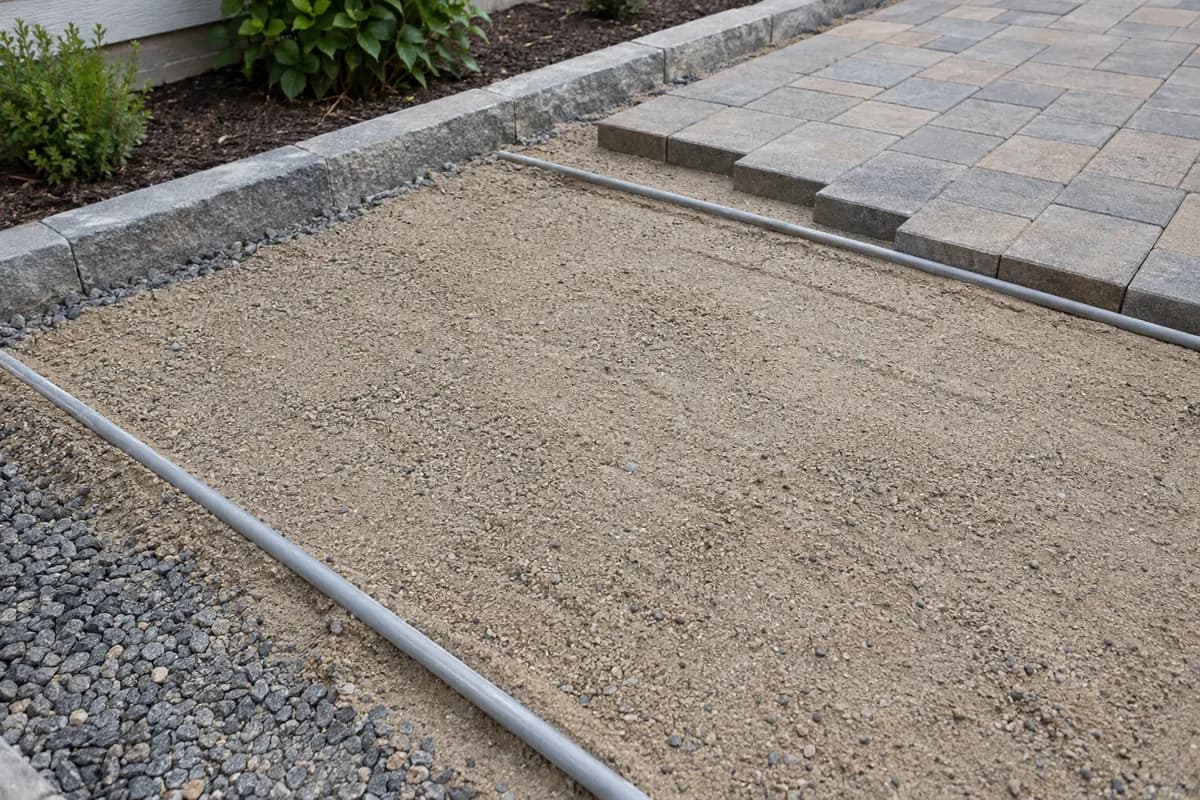
The tan to gray grains screed well too. Set two straight pipes on the compacted base, pour sand between them, and drag a straight board across the pipes. Coarse sand holds the line the board leaves without slumping. Pull the pipes, fill the grooves with a trowel, and the bed is ready. Stay off the screeded sand, because each footprint leaves a dip that shows through the finished patio.[1]
Edges hold the bed in place. Without a plastic, aluminum or concrete edge restraint, the sand slowly creeps out from under the outer row, and the border pavers drop. Spike the edging into the base before you lay the sand, and the bed stays put for the life of the patio.[1]
Most installers keep the coarse sand for the bed and use a finer product for the joints. Narrow joints need small grains that pack tight, and polymeric joint sand hardens once wet, which slows weeds and ants. Coarse Concrete Sand swept into joints works in a pinch, but it washes out faster on a busy patio.[1]
Worth considering
Mason Sand is finer and smoother, made for mortar and for a soft feel underfoot. It wins as a joint sand swept between pavers, where small grains fill narrow gaps. It is a poor choice for the bed itself, because its fine, rounded grains hold water and shift under load.[1]
Fill Sand is unwashed sand with a mix of grain sizes and some silt or clay. It wins below the base, where a low corner of the yard needs raising before the stone goes down. Spread it in thin layers and compact each one. Keep it out of the bedding layer, where those fines would trap water right under the pavers.[1]
Playground Sand is washed and screened for softness and a clean look. It is made for sandboxes and play areas. Under pavers it behaves much like Mason Sand, fine enough to drift and slow to drain, so leave it for the kids and the sandbox.[1]



How much to order
The sand bed under pavers is thin, about 1 inch once screeded, so the sand order is small next to the stone base. At 2 inches, 100 square feet takes about 0.83 tons of Concrete Sand, and a 1 inch bed over the same area needs roughly half that. Allow a little extra, since some sand fills low spots in the base and some goes into joints.[1]
Measure the patio length and width and multiply them to get square feet. Divide by 100 to count the number of 100 square foot blocks, then multiply by the tonnage for your depth. Add a margin for the edges, the screed grooves and spill around the pile.[1]
Some jobs use a thicker sand layer. A flagstone walk set in sand, a level pad under a hot tub cover or a shed floor on firm ground can call for more depth. At 3 inches, 100 square feet takes about 1.25 tons. At 4 inches it takes about 1.67 tons, and at 6 inches about 2.50 tons. For a driveway or anything a car drives on, use crushed stone base for the bulk of the depth and keep the sand as the thin top bed.[1]
Plan the base stone and the bedding sand as one job, so both piles are on site before the pavers arrive. Keep the sand pile covered with a tarp until you need it, which keeps it at an even moisture and stops rain from washing it into the lawn.[1]
| Project size | 3 inch depth | 4 inch depth |
|---|---|---|
| 100 sq ft | 0.9 cu yd / 1.3 tons | 1.2 cu yd / 1.7 tons |
| 300 sq ft | 2.8 cu yd / 3.8 tons | 3.7 cu yd / 5.0 tons |
| 600 sq ft | 5.6 cu yd / 7.5 tons | 7.4 cu yd / 10.0 tons |
Top picks side by side
| Material | Spec | Fit and price |
|---|---|---|
| Concrete SandTop pick | Coarse, tan to gray, 2,700 lb/yd³, by the ton | from $415 delivered, 2 tons |
| Mason Sand | Fine, tan, 2,700 lb/yd³, by the ton | from $418 delivered, 2 tons |
| Fill Sand | Unscreened, tan, 2,700 lb/yd³, by the ton | from $416 delivered, 2 tons |
| Playground Sand | Fine, washed, light tan, 2,700 lb/yd³, by the ton | from $415 delivered, 2 tons |
Verdict
Concrete Sand is the best sand for the bedding layer under pavers. Its coarse, sharp grains compact into a firm bed, pass the water that seeps through the joints and hold a screeded line. The tan to gray color never shows once the pavers are down.[1]
Use Mason Sand for joints, Fill Sand only for raising grade below the base, and Playground Sand for play areas. Put the strength of the patio in a compacted crushed stone base, and let a thin bed of Concrete Sand do the leveling.[1]
A patio built this way can be lifted and relaid. If a tree root pushes up a section or a utility line needs digging, the pavers come up, the coarse sand gets raked flat again, and the same stones go back down. That repair is one more reason a loose, well drained bed beats a mortar setting for most home patios.[1]
Get a delivered quote for Concrete Sand
Tell us your project and we price Concrete Sand delivered to your ZIP, no obligation.
Frequently Asked Questions
How thick should the sand be under pavers?
Aim for a bed of about 1 inch after screeding. A thinner bed may not cover the bumps in the base, and a thicker one can shift and settle unevenly. If the base has low spots, fix them with more stone and compaction rather than extra sand, since a deep sand layer is the most common reason pavers sink over time.
Can I use Mason Sand instead of Concrete Sand for the bed?
Keep Mason Sand for the joints. Its fine, smooth grains pack nicely into narrow gaps but hold water and slide under load when used as the bed. Coarse Concrete Sand has sharper grains that lock together under the compactor, so the pavers stay level longer.
Do I need to compact the sand?
Do not compact the sand on its own before laying pavers. Screed it loose and level, set the pavers, then run a plate compactor over them with a protective pad. The vibration pushes each paver into the sand and locks the coarse grains together. After that, sweep joint sand in and compact once more.
Should the sand be wet when I screed it?
Slightly damp sand screeds best because it holds the line of the board. Dry sand can flow, and soaked sand can slump. If a load arrives wet after rain, spread part of it out to drain for a while. Cover the pile with a tarp overnight to keep it near the right moisture.
What goes under the sand?
A compacted crushed stone base, laid in thin lifts and packed with a plate compactor. The base carries the load and the sand only levels the pavers. Road Base or a similar crushed stone with fines works well, laid over native soil that has been scraped and compacted, with fabric between them on soft or clay ground.