
Use case
Paver Base: Material Guide
Pavers look like the star of a patio, but the stone underneath decides whether it stays flat. A good paver base spreads weight, drains water and resists frost movement for years. This guide covers which stone to put under pavers, how to build and level the layers, how much to order and the faults that lead to sunken or rocking pavers.
Best materials for a paver base
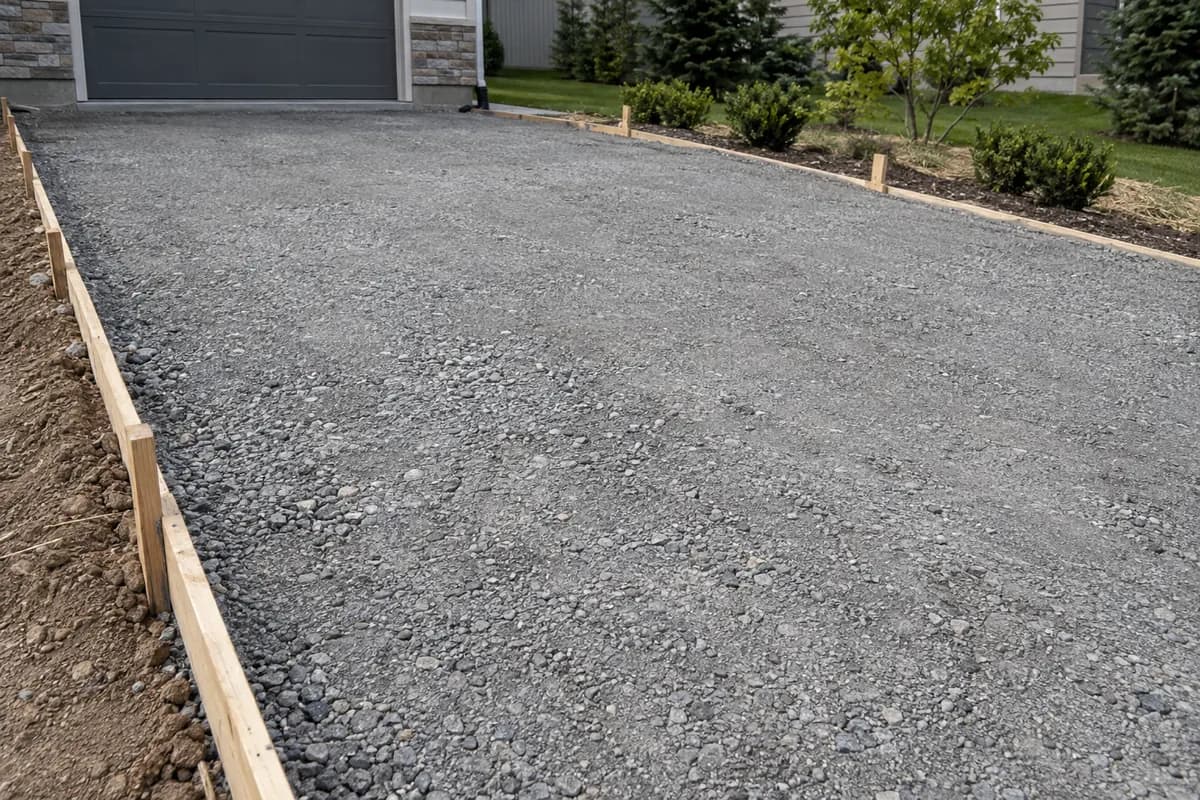
Road Base is the standard paver base. It is gray crushed stone graded 3/4 inch minus, so the coarse pieces come mixed with smaller chips and fine dust. When dampened and compacted, those sizes fill one another's gaps and form a dense, solid slab of stone under the paving.[1]
Stone Dust Screenings form the thin layer right under the pavers in many builds. The fine crushed particles screed flat with a straight board, giving each paver an even seat. Screenings sit on top of the Road Base, never in place of it, because they lack the coarse stone to carry loads alone.[1]
Concrete Sand is the other common setting bed. Its coarse, sharp grains drain better than screenings and are easy to screed. Many installers prefer it under patio pavers, where good drainage at the paver joint level matters most.[1]
Driveway Gravel is a clean, washed stone with no fines. It drains well but will not pack into a solid pad, so it is better as the top of a gravel drive than as a paver base. Under pavers it lets the setting bed wash down into its gaps over time.[1]
 From$4152 ton delivered
Road Base
Drainage and Base- Size
- 3/4 inch minus
- Weight
- 2,800 lb/yd³
- Color
- Gray
 From$4262 ton delivered
Driveway Gravel
Driveway and Landscaping- Size
- 3/4 inch clean crushed
- Weight
- 2,700 lb/yd³
- Color
- Gray
 From$4462 ton delivered
Stone Dust Screenings
Drainage and Base- Size
- 1/4 inch and fines
- Weight
- 2,800 lb/yd³
- Color
- Gray
What a paver base needs in a material
It needs a full range of sizes. A paver base works because large stones form the frame, smaller chips fill the spaces, and fines fill what is left. The 3/4 inch minus grading in Road Base supplies that whole range in one product.[1]
It needs to drain without washing out. Water that seeps through paver joints has to move down and away. A dense crushed base lets that water pass slowly while the fines stay locked between the larger stones. A base made of soil or loose sand holds water and softens, which is when pavers start to rock.[1]
It needs angular pieces. Crushed faces bite into one another during compaction, so the base resists the sideways push of feet, furniture and car tires on the pavers above. Rounded gravel of the same size would roll and let the paving drift out of line.[1]
It needs weight and density. A cubic yard of Road Base weighs about 2,800 lb, heavier than clean stone of similar size, because the fines fill the air spaces. That density is what stops the base from settling once the pavers go down.[1]
It should be easy to check. A uniform gray surface makes low spots, soft pockets and loose stone easy to see when you sight down a string line. A good base looks even in color and feels hard enough that a heel leaves no print.[1]
How to install a paver base
Mark out the area a little larger than the finished paving, so the base extends past the edge restraint. Dig out sod and topsoil down to firm soil. The depth of the dig equals the base thickness, plus the setting bed, plus the thickness of the pavers.[1]
Grade the bottom of the dig to the same fall you want on the finished surface, sloping away from the house. Compact the soil with a plate compactor. On clay or soft ground, lay a geotextile fabric over the soil before any stone goes in.[1]
Spread the Road Base in lifts of a few inches at a time. Mist each lift with a hose so the fines can move between the larger stones, then make several crossing passes with the compactor. Repeat until the base reaches its full depth, checking the slope with string lines as you go.[1]
Spread a thin, even setting bed of Concrete Sand or Stone Dust Screenings over the hard gray base. Screed it flat over pipes or rails and do not walk on it once screeded. Lay the pavers on that bed, set the edge restraint, sweep sand into the joints and run the compactor over the pavers with a pad to seat them.[1]
How much paver base do you need
A walkway or patio for foot traffic on firm ground can be built on 4 inches of compacted Road Base. At that depth, 100 square feet takes about 1.73 tons.[1]
A patio with heavy furniture, a hot tub nearby or soft ground underneath needs more. At 6 inches, 100 square feet takes about 2.59 tons. Driveways paved with pavers need a deeper base than that, built in several lifts.[1]
Shallower depths are for leveling and repair. At 2 inches, 100 square feet takes about 0.86 tons, enough to fix a low corner of an old base. A 3 inch layer takes about 1.30 tons per 100 square feet and fits a garden path on firm soil.[1]
For the order, find the area, add a margin around the edges, divide by 100 and multiply by the tons for your depth. Road Base is sold by the ton. Order the setting bed separately. The calculator on the site turns the patio size into tons of base.[1]
| Project size | 3 inch depth | 4 inch depth |
|---|---|---|
| 100 sq ft | 0.9 cu yd / 1.3 tons | 1.2 cu yd / 1.7 tons |
| 300 sq ft | 2.8 cu yd / 3.9 tons | 3.7 cu yd / 5.2 tons |
| 600 sq ft | 5.6 cu yd / 7.8 tons | 7.4 cu yd / 10.4 tons |
What paver base costs
Road Base is sold by the ton and delivered by dump truck. The delivered total depends on how many tons the job needs, how far the stone travels and how close the truck can tip the load to your work area.[1]
Base stone is heavy, so a paver project uses more tons than people expect. Ordering the setting bed and any joint material on the same trip keeps deliveries down.[1]
The ground under the patio sets the depth, and the depth sets the order. Firm, sandy soil needs a thinner base than wet clay, so a test dig before ordering can save stone.[1]
Enter your ZIP in the box on the site to see the delivered figure for your area.[1]
Delivered, 2 tons: from $415 to $676 depending on the city (366 cities priced). Enter your ZIP for the exact figure.
Paver base mistakes to avoid
Using sand as the whole base is the most common fault. Sand alone shifts and washes out, and pavers sink in patches. Use compacted Road Base, then a thin sand or screenings bed on top.[1]
Compacting the full depth in one go leaves the bottom loose. A compactor packs only the top few inches of a layer. Build in lifts and pack each one.[1]
Making the setting bed too thick lets pavers settle unevenly. Keep that bed thin and let the compacted base do the structural work.[1]
Skipping the slope does slower damage. A patio laid dead level holds water on its surface, and that water soaks the joints and the base. A gentle fall away from the house, set in the soil and carried up through every layer, keeps the paving dry.[1]
Stopping the base at the edge of the pavers lets the border tip outward. Run the base past the edge restraint so the outer row has firm stone beneath and beside it.[1]
Coverage
Browse more
FAQ for paver base
What is the best base for pavers?
Road Base is our first choice. It is gray crushed stone graded 3/4 inch minus, and its blend of coarse and fine pieces packs into a dense, hard layer. Over it, use a thin setting bed of Concrete Sand or Stone Dust Screenings to seat the pavers evenly.
How thick should a paver base be?
A foot traffic patio on firm soil is commonly built on 4 inches of compacted Road Base, about 1.73 tons per 100 square feet. Soft ground and heavy loads call for 6 inches or more, about 2.59 tons per 100 square feet at 6 inches. Pavers under cars need a deeper base still.
Can I lay pavers on sand only?
Sand alone is not a stable base. It moves under load, washes out at the edges and lets pavers sink unevenly. Sand works as a thin setting bed on top of a compacted crushed stone base, where it gives each paver a flat seat while the stone below carries the weight.
Should I put fabric under a paver base?
On clay or soft soil, fabric under the base is a good idea. It keeps the stone from pushing down into the soil and keeps fines from the ground mixing upward. On firm, sandy or gravelly soil, many patios are built without it.
How long should paver base settle before laying pavers?
A base compacted properly in lifts does not need to sit. Once the final lift is hard and checked with a string line, you can screed the setting bed and lay pavers right away. Skipping the lifts and hoping the base settles on its own leads to dips later.