
Use case
Crusher Run: Material Guide
Crusher run is the stone that comes straight off the crusher with the dust left in. That mix of chunks and fines packs into a near-solid floor for drives, pads and walkways. Gravel Valet ships it as Road Base, a gray 3/4 inch minus blend. Here is what it does well, where a different stone fits better, and how much to order.
Best materials for crusher run work
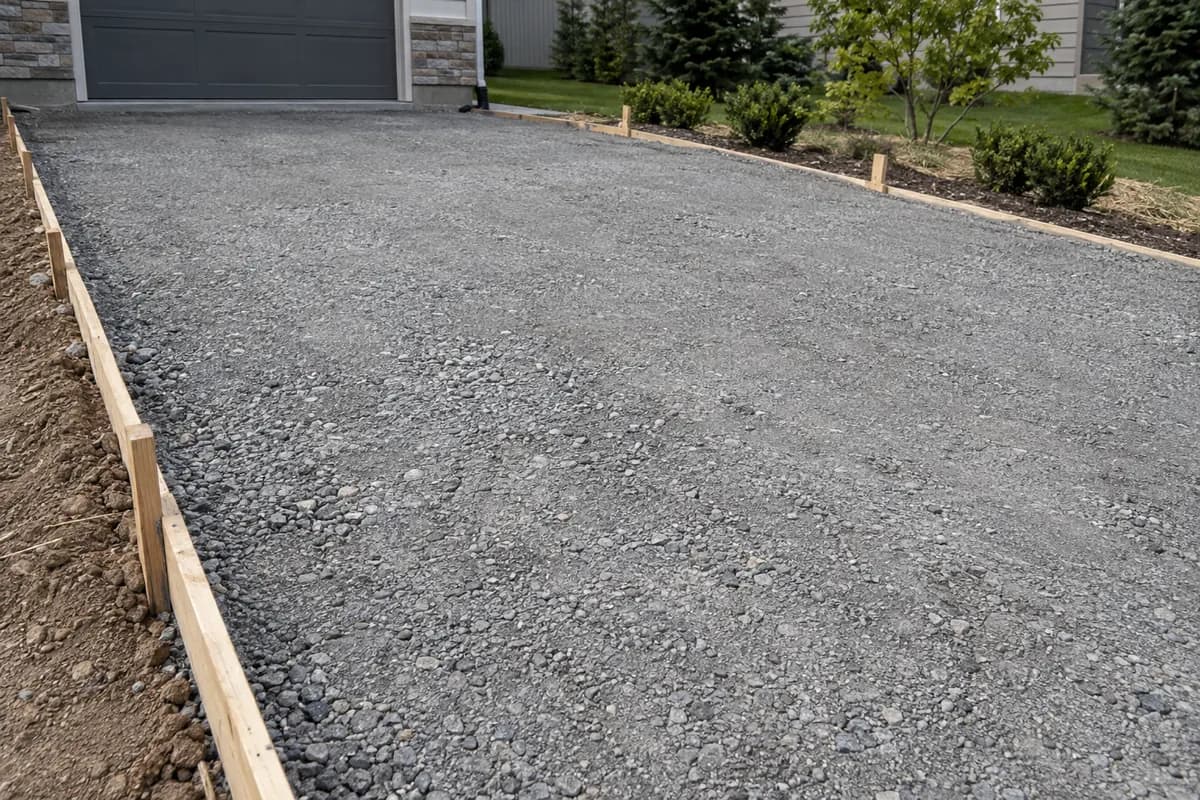
Crusher run earned its name from the way it is made. Rock passes through the crusher, the oversize gets screened off, and whatever falls through stays together, from 3/4 inch pieces down to powder. Gravel Valet sells that product as Road Base. The gray color and the gritty texture are what you see when a contractor builds the bottom of a new drive.[1]
Use crusher run anywhere the surface has to stay firm and flat under weight. Typical jobs are driveway bases, parking areas, the pad under a prefab garage, a level floor for a greenhouse, and the base under concrete pavers. Contractors also use it to backfill around a culvert or to build up a low yard before a slab.[1]
Driveway Gravel works best on top of it. A packed crusher run layer gives a drive its strength, and a clean stone over it gives tires something to grip in rain. On a steep drive, the clean top also keeps water from carrying fines downhill.[1]
Stone Dust Screenings belong in a thin setting bed. Pavers and flagstones sit on a level layer of screenings, and that layer rests on compacted crusher run. Each product does one task, and the patio stays flat for years.[1]
 From$4152 ton delivered
Road Base
Drainage and Base- Size
- 3/4 inch minus
- Weight
- 2,800 lb/yd³
- Color
- Gray
 From$4262 ton delivered
Driveway Gravel
Driveway and Landscaping- Size
- 3/4 inch clean crushed
- Weight
- 2,700 lb/yd³
- Color
- Gray
 From$4462 ton delivered
Stone Dust Screenings
Drainage and Base- Size
- 1/4 inch and fines
- Weight
- 2,800 lb/yd³
- Color
- Gray
What crusher run needs in a material
The range of sizes makes it pack. Big pieces form a frame, and the small grains slip into the spaces that frame leaves. When that mix is pressed while damp, the voids nearly vanish. A single-size stone always keeps its gaps, so it never reaches the same density.[1]
Fines are part of the product. Some buyers see dust on a load and assume it is dirty, but in crusher run those fines are the binder. A 3/4 inch minus blend with too little dust stays loose, and one with soil or clay mixed in turns to mud. Rock dust from crushing packs and drains in a way soil does not.[1]
Mass keeps the layer in place. At about 2,800 lb per cubic yard, Road Base is among the heavier stones on a truck. That weight, plus the tight pack, means the surface does not wash out in a normal storm and does not shift under a car parked in the same spot every night.[1]
A neutral color helps where the stone stays visible. The gray tone of this product sits quietly next to lawns, gravel shoulders and concrete, so an exposed edge or a crusher run parking strip does not look out of place.[1]
How to install crusher run
Mark the area and dig. Use paint or stakes to outline the pad or drive, then cut away grass and topsoil until the shovel hits firm subsoil. Save clean topsoil for the shoulders or a garden bed. Shape the bottom of the excavation so water will leave it.[1]
Firm the soil before the stone. A plate compactor on the bare subgrade shows soft spots, which squeeze out or bounce under the machine. Dig those spots out and refill them. Clay that stays wet does better with a woven fabric laid on top before the first load of stone.[1]
Bring the stone in and spread it. A dump truck can tailgate the load in a strip, or drop it in one pile for a smaller pad. Spread with a tractor box blade, a skid steer or a landscape rake. Keep each loose lift near 3 to 4 inches so the compactor can pack it all the way through.[1]
Wet, then compact. Mist the lift with a hose or sprinkler until the fines darken, then run the compactor in rows, overlapping by half a plate. Change direction on the second pass. The surface is ready for the next lift when a boot heel barely dents it.[1]
Check grade as you go. A long level or a string line shows where the surface sags. Fill low spots before the final pass, and leave a gentle fall to one side so rain runs off. Edges hold better when the last lift extends a little past the planned line.[1]
How much crusher run do you need
A small paver walk on good soil needs only a thin base. Road Base at 2 inches deep takes about 0.86 tons for every 100 square feet, and 3 inches takes about 1.30 tons.[1]
For a patio base or a shed pad, 4 inches is a solid figure, at about 1.73 tons per 100 square feet. A drive base for daily cars runs deeper, and a 6 inch layer takes about 2.59 tons per 100 square feet.[1]
Here is a quick way to size the order. Find the square feet, divide by 100, then multiply by the tons for the depth. Add a margin for settling and for the edges of the dig. The figure you get is in tons, which matches how Road Base is sold.[1]
Mixed jobs need two numbers. If the drive gets 6 inches and the walkway beside it gets 3 inches, work each area out on its own and add the totals. The calculator on the site handles each shape for you.[1]
| Project size | 3 inch depth | 4 inch depth |
|---|---|---|
| 100 sq ft | 0.9 cu yd / 1.3 tons | 1.2 cu yd / 1.7 tons |
| 300 sq ft | 2.8 cu yd / 3.9 tons | 3.7 cu yd / 5.2 tons |
| 600 sq ft | 5.6 cu yd / 7.8 tons | 7.4 cu yd / 10.4 tons |
What crusher run costs
Crusher run is sold by the ton. What you pay comes down to the tons in the order and the distance and size of the truck that brings them. The stone is a common, simple product, so the haul matters about as much as the rock.[1]
Thickness drives the tonnage. A 6 inch base over a given area takes about three times the stone of a 2 inch layer. Choose the depth for the load and the soil, not for the lowest number, since a base that fails has to be dug out and redone.[1]
Batching helps. A full truck of crusher run spreads the haul over more tons. If you plan a drive now and a shed pad later, ordering both together makes better use of the delivery. The ZIP box on the site lists current delivered figures for your area.[1]
Delivered, 2 tons: from $415 to $676 depending on the city (366 cities priced). Enter your ZIP for the exact figure.
Crusher run mistakes to avoid
Leaving the topsoil in. Crusher run over black dirt or roots sinks as that layer rots and compresses. Strip the area to firm subsoil, even on a small pad.[1]
Dumping it all at once. A single deep pour packs only at the top. The bottom stays loose and settles later, which leaves dips in the surface. Spread and compact in lifts.[1]
Working it bone dry or soaking wet. Dry fines do not bind, and a flooded lift turns to slurry and pumps under the compactor. Aim for damp stone that holds together when squeezed in a fist.[1]
Treating it as a drainage stone. Crusher run sheds water off its surface but lets little through. Under a dry well, around a pipe or in a French drain, use a clean stone instead. Keep crusher run where you need a firm floor.[1]
Building the base too thin for the load. A pickup or a delivery truck needs more depth than a garden path. Over soft soil, go for the 6 inch figure or more, in lifts.[1]
Coverage
Browse more
FAQ for crusher run
What is crusher run used for?
Crusher run is the standard base under gravel drives, parking pads, shed floors, patios and paver walks. It is also used to backfill around culverts and to raise low ground before a slab. Gravel Valet delivers it as Road Base, a gray 3/4 inch minus stone that packs firm when wet and compacted.
Is crusher run the same as road base?
Yes, in the Gravel Valet catalog. The two names describe crushed rock left with its fines, graded 3/4 inch minus. You may also hear it called dense grade aggregate or by a regional class number. Any of those names brings the same gray stone to your site.
Does crusher run harden like concrete?
It does not set the way concrete does, but a damp, well compacted layer becomes hard and stiff. Traffic and rain press it tighter over the first season. Dig into an old crusher run base and you will need a pick bar to break it.
Can I put crusher run on top of dirt?
You can, as long as the dirt is firm subsoil and not topsoil. Strip grass and dark soil first, compact the subgrade, and lay fabric if the ground is soft clay. Spreading crusher run straight onto lawn soil leads to sinking and ruts.
How many tons of crusher run for 100 square feet?
At 4 inches deep, plan on about 1.73 tons of Road Base per 100 square feet. At 6 inches the figure is about 2.59 tons. Add a margin for compaction and for uneven ground, and round up to whole tons when you order.
Should crusher run be wet before compacting?
Yes. Damp crusher run packs tighter, because the water helps the fines slide into the gaps between the larger stones. Mist each lift with a hose until the surface darkens, then compact. Avoid flooding it, since a soaked lift turns soft and pumps.