
Use case
Class Five Base: Material Guide
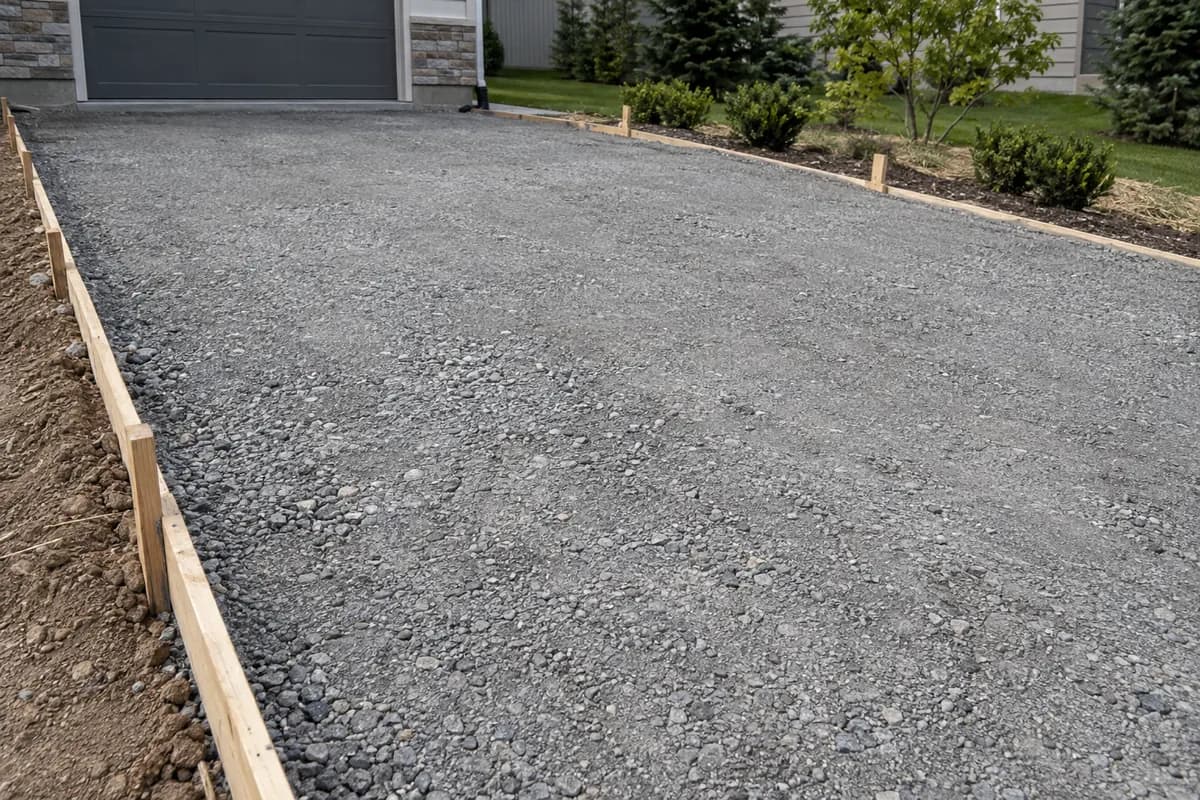
Class Five base is the packed layer that sits under driveways, parking pads, sheds and patios. It is crushed gray rock graded from 3/4 inch down to fine dust, and it turns hard when it is dampened and rolled. This guide covers the right material, the build steps, the tons for each depth and the errors that make a base fail.
Best materials for Class Five base
Class Five base is a trade name for a graded crushed aggregate that mixes stone and fines. Gravel Valet supplies it as Road Base: crushed rock screened to 3/4 inch minus, gray in color, with every size from that top stone down to dust. The blend is what makes it work. Coarse pieces carry the load, and the fine material fills the gaps between them so the layer packs into a hard, tight slab.[1]
Driveway Gravel is the partner material for the job. It is a clean stone with the fines screened out, so it stays loose and drains at the surface. Plenty of gravel drives use a compacted Class Five layer below and a thin cap of Driveway Gravel on top. The base gives strength, and the cap gives traction and a finished look.[1]
Stone Dust Screenings are the fines on their own, with no coarse stone. They pack flat and smooth, which suits a setting bed under pavers or flagstone. Used alone as a driveway base they lack the larger pieces that spread a wheel load, so they belong in a thin top layer over Class Five base and never in place of it.[1]
For a firm, load-bearing layer under something else, Class Five base is the right first choice. That covers driveways, parking pads, shed and garage slabs, patio and walkway subbases, and the floor of a pole barn. The 3/4 inch minus grading is small enough to spread and level by hand on a home project and coarse enough to hold up under a loaded truck.[1]
 From$4152 ton delivered
Road Base
Drainage and Base- Size
- 3/4 inch minus
- Weight
- 2,800 lb/yd³
- Color
- Gray
 From$4262 ton delivered
Driveway Gravel
Driveway and Landscaping- Size
- 3/4 inch clean crushed
- Weight
- 2,700 lb/yd³
- Color
- Gray
 From$4462 ton delivered
Stone Dust Screenings
Drainage and Base- Size
- 1/4 inch and fines
- Weight
- 2,800 lb/yd³
- Color
- Gray
What Class Five base needs in a material
A base layer must compact. Loose stone shifts under each tire and slowly ruts. Wet a graded mix with fines and roll it, and the particles press into each other until the finished layer behaves like one piece. A clean stone with no fines never reaches that state, however long you run the compactor.[1]
The stone must be crushed. Broken faces and sharp edges catch on each other, which keeps the layer from sliding sideways under a turning wheel. Rounded gravel of the same size rolls instead of locking, and a base made from it stays soft. Class Five base gets its strength from angular rock.[1]
Weight shapes how the layer behaves and how you plan the order. Road Base weighs about 2,800 lb per cubic yard, heavier than clean stone of a similar size because the fines fill the air spaces. That density is part of why it packs so firmly. A small pile in the driveway therefore holds more tons than it looks.[1]
Color is a minor point for a buried layer, but it shows at the edges. The gray stone reads as plain and neutral next to concrete, asphalt and most house siding. Where the base will be the finished surface, such as a work yard or farm lane, that gray hides dust and tire marks well.[1]
How to install Class Five base
Start with the ground. Strip the sod, roots and dark topsoil from the whole area, since organic soil keeps settling as it rots. Dig down until you reach firm mineral soil, then shape the bottom so it slopes slightly away from buildings. Compact that subgrade with a plate compactor or roller before any stone goes down.[1]
On soft clay or wet ground, roll out a woven geotextile over the subgrade. The fabric keeps the fines in Class Five base from pushing down into the mud and keeps mud from pumping up into the stone. Overlap the seams and run the fabric up past the edges of the dig.[1]
Spread the base in lifts. Dump the stone in piles along the area, then spread each lift to an even depth with a skid steer, a tractor blade or a rake. Loose lifts of about 3 to 4 inches pack better than one thick pour, because the compactor can reach the bottom of a thin layer.[1]
Water each lift until it is damp but not soupy, then compact it with several overlapping passes. The moisture lets the fines slide into the gaps and bind. A well-packed lift shows only faint marks when you walk across it. Repeat the spread, wet and compact cycle until you reach the planned depth.[1]
Finish with a crown or a cross slope so rain runs to the sides. On a driveway, add a thin cap of Driveway Gravel, or leave the compacted base as the surface for a utility area. Walk the surface after the first heavy rain and fill any low spots while the layer is still settling.[1]
How much Class Five base do you need
Order by area and depth. Road Base needed for 100 square feet is about 0.86 tons at 2 inches deep and about 1.30 tons at 3 inches deep. Those shallow depths suit a subbase under pavers or a walkway, where the load is light.[1]
At 4 inches, 100 square feet takes about 1.73 tons. That depth works for a shed pad or a patio subbase on firm soil, and for a drive over well drained ground that will get a separate surface layer.[1]
A driveway or parking pad for cars and light trucks wants a deeper base, and 6 inches takes about 2.59 tons per 100 square feet. Soft soil, heavy vehicles or frequent turning call for a thicker layer still, built up in more lifts.[1]
To work it out, multiply length by width for square feet, divide by 100, and multiply by the tons for your depth. Add a margin, because the stone packs down and the edges always take more than the plan shows. Road Base is sold by the ton, so take the total up to the next whole ton. The area calculator on the site does the arithmetic for any shape.[1]
| Project size | 3 inch depth | 4 inch depth |
|---|---|---|
| 100 sq ft | 0.9 cu yd / 1.3 tons | 1.2 cu yd / 1.7 tons |
| 300 sq ft | 2.8 cu yd / 3.9 tons | 3.7 cu yd / 5.2 tons |
| 600 sq ft | 5.6 cu yd / 7.8 tons | 7.4 cu yd / 10.4 tons |
What Class Five base costs
Class Five base is sold by the ton and arrives in a dump truck. Your delivered total comes from the tons you order and the trip to bring them. The material is a plain crushed product, so tonnage and hauling decide most of the bill.[1]
Depth drives tonnage faster than many buyers expect. Going from 4 inches to 6 inches over the same area adds about half again to the order. Settling the right depth before you order keeps you from paying for a second truck later.[1]
Load size counts as well. A full truck spreads the hauling over more tons, while a small top-up order carries the same trip for less stone. If a driveway and a shed pad are both on the list, ordering the base for both at once gets more out of one delivery.[1]
Site access shapes the job too. A truck that can back up and spread the stone in a line along the drive saves hours of moving piles by hand. Mark the drop spot, clear low branches and keep cars out of the path on delivery day. The ZIP box on the site shows the current delivered figures for your address.[1]
Delivered, 2 tons: from $415 to $676 depending on the city (366 cities priced). Enter your ZIP for the exact figure.
Class Five base mistakes to avoid
Skipping the excavation is the first. Laying stone straight on sod or topsoil traps organic matter under the base, and the surface sinks as that layer breaks down. Dig to firm mineral soil, even if it means a few extra loads of spoil to haul off.[1]
Placing the stone dry is the second. Class Five base that goes down bone dry will not pack, and it can look firm until the first rain softens it. Keep a hose running ahead of the compactor so each lift stays damp.[1]
Using clean stone as the base is the third. A layer of open stone with no fines drains well but never locks, so a drive built on it ruts and spreads at the edges. Keep clean stone for the top cap or for drainage trenches, and use the graded 3/4 inch minus mix where you need strength.[1]
Building it too thin is the fourth. A thin base over soft soil flexes under each wheel and breaks up. Match the depth to the load and the ground, and pick the deeper option when the soil is in doubt.[1]
Forgetting drainage is the last. Water that sits on or beside a base softens the subgrade underneath it. Slope the surface, keep the finished edge a little above the lawn, and give roof and yard water a path around the drive.[1]
Coverage
Browse more
FAQ for class 5 base
What is Class Five base made of?
It is crushed rock blended with its own fines. Gravel Valet delivers it as Road Base, graded 3/4 inch minus, which means the largest pieces are about 3/4 inch and everything smaller down to dust stays in the mix. The fines are what let it pack into a firm layer once it is damp and compacted.
Is Class Five base the same as crusher run?
The two names describe a similar graded crushed aggregate with fines, and both pack into a hard base. Names change from one area to the next. Gravel Valet fills both orders with Road Base at 3/4 inch minus, so a Class Five order and a crusher run order bring the same gray product to your drive.
Can Class Five base be the top layer of a driveway?
Yes. Many farm lanes, work yards and rural drives use compacted Road Base as the finished surface. It packs hard and sheds water when it is crowned. The trade is some dust in dry spells and a few loose fines after rain. A thin cap of Driveway Gravel gives a cleaner surface and better grip.
How deep should Class Five base be under pavers?
Under a patio or a walkway for foot traffic, a compacted base of about 4 inches on firm soil is a sound choice, with a thin setting bed of Stone Dust Screenings on top. At that depth, 100 square feet takes about 1.73 tons of Road Base. Go deeper on soft ground or under a paver driveway.
Does Class Five base drain?
It drains slower than clean stone, because the fines fill most of the open space. That is on purpose: a tight base keeps water at the surface, where a crown or slope can move it off. Where you need water to soak down through the stone, a clean stone such as Driveway Gravel is the better pick.
How much area does a ton of Class Five base cover?
At 2 inches deep, one ton of Road Base covers a little more than 100 square feet, since that area takes about 0.86 tons. At 4 inches deep a ton covers a bit more than half that area. The area calculator gives an exact tonnage for your shape and depth.