
Use case
Erosion Control Rock: Material Guide
Running water carries soil away one storm at a time, from a ditch edge, a pond bank or the slope below a downspout. Erosion control rock armors that ground. The product for it is Riprap, a gray stone from 6 to 12 inches in size. This guide covers where it works, how to place it, how thick the layer should be and how much to order.
Best materials for erosion control
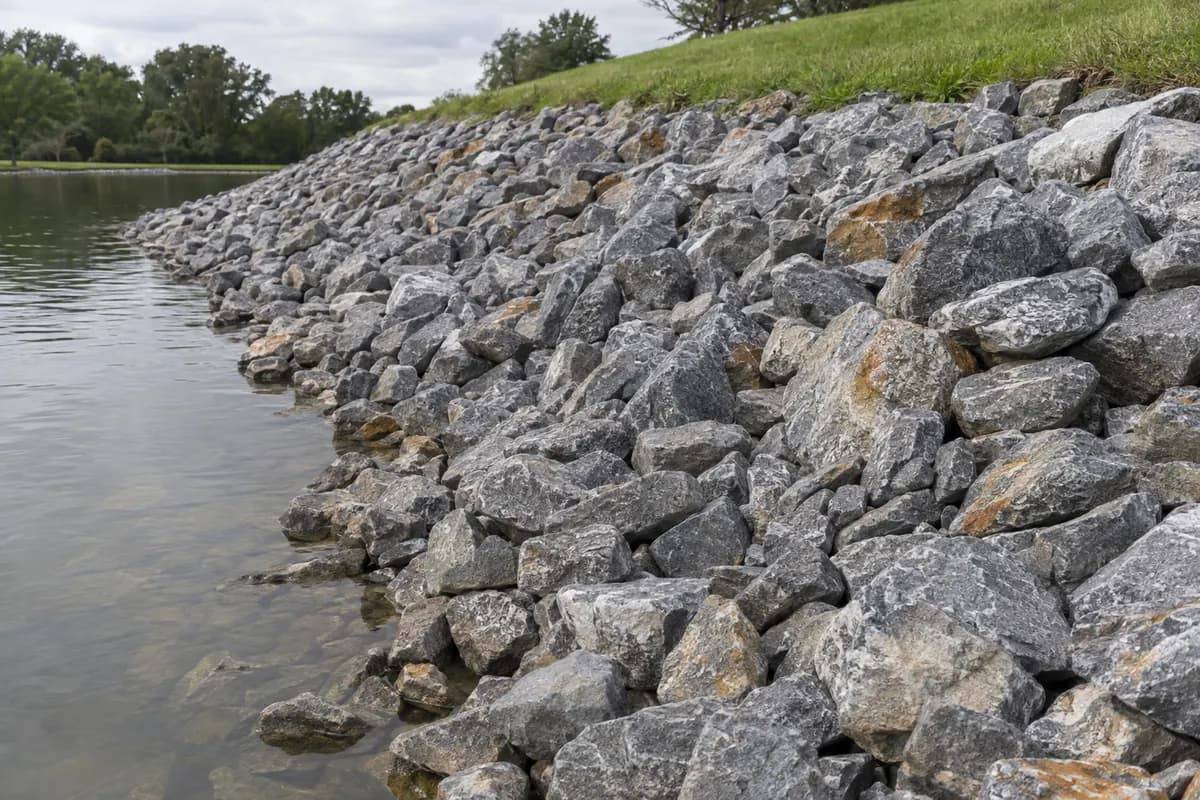
Riprap is the stone for this job. Its stones measure from 6 to 12 inches, gray, broken from solid rock with rough angular faces. Each stone is too heavy for normal runoff to roll, and together they form a rough blanket that slows water and spreads its force before it reaches the soil.[1]
Riprap fits places where water moves fast or hits hard. Common jobs are the outfall of a culvert or a drain pipe, the banks of a drainage ditch, the edge of a pond where waves lap the shore, a swale that carries yard runoff, and a steep cut slope beside a driveway.[1]
Smaller stones lack the weight for this work. A clean drainage stone or a decorative gravel washes out of a ditch in the first big storm, because each piece is light enough for moving water to lift. Erosion control depends on mass, and the larger pieces in a Riprap load supply it.[1]
The range of sizes helps too. A load with stones from the small to the large end of the range fills in better than stones that are all one size. Smaller pieces wedge into the gaps between bigger ones and lock the layer so it does not slide down the bank.[1]
 From$4432 ton delivered
Riprap
Drainage and Base- Size
- 6 to 12 inches
- Weight
- 2,700 lb/yd³
- Color
- Gray
 From$4242 ton delivered
#57 Crushed Stone
Gravel and Crushed Stone- Size
- 3/4 to 1 inch
- Weight
- 2,700 lb/yd³
- Color
- Gray
 From$4372 ton delivered
#67 Stone
Gravel and Crushed Stone- Size
- 3/4 inch and under
- Weight
- 2,700 lb/yd³
- Color
- Gray
 From$4252 ton delivered
#89 Crushed Stone
Gravel and Crushed Stone- Size
- 3/8 inch
- Weight
- 2,700 lb/yd³
- Color
- Gray
What erosion control needs in a material
Weight is the first need. Riprap weighs about 2,700 lb per cubic yard, and each large stone on its own is heavy enough that runoff from a yard or a road ditch flows around it rather than moving it. Heavier stone holds against faster water.[1]
Rough, angular shape comes next. Broken faces catch on each other and on the ground, so the stones interlock on a slope. Rounded field stone of the same size rolls downhill under its own weight and a flood can push it out.[1]
The rock has to be hard. Erosion control stone sits in wet and dry cycles and freezing water for decades. Sound crushed rock does not split or crumble. Soft rock that flakes in water shrinks over time and leaves the soil exposed.[1]
The stone needs a filter layer under it. Water passes through the gaps between large stones and can pull soil out from under them. A heavy non-woven fabric or a layer of smaller crushed stone under the Riprap keeps the soil in place while still letting water drain out.[1]
How to install erosion control rock
Shape the ground. Cut the bank or ditch to a smooth, even slope and remove roots, loose soil and debris. A gentle slope holds stone better than a steep one. Key the bottom edge by digging a trench at the toe, so the lowest row of stone sits below the ground line and cannot be undercut.[1]
Lay the filter. Roll heavy geotextile up the slope from the toe, overlap each strip by a wide margin with the upper strip on top, and pin it down. On a culvert outlet, run the fabric from under the pipe end out to where the water spreads.[1]
Place the stone with care. Set the largest stones first, along the toe trench and on the outer edge of the area, then fill toward the middle. Lower stones from a bucket or set them by hand rather than dropping them from height, which tears fabric and leaves gaps.[1]
Fill the gaps. Tuck the smaller pieces of the load into holes between the large stones so the surface is even and locked. Step back and look for any spot where fabric shows or a stone rocks under a boot, and fix it before you finish.[1]
Blend the edges. Where the rock meets lawn or a planting area, taper the layer and bury the edge stones partly into the soil. Water running along the edge of a stone blanket can cut a new channel if the transition is abrupt.[1]
How much erosion control rock do you need
Riprap is laid much thicker than surface gravel. A sound rule is to build the layer at least as thick as the largest stones, and thicker on a steep bank or where water hits hard. With stones up to 12 inches, that means a blanket of a foot or more.[1]
Use the 6 inch figure as your building block. Every 6 inches of Riprap thickness over 100 square feet takes about 2.50 tons. A layer twice that thick takes twice the stone, and so on for each further 6 inches.[1]
Measure the real surface, not the flat footprint. A bank slope has more area than its plan view shows. Run a tape down the face of the slope from the top to the toe and multiply by the length along the bank. Add the toe trench as its own area.[1]
Riprap is sold by the ton, so the order is easy to set once the area and thickness are known. Round up to cover the toe trench, the gaps and the larger stones that take more room than expected.[1]
| Project size | 3 inch depth | 4 inch depth |
|---|---|---|
| 100 sq ft | 0.9 cu yd / 1.3 tons | 1.2 cu yd / 1.7 tons |
| 300 sq ft | 2.8 cu yd / 3.8 tons | 3.7 cu yd / 5.0 tons |
| 600 sq ft | 5.6 cu yd / 7.5 tons | 7.4 cu yd / 10.0 tons |
What erosion control rock costs
Riprap is sold by the ton. Thick layers mean a lot of tons for a small area, so the total depends heavily on the thickness you plan. The trucking adds the rest. Large stone loads are heavy, and a truck carries fewer cubic yards of it before it hits its weight limit.[1]
Placement shapes the effort. Riprap does not spread with a rake. On a small job you can set the stone by hand with a pry bar and a strong back, while a long ditch or a pond bank goes much faster with a skid steer or an excavator. Plan the equipment before the stone arrives.[1]
Access matters most of all. A truck needs firm ground to get close to the bank. If the slope sits behind a house or across soft lawn, the load may have to be dumped at the drive and moved. The ZIP box on the site gives current delivered figures for your address.[1]
Delivered, 2 tons: from $443 to $737 depending on the city (366 cities priced). Enter your ZIP for the exact figure.
Erosion control mistakes to avoid
Laying stone on bare soil. Without fabric or a filter stone, water pulls soil out from between the rocks, and the whole layer sinks and slides. Always put a filter under the stone.[1]
Skipping the toe. Water attacks the base of a bank first. If the bottom row of Riprap sits on the surface, the current cuts under it and the slope fails from the bottom up. Bury the toe.[1]
Using stone that is too small. A layer of light rock looks fine until the first hard storm moves it downstream. Match the stone size to the flow, and use the larger end of the range where water is fastest.[1]
Building too thin. A single scattered row of stones leaves soil open between them. Build a full, locked layer at least as thick as the largest stones.[1]
Dropping stone from height. Riprap dropped off a truck bed onto a slope tears the fabric and rolls to the bottom. Set it in place, starting at the toe and working uphill.[1]
Coverage
Browse more
FAQ for erosion control rock
What size riprap do I need for erosion control?
For yard ditches, swales, pond edges and culvert outlets, a Riprap of 6 to 12 inches covers most home and farm jobs. Faster or deeper water needs heavier stone. Gravel Valet delivers this gray size range by the ton, with a mix of sizes inside each load to lock the layer.
Do I need fabric under riprap?
Yes. Water flows through the gaps between the stones and can carry soil out from below. A heavy non-woven fabric keeps the soil in place and lets the water drain. Without it, the stone settles and the bank keeps eroding under the rock.
How thick should a riprap layer be?
Build the layer at least as thick as the largest stones, and thicker on a steep slope or a fast channel. With stones up to 12 inches, plan on a foot or more. Every 6 inches of thickness over 100 square feet takes about 2.50 tons.
Can I place riprap by hand?
On a small bank or a culvert outlet, yes. Each stone is heavy, so wear gloves and boots, use a pry bar and work with a partner. Set the stones rather than dropping them. For a long ditch or a large slope, a skid steer or an excavator saves days.
Is riprap the same as drainage stone?
No. Drainage stone is a clean, smaller rock that lets water pass through a buried bed. Riprap is much larger stone set on the surface to take the force of moving water. One handles water underground, and the other armors the ground where water runs over it.