

The weight in numbers
Crushed Concrete comes to 2,600 lb a yard, which we list as 1.30 tons. Going the other way, a ton fills 0.77 of a yard.[1]
Set beside the stone it replaces, that is on the light side of the catalog. #57 Crushed Stone sits at 2,700 lb a yard and Road Base at 2,800 lb. The gap is small on one yard and useful across a whole job, because orders go by weight, and a lighter material gives you more volume for each ton.[1]
Old concrete is lighter than most solid rock for a simple reason. Cement paste has tiny air pockets through it, and the mix includes sand as well as stone.
Treat 2,600 lb as a planning figure. Recycled material varies with the slabs it came from, and rain adds weight to any pile.
What it is
Crushed Concrete starts life as old driveways, sidewalks, foundations and road panels, and the trade name is recycled concrete aggregate. Demolition crews break those up and haul them to a crushing plant, where magnets pull out most of the steel and machines reduce the rest to size.
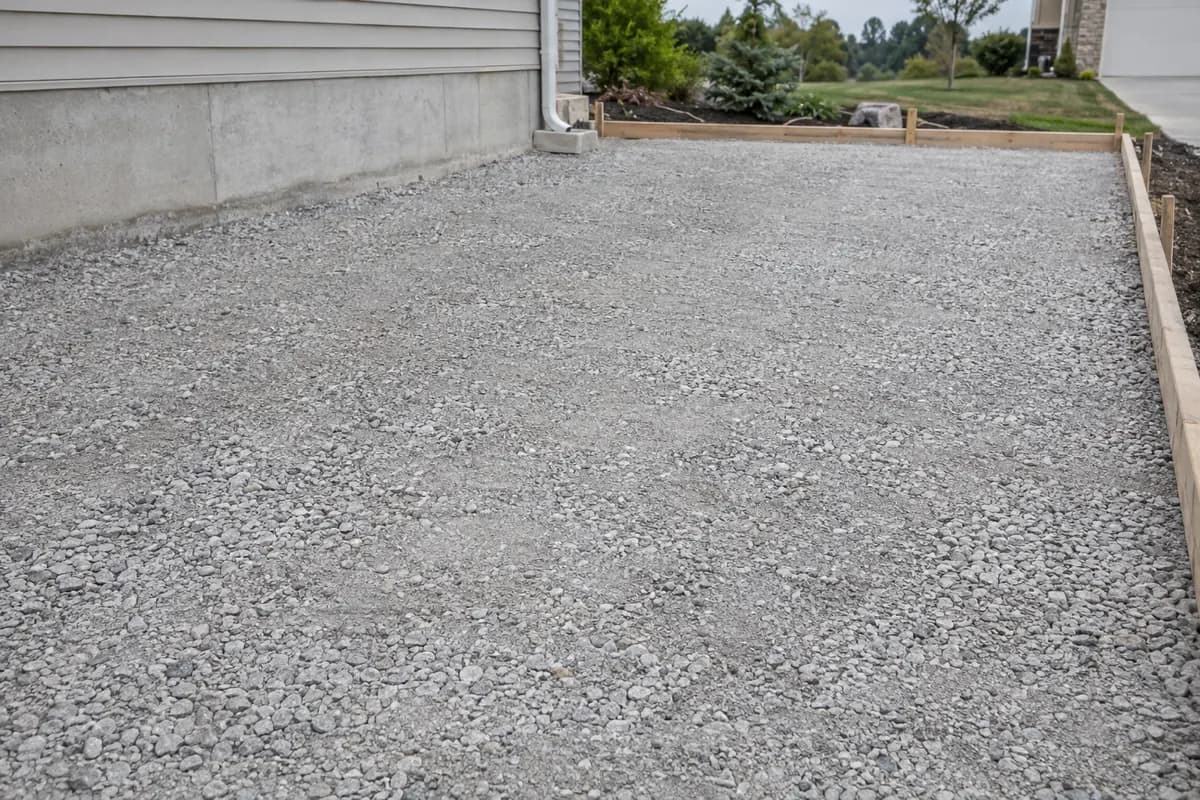
Ours is sized at 3/4 inch minus and light gray in color. So a load holds 3/4 inch pieces along with smaller chips and fine powder, much like Road Base from a quarry.[1]
That fine powder holds a surprise. Some old cement in it never fully reacted, and once wetted and packed, the layer can harden further over time. A base of Crushed Concrete tends to knit together as it ages.
How far it goes on the ground
Our coverage figures start from a patch of 100 square feet. A 2 inch depth takes 0.80 tons. Three inches takes 1.20 tons, 4 inches takes 1.60 tons and 6 inches takes 2.41 tons.[1]
Read them the other way when you already know the order size. One ton laid 2 inches deep covers 125 square feet. That drops to 83 at 3 inches, 62 at 4 inches and 42 at 6 inches.[1]
For a surface that will be compacted, measure for the finished depth and add a little, since the plate compactor draws the layer down. Ground and traffic decide the depth itself. A shed pad on firm soil asks for less than a farm yard on clay.
Where it beats quarried stone
Price is the first reason. At the median, Crushed Concrete costs $392 for 2 tons against $438 for #57 Crushed Stone, and $730 for 10 tons against $810.[2]
The gap holds at the big end. Forty tons of it is $1,959, and the same weight of #57 Crushed Stone is $2,176.[2]
Road Base is the fairer rival, since it packs the same way. Crushed Concrete wins at 5 tons, $554 to $563, and Road Base wins at 40 tons, $1,809 to $1,959. Check both on your own ZIP before you decide.[2]
Performance is the second reason. As a packed sub-base under a gravel drive, a parking area or a haul road, it holds up well, and those fines bind it into a tight layer. Job sites use it for construction entrances for that reason.
It also reuses material that already exists. Old slabs stay out of a landfill, and nobody has to open new ground at a quarry for that load.
Where quarried stone is the better buy
Water is the big one. Rain moving through fresh crushed concrete picks up lime from the cement, and the runoff turns alkaline. That can harm plants, and it can raise the pH of the water it reaches.
So keep it away from wells, ponds, streams and anything that drains into them. The safe distance depends on your slope and your soil, so place it well clear and on the downhill side. Garden beds, young trees and lawn edges that take its runoff are poor neighbors too.
Drainage is the next. Crushed Concrete is 3/4 inch minus, packed with fines, and it does not drain the way clean stone does. Drain Rock belongs in a French drain, because lime in the water from concrete can build up scale and clog a pipe.[1]
Looks can settle it as well. A pale gray surface with bits of old aggregate showing will never match a clean quarried stone, and some loads may contain small pieces of brick or wire. For a surface people see every day, Driveway Gravel looks tidier.[1]
Dust is a smaller issue. The powder in a load lifts on dry days, and a pale film can settle on parked cars until the surface is packed or topped with clean stone.
Structural work has its own rules. Under a slab or behind a retaining wall, follow the engineer's plan and use what it names.
Laying it so it sets up
Crushed Concrete rewards good preparation. Grade the ground first and give the surface a gentle fall, so rain runs off the finished surface and away from the base.
Spread it in layers of about 3 or 4 inches, never one deep pass. Mist each layer lightly if it looks dry, then pack it down with the plate compactor. Keep going until your boots leave little mark.
The water matters more here than it does with clean stone. Fines need moisture to pack, and the old cement needs it to bind. A dry layer stays loose, and a soaked one pumps under the machine.
Let traffic finish the job. A few weeks of light use tightens the surface further, so expect a little settling before you judge the result.
An equipment yard, start to finish
Take a yard 18 feet wide and 68 feet long, surfaced 4 inches deep for a tractor and a trailer. The area is 1,224 square feet. Four inches is a third of a foot, so the volume is 408 cubic feet.[3]
Dividing by 27 gives 15.11 cubic yards. Multiply by 1.30 tons and the job comes to 19.64 tons, which the calculator rounds to 20 tons. The median total is $1,450, or $73 a ton.[1],[2],[3],[4]
Now run the same 15.11 yards through its rivals. #57 Crushed Stone needs 20.4 tons at its weight of 1.35 tons a yard, so the order goes up to 20.5 tons, past the 20 ton total of $1,612. Road Base at 2,800 lb needs 21.2 tons, which rounds up to 21.5 tons, past its $1,434 rung.[1],[2]
A dump truck wants a firm path about 12 feet wide and room to raise its bed, and you mark where the pile should go.[4]
Twenty tons of anything makes a big pile on the ground. Ask in the delivery notes if you want it split across the yard, and we confirm by phone.[4]
The numbers behind this page
| Fact | Value | Applies to | Source |
|---|---|---|---|
| Crushed Concrete weight per cubic yard | 2,600 lb | Material spec | [1] |
| tons in one cubic yard of Crushed Concrete | 1.30 | Material spec | [1] |
| cubic yards in one ton of Crushed Concrete | 0.77 | Material spec | [1] |
| #57 Crushed Stone weight per cubic yard | 2,700 lb | Material spec | [1] |
| Road Base weight per cubic yard | 2,800 lb | Material spec | [1] |
| Crushed Concrete size | 3/4 inch minus | Material spec | [1] |
| Crushed Concrete color | Light gray | Material spec | [1] |
| Crushed Concrete needed for 100 square feet at 2 inches deep | 0.80 tons | Material spec | [1] |
| Crushed Concrete needed for 100 square feet at 3 inches deep | 1.20 tons | Material spec | [1] |
| Crushed Concrete needed for 100 square feet at 4 inches deep | 1.60 tons | Material spec | [1] |
| Crushed Concrete needed for 100 square feet at 6 inches deep | 2.41 tons | Material spec | [1] |
| square feet one ton of Crushed Concrete covers at 2 inches deep | 125 | Material spec | [1] |
| square feet one ton of Crushed Concrete covers at 3 inches deep | 83 | Material spec | [1] |
| square feet one ton of Crushed Concrete covers at 4 inches deep | 62 | Material spec | [1] |
| square feet one ton of Crushed Concrete covers at 6 inches deep | 42 | Material spec | [1] |
| Crushed Concrete: median delivered total for 2 tons across priced cities | $392 | Material spec | [2] |
| #57 Crushed Stone: median delivered total for 2 tons across priced cities | $438 | Material spec | [2] |
| Crushed Concrete: median delivered total for 10 tons across priced cities | $730 | Material spec | [2] |
| #57 Crushed Stone: median delivered total for 10 tons across priced cities | $810 | Material spec | [2] |
| Crushed Concrete: median delivered total for 40 tons across priced cities | $1,959 | Material spec | [2] |
| #57 Crushed Stone: median delivered total for 40 tons across priced cities | $2,176 | Material spec | [2] |
| Crushed Concrete: median delivered total for 5 tons across priced cities | $554 | Material spec | [2] |
| Road Base: median delivered total for 5 tons across priced cities | $563 | Material spec | [2] |
| Road Base: median delivered total for 40 tons across priced cities | $1,809 | Material spec | [2] |
| Drain Rock size | 3/4 to 1-1/2 inches | Material spec | [1] |
| Driveway Gravel size | 3/4 inch clean crushed | Material spec | [1] |
| inches in one foot | 12 | Material spec | [3] |
| cubic feet in one cubic yard | 27 | Material spec | [3] |
| Calculator rounding | the calculator rounds up to the next half unit | Material spec | [4] |
| Crushed Concrete: median delivered total for 20 tons across priced cities | $1,450 | Material spec | [2] |
| Crushed Concrete: median delivered price per ton at 20 tons | $73 | Material spec | [2] |
| tons in one cubic yard of #57 Crushed Stone | 1.35 | Material spec | [1] |
| #57 Crushed Stone: median delivered total for 20 tons across priced cities | $1,612 | Material spec | [2] |
| Road Base: median delivered total for 20 tons across priced cities | $1,434 | Material spec | [2] |
| Truck access | a firm path roughly 12 feet wide, room to raise the bed with no branches or wires above it, and a spot clear of septic tanks and buried lines | Material spec | [4] |
| Where the load lands | in one pile at the spot you mark, as long as a loaded truck can get there safely, the driver does not spread it | Material spec | [4] |
| Splitting a load | often possible on the same property, ask in the delivery notes and we confirm by phone | Material spec | [4] |
Sources
- Gravel Valet material specs, retrieved 2026-11-01
- Gravel Valet delivered price table, national figures across priced cities, retrieved 2026-11-01
- US customary units of measure, retrieved 2026-11-01
- Gravel Valet ordering and delivery terms, retrieved 2026-11-01
Point and station values describe one spot, not every lot in town. Check your own site before you build.
Plan this project with a real person
Tell us the scope and we size the load, quote the delivery and name the material that fits.
Materials and projects mentioned
Use a calculator
Deep reading
More guides like this
Frequently Asked Questions
Is Crushed Concrete as strong as gravel?
As a packed base, yes, for drives, parking areas and pads. Its pieces are softer than hard quarried rock and can wear down faster on a surface under heavy traffic, so many builders keep it in the lower layer and top it with clean stone.
Does Crushed Concrete drain?
It drains poorly once packed, because the 3/4 inch minus mix is full of fines. That helps a base shed water to the sides. For anything that must pass water downward, use Drain Rock or another clean stone.
Can I use it near a vegetable garden?
Leave it out of the garden and away from anything that drains into one. Rainwater leaving a fresh pile runs alkaline, and most vegetables will not thank you for it. Use a quarried stone like Driveway Gravel along the edges.