

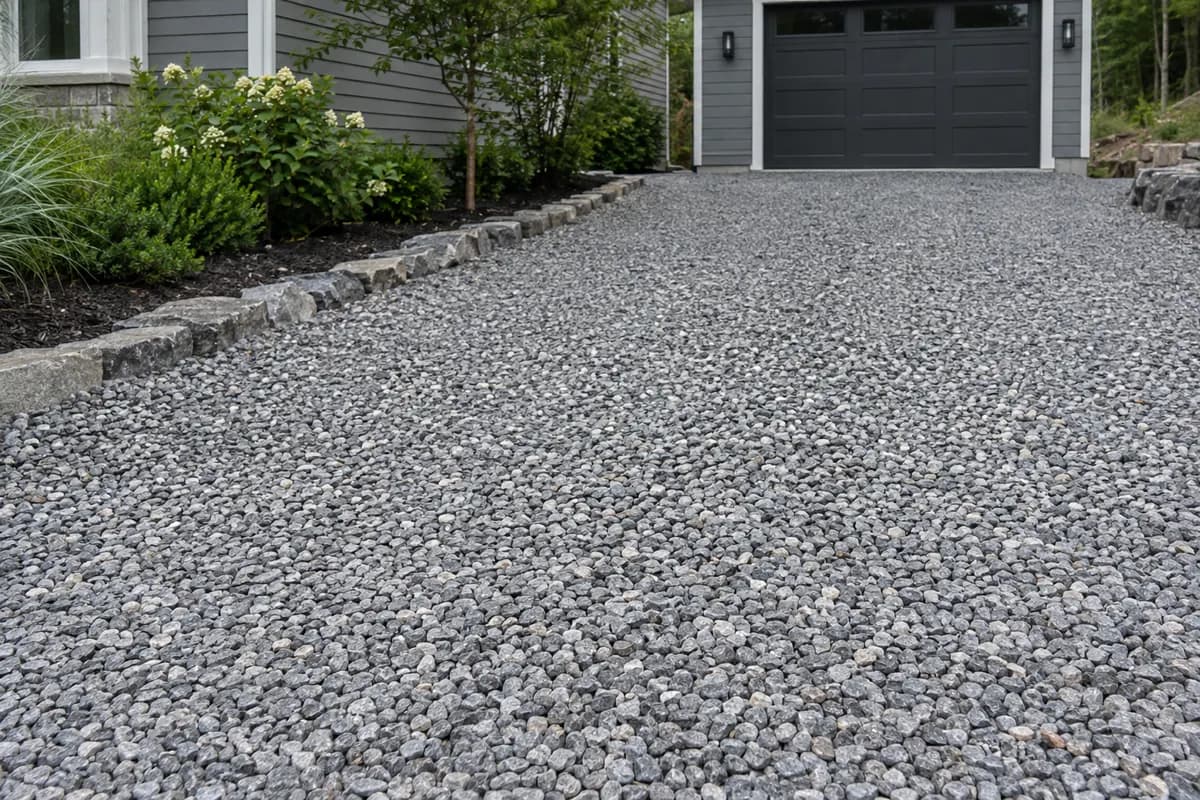
From rock face to screen deck
Everything starts with solid bedrock. Crews drill a line of holes into a quarry wall and blast it, which drops a pile of rough boulders onto the quarry floor.
Loaders carry that rock to a primary crusher, usually a pair of steel jaws that chew it down to fist and head sized lumps. A conveyor takes the lumps to a second crusher, then often a third, and each stage breaks them smaller.
Screens do the sorting. These are big shaking decks of steel mesh stacked one above the other. Stone falls through until it meets an opening too small to pass, then rides off the end of that deck onto its own belt and into its own pile. Anything too large goes back to the crusher for another round.
Some products get washed at this point to rinse off dust. Others stay unwashed on purpose, or get blended back with the fines. What drops through the last screen is sold as well, so little of the blast goes to waste.
The rock itself depends on geography. Limestone is common, trap rock and granite too, and a quarry sells whatever lies under its own ground. That is why the same product can look pale in one state and dark in the next. A hard rock wears longer under traffic, and softer limestone breaks down faster, though it packs well for that very reason.
Natural gravel works differently
Natural gravel was broken and shaped long ago by rivers, glaciers and old seabeds. It is dug from pits or dredged from water, then washed and screened. No crusher is needed, because the sorting and the rounding happened over thousands of years.
In our catalog the two you will meet are Pea Gravel and the larger River Rock. They have smooth sides, and they feel good underfoot and look good in a garden. Under a wheel they slide past one another.
Then there is the middle case. Crushed gravel starts as round natural stone and passes through a crusher to gain broken faces. 1-1/2" Crushed Gravel, in gray to tan, is ours. Expect some smooth sides left on a stone like that, along with the broken ones.[1]
In everyday talk people say gravel for all of these, and suppliers do it too. The word does no harm so long as you know which shape you are buying.
Why broken faces matter
Fill a jar with marbles and push a pencil in. It slides down easily. Fill the same jar with broken tile and the pencil stops. That jar explains crushed stone.
Flat faces meet other flat faces, so pressure from above jams them tighter. Sharp corners catch and hold. A truck rolling across a layer of them pushes the pieces into each other, and the load spreads out across a wide patch of the ground below.
Slopes behave the same way. A pile of angular stone stands at a steeper angle than a pile of round stone, so it stays put on a grade where Pea Gravel would creep downhill.
Concrete likes broken faces too. Cement paste grabs a rough surface better than a smooth one, and that explains its place in structural mixes.
Water is the bonus. A clean angular stone still leaves wide gaps between its pieces, so it locks and drains at the same time. Few materials manage both.
Those edges do not last forever. Years of traffic grind the corners down and make new fines, so an old drive grows tighter, then thinner, and needs a fresh top.
Sizes we carry
Our crushed range runs from small chips to stone wider than a golf ball. #89 Crushed Stone and 3/8" Crushed Stone are the small end at 3/8 inch. #67 Stone is 3/4 inch and under, 3/4" Crushed Stone is 3/4 inch and #57 Crushed Stone is 3/4 to 1 inch.[1]
Above those, #4 Crushed Stone reaches 1-1/2 to 2-1/2 inches. Railroad Ballast matches it, and Drain Rock tops out at 1-1/2 inches. Both carry the name of their job.[1]
Small sizes finish a surface and fill narrow spaces. Middle sizes take the most work, on drives and in drains. Big sizes go low, where they bridge soft ground and carry heavy wheels.
Road Base and Stone Dust Screenings come from the same plant. Road Base keeps its fines at 3/4 inch minus, and screenings are the fines on their own at 1/4 inch and fines.[1]
Pricing a 13 by 30 pad
Most of our crushed sizes weigh 2,700 lb to the yard, and that is 1.35 tons, so the sums barely change from one to the next.[1]
Take a pad 13 feet by 30 feet for a shed and a trailer, with #57 Crushed Stone laid 3 inches deep over firm ground. The area is 390 square feet. Multiply by a quarter of a foot for 97.5 cubic feet, which makes 3.61 yards at 27 cubic feet each. Times 1.35, that comes to about 4.9 tons.[1],[2]
Rounding on the calculator gives 5 tons. At the median across our priced cities, 5 tons costs $615, which is $123 a ton.[3],[4]
The same pad in Pea Gravel also rounds up to 5 tons, and the total comes to $1,001. That stone took no crusher at all, and it still costs more on the ladder.[1],[4]
Order online or request a quote. We sell loose bulk stone, 2 tons at the least, and it comes by the truckload. Mark the spot for the pile, and the driver dumps there if the truck can reach it.[3]
Washed or dusty
Dust on stone is normal. Crushing makes fines, and a coating of them sticks to the faces until rain or a wash takes it off.
Washed stone looks cleaner and drains better from the first day. Unwashed stone packs a little tighter, and the film rinses away over the first few rains. If you want a clean look at once, hose the surface down after you spread it.
Jobs it handles badly
Sharp stone is unkind to bare feet and to children falling on it, so it stays out of play areas and away from pool edges.
Wheels that need to roll easily, like strollers and wheelchairs, also struggle on loose clean stone. A packed surface of Stone Dust Screenings or Decomposed Granite suits them far better.[1]
A thin layer on soft ground is the classic failure. Crushed stone can only lock with itself, so if the soil beneath it turns to mud, the stone sinks. Ground and traffic set the right depth, and soft ground needs a base under the surface stone.
Clean crushed stone also lacks the fines to set hard. Alone under heavy traffic, it stays a little loose on top, which is why a good drive has a packed layer below it.
The numbers behind this page
| Fact | Value | Applies to | Source |
|---|---|---|---|
| 1-1/2" Crushed Gravel size | 1-1/2 inch | Material spec | [1] |
| 1-1/2" Crushed Gravel color | Gray to tan | Material spec | [1] |
| #89 Crushed Stone size | 3/8 inch | Material spec | [1] |
| 3/8" Crushed Stone size | 3/8 inch | Material spec | [1] |
| #67 Stone size | 3/4 inch and under | Material spec | [1] |
| 3/4" Crushed Stone size | 3/4 inch | Material spec | [1] |
| #57 Crushed Stone size | 3/4 to 1 inch | Material spec | [1] |
| #4 Crushed Stone size | 1-1/2 to 2-1/2 inches | Material spec | [1] |
| Drain Rock size | 3/4 to 1-1/2 inches | Material spec | [1] |
| Railroad Ballast size | 1-1/2 to 2-1/2 inches | Material spec | [1] |
| Road Base size | 3/4 inch minus | Material spec | [1] |
| Stone Dust Screenings size | 1/4 inch and fines | Material spec | [1] |
| #57 Crushed Stone weight per cubic yard | 2,700 lb | Material spec | [1] |
| tons in one cubic yard of #57 Crushed Stone | 1.35 | Material spec | [1] |
| cubic feet in one cubic yard | 27 | Material spec | [2] |
| Calculator rounding | the calculator rounds up to the next half unit | Material spec | [3] |
| #57 Crushed Stone: median delivered total for 5 tons across priced cities | $615 | Material spec | [4] |
| #57 Crushed Stone: median delivered price per ton at 5 tons | $123 | Material spec | [4] |
| Pea Gravel weight per cubic yard | 2,600 lb | Material spec | [1] |
| Pea Gravel: median delivered total for 5 tons across priced cities | $1,001 | Material spec | [4] |
| How to order | order online or request a quote | Material spec | [3] |
| Delivery format | loose bulk material by the truckload | Material spec | [3] |
| Minimum order | 2 tons of stone, gravel, sand or soil, or 2 cubic yards of mulch or compost | Material spec | [3] |
| Where the load lands | in one pile at the spot you mark, as long as a loaded truck can get there safely, the driver does not spread it | Material spec | [3] |
| Decomposed Granite size | 1/4 inch and fines | Material spec | [1] |
| #57 Crushed Stone color | Gray | Material spec | [1] |
Sources
- Gravel Valet material specs, retrieved 2026-11-01
- US customary units of measure, retrieved 2026-11-01
- Gravel Valet ordering and delivery terms, retrieved 2026-11-01
- Gravel Valet delivered price table, national figures across priced cities, retrieved 2026-11-01
Point and station values describe one spot, not every lot in town. Check your own site before you build.
Plan this project with a real person
Tell us the scope and we size the load, quote the delivery and name the material that fits.
Materials and projects mentioned
Use a calculator
Deep reading
More guides like this
Frequently Asked Questions
Do crushed stone and gravel mean the same thing?
Not quite. Crushed stone is rock broken by machine, with sharp corners and flat faces. Natural gravel was rounded by water or ice. People use the two words loosely, so ask about the shape of the stone before you order.
Does crushed stone compact?
Clean crushed stone locks and settles, but it will not pack into a tight crust, since nothing fine is there to fill the gaps. For a hard, dense layer use Road Base, which keeps its fines at 3/4 inch minus.
What rock is it made from?
Whatever the local quarry has, and limestone, trap rock and granite lead the list. Our catalog lists these stones by size and color rather than by rock type, and #57 Crushed Stone is sold as gray. The exact shade will depend on the source.