

Reading the numbers on a chart
A plain fraction is the screen the stone was sorted over. Stone sold as 3/4 inch has passed through a 3/4 inch opening and been held back by a smaller one, so the name tells you the top size and hints at the bottom.
A range is more exact. #4 Crushed Stone at 1-1/2 to 2-1/2 inches tells you both ends. Expect a few pieces outside any stated range, since crushers do not cut stone to a ruler.[1]
The numbers with a pound sign work backwards. They come from a standard grading chart used by road builders, and a lower number means a bigger stone. So the biggest of these is #4 Crushed Stone, #89 Crushed Stone is small, and #57 Crushed Stone falls between them. Two digit numbers are blends of two single sizes on that chart, which is why #57 and #67 cover a band of sizes where #4 covers another.[1]
Product words change from one region to the next, and a stone called one thing in your county may carry another name two states away. Go by the inches.
Minus, clean and fines
These three words tell you as much as the number does.
Minus means the stone comes with everything smaller than the stated size, right down to dust. Road Base is 3/4 inch minus, so a load holds 3/4 inch pieces, smaller chips and fine grit together. The fines sit in the spaces around the larger pieces, so the mix packs into a tight layer that will carry a truck.[1]
A clean stone went through a wash or a final screen, so its dust is gone. Driveway Gravel is 3/4 inch clean crushed. Rain drops through the open gaps, and the stone stays loose enough to shift a little under your boot.[1]
The trade-off is simple to hold in your head. Minus stone locks and sheds water. Clean stone lets water through and stays open.
Fines on their own are the small end of the scale. When a label says 1/4 inch and fines, picture coarse grit mixed with powder.
Fines and the 1/4 inch stuff
Stone Dust Screenings are what falls through the bottom screen at a quarry, sized at 1/4 inch and fines. They pack hard, which makes them a good bed under pavers and a firm finish on a garden path.[1]
Decomposed Granite has the same size label, but it is weathered rock in a gold to tan color. It suits paths and patios where looks count. Both firm up when wetted and tamped.[1]
Neither one drains the way clean stone does. Keep them away from low spots that hold water.
The 3/8 inch group
Four of our products sit at 3/8 inch, and they behave differently because of shape.
#89 Crushed Stone and 3/8" Crushed Stone are both angular chips. They knit together well for their size, so they work as a top layer on a path and as a bedding layer where a coarser stone would leave gaps.[1]
Pea Gravel is the same width with its corners worn away, in mixed tan and brown. It feels good under bare feet and rolls under anything with wheels. Reach for it in dog runs and around plantings.[1]
Walkway Gravel, at 3/8 inch, is the one we name for the job. Use it where people walk and a stroller might follow.[1]
The 3/4 inch group
This is the busiest band on the chart, and the one where the words above earn their keep.
#67 Stone is 3/4 inch and under, and 3/4" Crushed Stone is sized at 3/4 inch. Both go under concrete and into drainage layers.[1]
Driveway Gravel is clean, so it makes a good surface course. Road Base is minus, so it belongs under that surface. Crushed Concrete is also 3/4 inch minus, made from broken and recycled slabs, and it packs in much the same way. Three products share a top size and do different jobs, so asking for 3/4 stone by size alone leaves out the part that matters. Say clean or minus when you ask.[1]
Around the 1 inch mark
#57 Crushed Stone, at 3/4 to 1 inch, is the size most people mean when they say driveway stone. It is open, it drains and it bites into a base under tires.[1]
Asphalt Millings run 1 inch minus. They are ground up road surface, black in color, and they bind together as they warm in the sun and get driven on.[1]
Drain Rock starts at 3/4 inch and tops out at 1-1/2 inches, which leaves wide open gaps for water. French drains and soakaways want exactly that.[1]
For a bottom course, use 1-1/2" Crushed Gravel. A layer of it under a soft lane bridges wet ground and gives finer stone something to lock against.[1]
Fist size and bigger
River Rock measures 1 to 3 inches, rounded and in mixed earth tones. Water shaped it, so it looks right along a dry creek or a foundation band, and it is hard going to walk on.[1]
#4 Crushed Stone and Railroad Ballast both measure 1-1/2 to 2-1/2 inches. Railroad Ballast does the job the name says, holding track in place under heavy loads. On a farm or a construction entrance, either one will stand up to mud and big tires.[1]
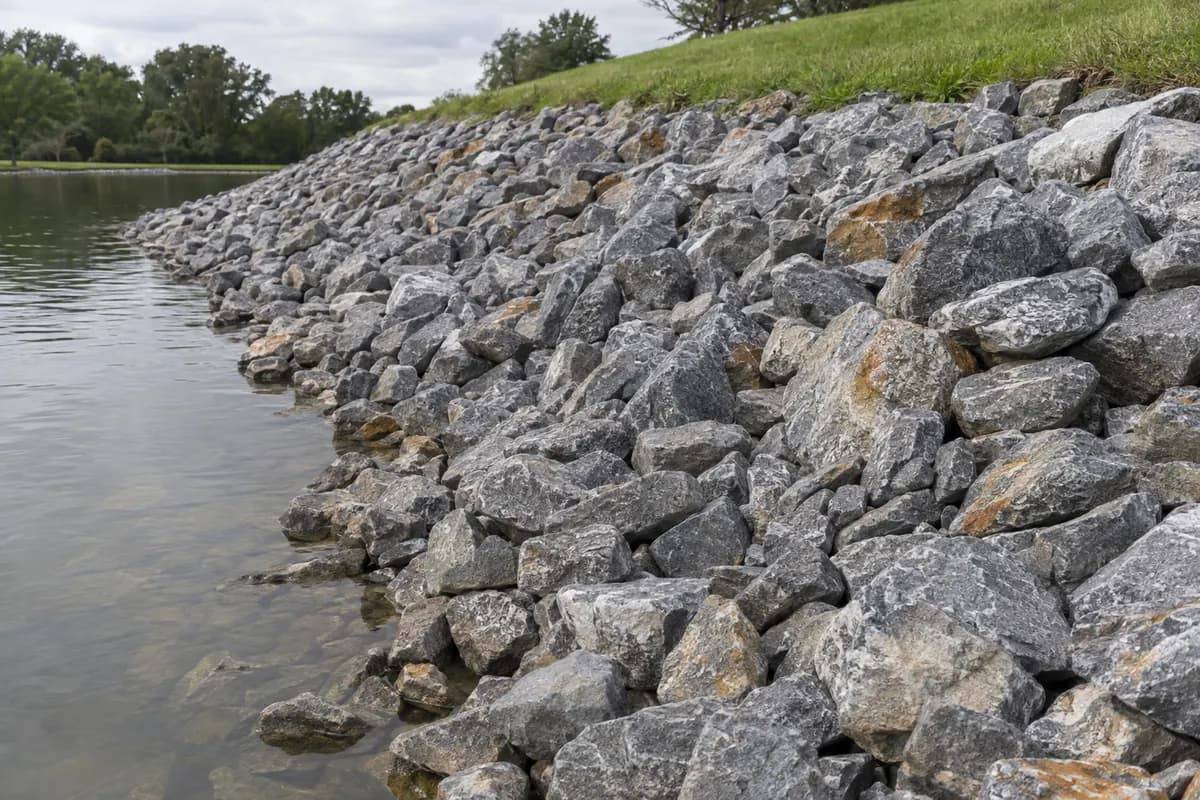
Riprap, at 6 to 12 inches, is the end of the chart. These are single rocks, set by machine, used to armor banks and outfalls against moving water. On a retaining wall or a slope that matters, follow the engineer's plan.[1]
Choosing sizes for one carport pad
Say you want a pad 22 feet by 14 feet to park under a carport. That is 308 square feet, and it shows how sizes stack.
Go with Road Base at the bottom, 4 inches deep. Dividing 308 by 3 gives 102.67 cubic feet, which is 3.8 yards at 27 cubic feet each. Road Base weighs 2,800 lb to the yard, which brings it to 5.3 tons, and the calculator rounds that to 5.5 tons.[1],[2],[3]
Finish with #57 Crushed Stone at 2 inches, which takes 51.33 cubic feet, or 1.9 yards, and 1.9 times 1.35 tons makes about 2.6 tons, which the calculator takes to 3 tons.[1],[2],[3]
A rule from the trade helps at this point. Make a layer at least twice as deep as its largest stone, so the pieces can overlap and lock. A 1 inch stone wants 2 inches or more, and 1-1/2" Crushed Gravel wants at least 3 inches.
Step the sizes down as you go up. A fine stone laid straight on big open rock will wash into the gaps below it, and the top layer slowly vanishes. The dense Road Base under the #57 Crushed Stone gives the top course a tight floor, so it stays on top.
The numbers behind this page
| Fact | Value | Applies to | Source |
|---|---|---|---|
| #4 Crushed Stone size | 1-1/2 to 2-1/2 inches | Material spec | [1] |
| #57 Crushed Stone size | 3/4 to 1 inch | Material spec | [1] |
| #89 Crushed Stone size | 3/8 inch | Material spec | [1] |
| Road Base size | 3/4 inch minus | Material spec | [1] |
| Driveway Gravel size | 3/4 inch clean crushed | Material spec | [1] |
| Stone Dust Screenings size | 1/4 inch and fines | Material spec | [1] |
| Decomposed Granite size | 1/4 inch and fines | Material spec | [1] |
| Decomposed Granite color | Gold to tan | Material spec | [1] |
| 3/8" Crushed Stone size | 3/8 inch | Material spec | [1] |
| Pea Gravel size | 3/8 inch | Material spec | [1] |
| Pea Gravel color | Mixed tan and brown | Material spec | [1] |
| Walkway Gravel size | 3/8 inch | Material spec | [1] |
| #67 Stone size | 3/4 inch and under | Material spec | [1] |
| 3/4" Crushed Stone size | 3/4 inch | Material spec | [1] |
| Crushed Concrete size | 3/4 inch minus | Material spec | [1] |
| Asphalt Millings size | 1 inch minus | Material spec | [1] |
| Asphalt Millings color | Black | Material spec | [1] |
| Drain Rock size | 3/4 to 1-1/2 inches | Material spec | [1] |
| 1-1/2" Crushed Gravel size | 1-1/2 inch | Material spec | [1] |
| River Rock size | 1 to 3 inches | Material spec | [1] |
| River Rock color | Mixed earth tones | Material spec | [1] |
| Railroad Ballast size | 1-1/2 to 2-1/2 inches | Material spec | [1] |
| Riprap size | 6 to 12 inches | Material spec | [1] |
| cubic feet in one cubic yard | 27 | Material spec | [2] |
| Road Base weight per cubic yard | 2,800 lb | Material spec | [1] |
| Calculator rounding | the calculator rounds up to the next half unit | Material spec | [3] |
| tons in one cubic yard of #57 Crushed Stone | 1.35 | Material spec | [1] |
Sources
- Gravel Valet material specs, retrieved 2026-11-01
- US customary units of measure, retrieved 2026-11-01
- Gravel Valet ordering and delivery terms, retrieved 2026-11-01
Point and station values describe one spot, not every lot in town. Check your own site before you build.
Plan this project with a real person
Tell us the scope and we size the load, quote the delivery and name the material that fits.
Materials and projects mentioned
Use a calculator
Deep reading
More guides like this
Frequently Asked Questions
Does a bigger number mean a bigger stone?
For the numbers with a pound sign, no. The numbers run backwards, so #4 Crushed Stone at 1-1/2 to 2-1/2 inches is far larger than #89 Crushed Stone at 3/8 inch. Fractions are simple inch sizes and read the normal way.
What size should go on a driveway?
Use Road Base, at 3/4 inch minus, as the packed layer, then finish with a clean top of Driveway Gravel or #57 Crushed Stone. Ground and traffic change the depth, so soft soil or heavy trucks call for more.
Which size drains best?
Clean stone with big gaps drains best. Drain Rock, which tops out at 1-1/2 inches, is made for it, and #57 Crushed Stone works in a shallower trench. Stay away from anything labeled minus or fines, because the dust clogs the gaps that move water.