

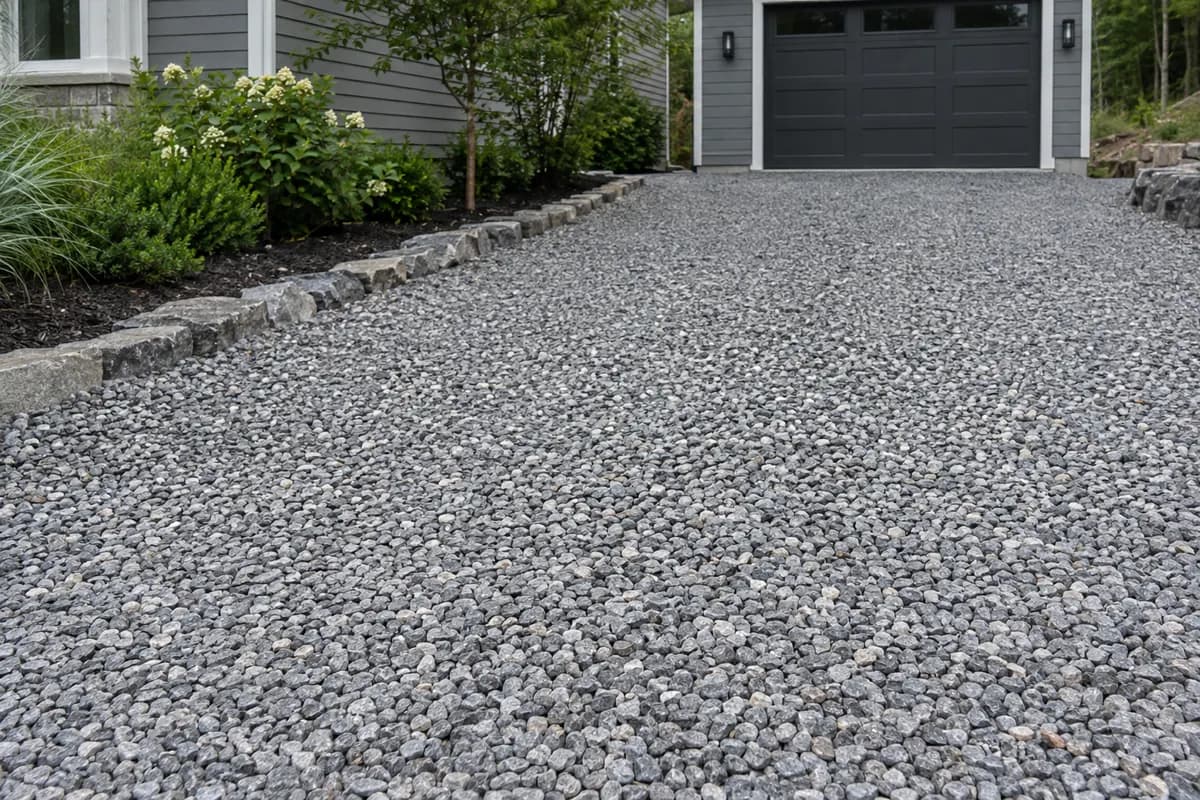
Stone that locks
Broken stone locks because every piece has flat faces and sharp corners. Press a load of it down and the pieces jam together, so a tire can cross without pushing them aside.
Four names cover this group: #67 Stone, #57 Crushed Stone, Driveway Gravel and 3/4" Crushed Stone. All four are crushed from solid rock, and they make the surface course on most working drives. Driveway Gravel, at 3/4 inch clean crushed, is the plain pick for that job.[1]
Its weak spot is comfort. Nobody wants to cross it barefoot, and a kick stand or a chair leg will find the gaps. Clean crushed stone also needs something firm below it, or it slowly works its way into soft soil.
Stone that rolls
Round stone has no corners left to catch, so it moves. Water shaped both Pea Gravel, a 3/8 inch stone, and the larger River Rock, which starts at 1 inch and reaches 3. Both shift under a foot or a wheel the way marbles would.[1]
For some jobs that is the whole appeal. Pea Gravel feels soft to walk on and gives a dog an easy surface. It settles level on its own and stays comfortable in bare feet.
Put a car on it and you will carve ruts by the weekend. Any slope makes things worse, since the stone creeps downhill a little with every step, and it needs a firm edge along the sides or it wanders into the lawn.
Stone that drains
Water moves through the empty space between stones, so a draining stone needs big gaps and no dust to clog them. That rules out anything labeled minus.
Drain Rock tops out at 1-1/2 inches and is the one made for this work, in French drains, soakaways and behind foundations. #4 Crushed Stone and Railroad Ballast go larger at 1-1/2 to 2-1/2 inches, with even wider gaps. #57 Crushed Stone serves too, with smaller gaps that still pass water freely.[1]
In the ground, surrounding soil will try to fill those gaps over the years, so most drains wrap the stone in non-woven fabric.
Open stone does a poor job of carrying weight on its own. A wide layer of it under a car shifts and spreads unless something holds the edges in.
Stone that packs
Dense mixes keep their fines, and the fines change everything. Small particles sit in the spaces around larger ones, and when you dampen the layer and pass a plate compactor across it, the whole thing sets into a hard, close crust.
Road Base is the main one, at 3/4 inch minus. Crushed Concrete behaves in much the same way at the same size, and Asphalt Millings at 1 inch minus bind as sun and traffic work on them. Stone Dust Screenings and Decomposed Granite pack too, on a finer scale, for paths and paver beds.[1]
This is the group that holds a driveway up. Lay it in thin lifts, compacting as you go, since a thick layer dumped all at once stays soft in the middle.
Those same fines slow any water that needs to go down. A packed layer sheds rain to the sides, so give it a crown or a slight fall, and keep it away from anywhere a drain needs to work.
Stone that decorates
Here color and shape do the job. River Rock brings mixed earth tones and round forms to a dry creek or a foundation band. Pea Gravel adds mixed tan and brown. Decomposed Granite lays down gold to tan, with a soft, close surface that looks at home on a garden path.[1]
Walkway Gravel sits between looks and use, in mixed color at 3/8 inch.[1]
You pay for looks. River Rock costs $841 for a 2 ton load at the median, and Pea Gravel costs $702. The same load of Driveway Gravel is $435.[2]
So keep decorative stone in the places people see. Put plainer stone under it and behind it, where nobody looks.
Judge color with care, because wet stone looks darker than dry stone. A pile that seemed rich in the rain can look pale on a hot afternoon.
Riprap, the outlier
One stone in our catalog fits none of these groups. Riprap measures 6 to 12 inches, and its only job is to stay put while water tries to move it. Banks and outfalls are where you meet it, and on a wall or a bank that matters, follow the engineer's plan.[1]
One lot, five jobs
Say one rural lot needs work in all five groups. The sums show how differently the jobs add up.
The lane is 64 feet by 9 feet, and it starts with packing stone. Four inches of Road Base is 192 cubic feet, or 7.11 yards, and at 2,800 lb to the yard that comes to 9.96 tons. Order 10 tons, which is $763 at the median.[1],[2],[3]
Locking stone goes on top. Driveway Gravel at 2 inches is 96 cubic feet, or 3.56 yards, and 1.35 tons a yard makes 4.8 tons. That rounds up to 5 tons, at $616.[1],[2],[3],[4]
A dog run of 16 feet by 15 feet wants rolling stone. Pea Gravel at 2 inches comes to 40 cubic feet, 1.48 yards and about 1.9 tons, so the 2 ton minimum covers it at $702.[1],[2],[3],[4]
A soggy corner needs a trench 26 feet long, 1 foot wide and 1.5 feet deep. That is 39 cubic feet of Drain Rock, or 1.44 yards, which makes about 1.95 tons and fits a 2 ton order at $428.[1],[2],[3]
Last, a decorative band of River Rock along the house, 30 feet by 3 feet at 3 inches, needs only 22.5 cubic feet, about 1.1 tons. The minimum applies again, and 2 tons costs $841. You will have plenty left to carry the band around a corner.[1],[2],[3],[4]
When a job sits between two groups
A handful of stone tells you most of what you need. Sharp edges mean it will lock, and smooth sides mean it will roll. Dust left on your palm means it will pack. Clean hands and wide gaps mean it will drain.
Plenty of jobs ask for two things at once. Ask which one fails first.
A steep path needs grip more than softness, so locking or packing stone beats anything round. A patio that floods needs drainage first and looks second, so a drain goes in below the pretty stone. A driveway needs packing stone for strength and locking stone for the surface, which is why the good ones have two layers.
Ground and traffic change the answer every time. Soft clay and a loaded truck ask more of a stone than firm soil and a small car.
The numbers behind this page
| Fact | Value | Applies to | Source |
|---|---|---|---|
| Driveway Gravel size | 3/4 inch clean crushed | Material spec | [1] |
| Pea Gravel size | 3/8 inch | Material spec | [1] |
| River Rock size | 1 to 3 inches | Material spec | [1] |
| Drain Rock size | 3/4 to 1-1/2 inches | Material spec | [1] |
| #4 Crushed Stone size | 1-1/2 to 2-1/2 inches | Material spec | [1] |
| Railroad Ballast size | 1-1/2 to 2-1/2 inches | Material spec | [1] |
| Road Base size | 3/4 inch minus | Material spec | [1] |
| Crushed Concrete size | 3/4 inch minus | Material spec | [1] |
| Asphalt Millings size | 1 inch minus | Material spec | [1] |
| Stone Dust Screenings size | 1/4 inch and fines | Material spec | [1] |
| Decomposed Granite size | 1/4 inch and fines | Material spec | [1] |
| River Rock color | Mixed earth tones | Material spec | [1] |
| Pea Gravel color | Mixed tan and brown | Material spec | [1] |
| Decomposed Granite color | Gold to tan | Material spec | [1] |
| Walkway Gravel size | 3/8 inch | Material spec | [1] |
| Walkway Gravel color | Mixed | Material spec | [1] |
| River Rock: median delivered total for 2 tons across priced cities | $841 | Material spec | [2] |
| Pea Gravel: median delivered total for 2 tons across priced cities | $702 | Material spec | [2] |
| Driveway Gravel: median delivered total for 2 tons across priced cities | $435 | Material spec | [2] |
| Riprap size | 6 to 12 inches | Material spec | [1] |
| cubic feet in one cubic yard | 27 | Material spec | [3] |
| Road Base weight per cubic yard | 2,800 lb | Material spec | [1] |
| pounds in one US ton | 2,000 | Material spec | [3] |
| Road Base: median delivered total for 10 tons across priced cities | $763 | Material spec | [2] |
| tons in one cubic yard of Driveway Gravel | 1.35 | Material spec | [1] |
| Calculator rounding | the calculator rounds up to the next half unit | Material spec | [4] |
| Driveway Gravel: median delivered total for 5 tons across priced cities | $616 | Material spec | [2] |
| Pea Gravel weight per cubic yard | 2,600 lb | Material spec | [1] |
| Minimum order | 2 tons of stone, gravel, sand or soil, or 2 cubic yards of mulch or compost | Material spec | [4] |
| Drain Rock weight per cubic yard | 2,700 lb | Material spec | [1] |
| Drain Rock: median delivered total for 2 tons across priced cities | $428 | Material spec | [2] |
| River Rock weight per cubic yard | 2,600 lb | Material spec | [1] |
| #57 Crushed Stone size | 3/4 to 1 inch | Material spec | [1] |
Sources
- Gravel Valet material specs, retrieved 2026-11-01
- Gravel Valet delivered price table, national figures across priced cities, retrieved 2026-11-01
- US customary units of measure, retrieved 2026-11-01
- Gravel Valet ordering and delivery terms, retrieved 2026-11-01
Point and station values describe one spot, not every lot in town. Check your own site before you build.
Plan this project with a real person
Tell us the scope and we size the load, quote the delivery and name the material that fits.
Materials and projects mentioned
Use a calculator
Deep reading
More guides like this
Frequently Asked Questions
Is crushed stone a type of gravel?
In everyday use, yes. Strictly, gravel is rock that water or weather rounded, and crushed stone is rock broken by machine. The corners are what count. A broken face locks and a worn one rolls, whatever the name on the ticket says.
Which group works best on a slope?
Locking or packing stone. Angular pieces wedge together and resist the pull downhill, and Road Base, once compacted, holds better still. Keep round stone off anything steep, because it creeps down with every step and every rain.
Can one load do two of these jobs?
Sometimes. #57 Crushed Stone locks under tires and drains in a trench, so it covers both. It will not pack like Road Base or feel like Pea Gravel, and a job that needs either one should get the right stone.