
Use case
Crushed Stone: Material Guide
Crushed stone is quarried rock broken into angular pieces and screened into sizes. The sizes go by numbers, and each one fits different work, from drainage trenches to paver bedding to driveway surfaces. This guide sorts out the common grades, explains what makes crushed rock behave the way it does, and shows how much #57 Crushed Stone each depth takes.
Best materials for a crushed stone project
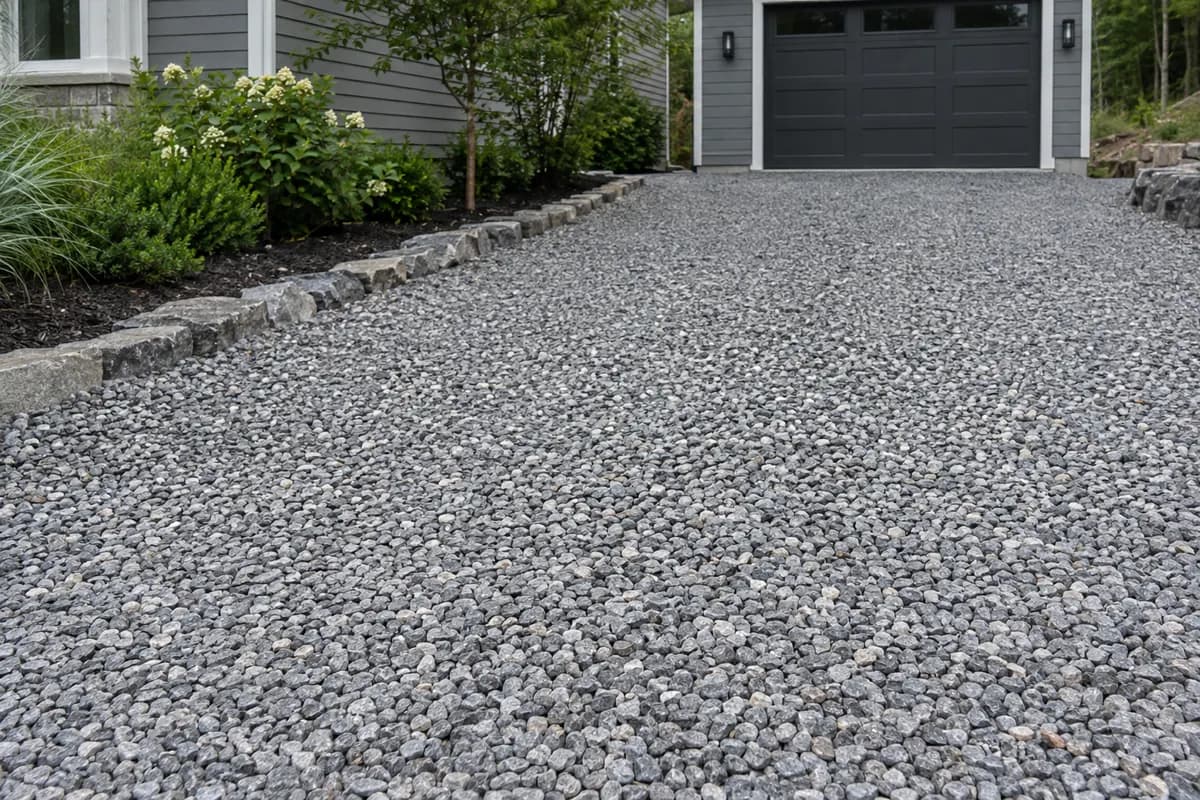
#57 Crushed Stone is the all-round grade. Its pieces run from 3/4 to 1 inch, gray, washed clean of fines, with sharp broken faces. That size is large enough to leave open space for water and small enough to walk on and spread with a rake. It goes under concrete slabs, around footing drains, behind walls, on driveways and as a base for sheds.[1]
#67 Stone is a close neighbor, a touch smaller and with a wider spread of sizes inside each load. It packs a little tighter than #57 and leaves a smoother surface, which makes it a good pick for a walkable drive or a base under a hot tub pad. It still drains, though not quite as freely.[1]
#89 Crushed Stone is the small chip. Its fine pieces fill the spaces around pipe, sit flat under pavers and make a neat top dressing for a path. It is too small to carry a car on its own, so it belongs in light-duty and finish work.[1]
#4 Crushed Stone is the big grade, with pieces much larger than #57. It suits a construction entrance, the bottom layer of a heavy drive on soft ground, and deep drainage beds that need a lot of open space. It is hard to walk on and rough under tires, so it is almost always covered by a finer stone.[1]
3/4" Crushed Stone is the name many buyers use for a clean stone close to the small end of the #57 range. It fills the same roles: drainage, slab base and a driveway top layer. When a plan calls for clean 3/4 inch stone, either product will do the job.[1]
 From$4242 ton delivered
#57 Crushed Stone
Gravel and Crushed Stone- Size
- 3/4 to 1 inch
- Weight
- 2,700 lb/yd³
- Color
- Gray
 From$4372 ton delivered
#67 Stone
Gravel and Crushed Stone- Size
- 3/4 inch and under
- Weight
- 2,700 lb/yd³
- Color
- Gray
 From$4252 ton delivered
#89 Crushed Stone
Gravel and Crushed Stone- Size
- 3/8 inch
- Weight
- 2,700 lb/yd³
- Color
- Gray
 From$4452 ton delivered
#4 Crushed Stone
Gravel and Crushed Stone- Size
- 1-1/2 to 2-1/2 inches
- Weight
- 2,700 lb/yd³
- Color
- Gray
What a crushed stone project needs in a material
Angular faces come first. Crushing breaks rock along sharp edges, and those edges bite into each other when the stone is spread and pressed. A layer of crushed rock resists sliding, which is why it holds a drive together on a slope and stays put under a slab. River gravel of the same size rolls and shifts instead.[1]
Clean stone drains. Washed grades such as #57 have almost no dust, so the gaps between pieces stay open. Water passes through quickly, which suits French drains, foundation backfill and the bed under a gravel patio. A stone with fines packs harder but slows water down, so pick the grade by whether the job needs flow or strength.[1]
Size has to match the depth and the load. As a rule of thumb, a layer should be at least two to three stones thick to lock. Small stone in a deep bed is fine. Large stone in a thin layer leaves gaps and rocks under foot.[1]
Weight tells you what the order will look like. A cubic yard of #57 Crushed Stone weighs about 2,700 lb. Gray rock of that weight stays where you put it, does not float in a storm and does not blow away like bark or mulch.[1]
How to install crushed stone
Prepare the bed. Remove sod and loose topsoil, then level and compact the soil below. For drives and pads, dig deep enough to fit the full stone depth plus any base layer. For drainage work, shape the trench so it falls toward the outlet along its whole length.[1]
Add fabric where soil could mix in. A layer of landscape fabric or geotextile between the soil and the stone keeps the gaps from filling with mud. In a drain, wrap the fabric around the stone and pipe so silt cannot move in from the sides over the years.[1]
Spread the stone in even layers. Dump it in several small piles instead of one tall one, then push and rake it out. Work to a depth marked on stakes or a string line so the surface stays even. Clean stone like #57 does not need water to settle, but a few passes with a plate compactor seat the pieces and firm the surface.[1]
Finish the edges. Clean crushed rock spreads sideways under traffic, so a border of steel, timber or stone keeps it in place on drives and paths. In a trench, cover the top of the stone with fabric before backfilling with soil or topping it with a decorative layer.[1]
How much crushed stone do you need
For a thin top layer over an existing drive or a path, 2 inches of #57 Crushed Stone takes about 0.83 tons per 100 square feet. A 3 inch layer takes about 1.25 tons for the same area and gives better cover over a worn base.[1]
A shed base, a slab subbase or a new drive surface wants more. At 4 inches, 100 square feet takes about 1.67 tons. At 6 inches the figure rises to about 2.50 tons, which suits a drainage bed or the main layer of a driveway on firm soil.[1]
For trenches, figure the volume the same way. Multiply the trench length by its width for square feet, then use the depth to pick the tons per 100 square feet. Most trenches go deeper than 6 inches, so add the 6 inch figure for each 6 inches of depth.[1]
Crushed stone is sold by the ton. Round up, since the stone settles and the edges of a dig are rarely as neat as the plan. The area calculator on the site takes length, width and depth and returns tons for the grade you choose.[1]
| Project size | 3 inch depth | 4 inch depth |
|---|---|---|
| 100 sq ft | 0.9 cu yd / 1.3 tons | 1.2 cu yd / 1.7 tons |
| 300 sq ft | 2.8 cu yd / 3.8 tons | 3.7 cu yd / 5.0 tons |
| 600 sq ft | 5.6 cu yd / 7.5 tons | 7.4 cu yd / 10.0 tons |
What crushed stone costs
Crushed stone is sold by the ton, and your delivered total is built from tons and trucking. The grade matters less than you might think. Washed grades go through an extra screening step, and the smallest and largest sizes are less common in some areas. Trucking and quantity still move the bill the most.[1]
Depth sets the tonnage. Going from 2 inches to 4 inches doubles the stone for the same area. Measure carefully and pick the shallowest depth that does the job, then order it all at once so one truck handles the delivery.[1]
Access and drop location affect the day. A dump truck needs a firm path, room to raise the bed and no low branches or wires overhead. If the stone can land where it will be spread, you save a long run with a wheelbarrow. Check the ZIP box on the site for delivered figures at your address.[1]
Delivered, 2 tons: from $424 to $803 depending on the city (366 cities priced). Enter your ZIP for the exact figure.
Crushed stone mistakes to avoid
Picking a grade by name alone. Ask what the stone has to do. A trench needs clean, open stone. A drive surface needs stone that locks. A paver bed needs a small chip or screenings. The wrong grade drains poorly, shifts or ruts.[1]
Spreading clean stone with no border. Washed #57 Crushed Stone rolls outward under tires and feet. Without an edge, a drive grows wider and thinner every season. Set the border before the stone arrives.[1]
Skipping fabric in a drain. Soil washing into the gaps can clog a drainage bed within a few years. A fabric wrap adds little time on the day and keeps the stone open for much longer.[1]
Using large stone in a thin layer. A 2 inch layer of a big grade leaves holes and loose pieces. Match the stone size to the depth so the layer is several stones thick.[1]
Ordering by guesswork. A pile of gray rock in the driveway looks large, but 100 square feet at 4 inches already takes about 1.67 tons. Measure, use the calculator, and order the whole job in one go.[1]
Coverage
Browse more
FAQ for crushed stone
What size is #57 crushed stone?
#57 Crushed Stone runs from about 3/4 to 1 inch, washed, with angular faces. It is the most widely used clean grade for drainage, slab bases and driveway surfaces, because it leaves open space for water while still locking under load. Gravel Valet delivers it by the ton in a gray color.
Which crushed stone is best for a driveway?
For the top layer, #57 Crushed Stone or #67 Stone gives good grip and drains well. Under it, a packed base of a graded stone with fines carries the load. On soft ground, a bottom layer of #4 Crushed Stone spreads weight before the finer layers go on.
Is crushed stone the same as gravel?
Not quite. Crushed stone is rock broken by a crusher, so the pieces have sharp faces and lock together. Gravel can mean stone rounded by water, which rolls and shifts. People use the words loosely, so check the product name and size before you order.
Do I need to compact crushed stone?
Clean crushed stone settles under its own weight, but a few passes with a plate compactor seat the pieces and give a firmer surface for a drive, a shed or a slab. In a drain trench, light tamping is enough, since the goal there is open space for water.
How much does a ton of #57 stone cover?
At 2 inches deep, 100 square feet takes about 0.83 tons, so one ton covers a little more than that area. At 4 inches a ton covers roughly half as much ground. Use the calculator with your real length and width for an order you can trust.