

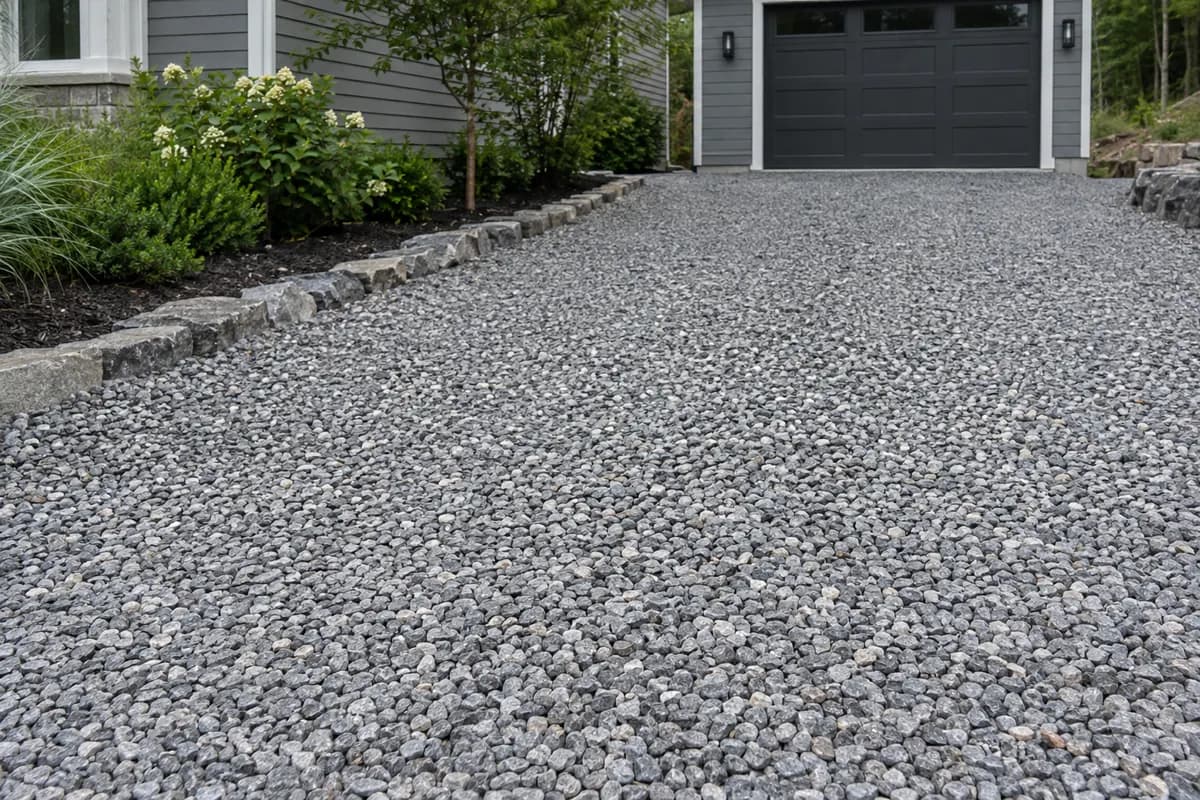
Read the ground before you buy
The answer depends on what happens when your soil gets wet, so look at it wet. Walk the spot the day after heavy rain. If your boots sink or the ground smears, you have soft soil that needs help. If it stays firm, you may need very little.
A small test settles the soil type. Dig a hole about a foot deep and squeeze a damp handful. Clay holds a ribbon and shines where your thumb presses it. Sandy soil crumbles in your palm.
Fill the hole with water as well, and watch how long it stands. Water still sitting there the next morning tells you the ground drains badly, and the build has to deal with that.
Then think about the load. A path, a shed pad and a driveway each ask a different amount from the same soil. We use one job through the rest of these notes, a parking bay 15 feet by 34 feet, or 510 square feet, for one car and a small trailer.
Clay
Clay is the hard case. It holds water, turns greasy when wet, shrinks when dry and pumps up into any stone sitting on it. Lay gravel straight on clay and the first wet winter will mix them into a gray paste.
Put a woven fabric on the graded clay first. It keeps the two layers apart, and the stone can do its work without sinking.
Road Base follows. Four inches gives the bay a packed layer, laid in two lifts, with the plate compactor run over each. For 510 square feet that is 170 cubic feet, or 6.3 yards. At 2,800 lb to the yard it comes to 8.8 tons, which rounds up to 9 tons.[1],[2],[3]
Finish with 2 inches of clean surface stone. If the spot stays wet, give the water a way out by cutting a shallow fall to one side or adding a French drain at the low edge. Fabric separates soil from stone, and it does nothing about water that has nowhere to leave.
Sandy ground
Sand drains well, so water is rarely the trouble. Grip is. Loose sand has no cohesion, and stone laid on it works downward a little at a time, with sand rising to take its place.
Where only feet cross the surface, 2 inches of an angular stone packed well into the sand may be enough. For the parking bay, use a base. A 3 inch layer of Road Base locks the sand down at 127.5 cubic feet, which is 4.72 yards and about 6.6 tons, and the calculator takes that to 7 tons.[1],[2],[3]
Dampen the sand and run the plate across it before the Road Base goes on. Damp sand tightens under a plate, while bone dry sand just shuffles around.
Fabric is optional here. On very loose sand, a non-woven layer stops the base from sifting down into it, and it costs little against the stone it protects.
Grass and topsoil
Keep gravel off live grass. Turf and topsoil are full of roots and organic matter, and they rot, soften and sink. The stone follows them down, and new grass comes up through it by the following summer.
Strip the turf and the dark topsoil until you reach firmer ground. On most lawns that means a few inches, but keep digging until the color changes and the soil feels tight underfoot. Save the good topsoil for the beds.
Your new surface should finish level with the lawn or just below it, so count the stone depth when you dig. Once the soil is stripped, you are back to clay or sand, and you follow the notes above for whichever one you hit.
Old asphalt
Old asphalt is a gift, since it is already firm and already graded. It has two weaknesses. Water cannot pass through it, and loose stone tends to skate across a smooth surface.
Break up any spot where water sits so it can drain through to the soil, and cut back the edges that have crumbled. Then lay a crushed stone with sharp faces, 2 inches deep. Pea Gravel is the wrong choice, because round stone rolls on a hard surface.
For the parking bay, #57 Crushed Stone at 2 inches comes to 85 cubic feet, or 3.15 yards. Times 1.35 tons a yard, that comes to about 4.25 tons, and the order is 4.5 tons.[1],[2],[3]
No fabric is needed. The asphalt already parts stone from soil. If it has broken into loose chunks, treat those as a rough base, pack them down and add Road Base to level the low spots.
Woven fabric against non-woven
The two fabrics do different jobs, and buying one where you needed the other wastes money.
Woven fabric looks like a tight plastic tarp, and it is strong in tension. It spreads the load from stone to soil, which is the job below a drive or parking pad. Water moves through it slowly.
Non-woven fabric feels like thick felt. It filters water while holding soil back, so it belongs around drains, behind walls and anywhere water must get through. Under heavy wheels it stretches.
For a driveway on soft ground, use woven. For drains and beds, use non-woven. Overlap the seams at least a foot, and pin them, or the stone will drag them apart as it lands.
We sell loose bulk material only, so pick up fabric from a local supply store before the truck comes. Lay it out in advance so the stone can go down right away.[3]
When nothing goes under it
Plenty of jobs need no base and no fabric. Fresh stone on an existing gravel drive is one, because the old stone is the base. Rake it, fix the low spots and top it up.
A garden path on firm ground that drains is another. So is a thin decorative layer in a bed that nobody walks on, though you may want fabric there for weeds. Hard packed ground that has carried cars for years, with no ruts, can take a surface course as it is.
If you are unsure, watch the spot through one wet spell. Ground that stays firm under your boots has already answered the question.
Fabric is a separator, and it will not hold up a heavy load by itself. On a structural slab or a retaining wall, follow the engineer's plan.
Pricing the bay on clay
The clay build is the full version, so it makes a fair budget for the worst case. Nine tons of Road Base sits between the 5 ton total of $563 and the 10 ton total of $763 at the median.[4]
The 2 inch top of #57 Crushed Stone needs 4.5 tons, just under the 5 ton total of $615. Your city's own ladder gives the exact figure for each amount.[3],[4]
The numbers behind this page
| Fact | Value | Applies to | Source |
|---|---|---|---|
| cubic feet in one cubic yard | 27 | Material spec | [1] |
| Road Base weight per cubic yard | 2,800 lb | Material spec | [2] |
| Calculator rounding | the calculator rounds up to the next half unit | Material spec | [3] |
| tons in one cubic yard of #57 Crushed Stone | 1.35 | Material spec | [2] |
| Delivery format | loose bulk material by the truckload | Material spec | [3] |
| Road Base: median delivered total for 5 tons across priced cities | $563 | Material spec | [4] |
| Road Base: median delivered total for 10 tons across priced cities | $763 | Material spec | [4] |
| #57 Crushed Stone: median delivered total for 5 tons across priced cities | $615 | Material spec | [4] |
| How the delivered price is set | each city has a ladder of delivered totals, delivery included, in whole dollars | Material spec | [3] |
| Pea Gravel size | 3/8 inch | Material spec | [2] |
| Road Base size | 3/4 inch minus | Material spec | [2] |
Sources
- US customary units of measure, retrieved 2026-11-01
- Gravel Valet material specs, retrieved 2026-11-01
- Gravel Valet ordering and delivery terms, retrieved 2026-11-01
- Gravel Valet delivered price table, national figures across priced cities, retrieved 2026-11-01
Point and station values describe one spot, not every lot in town. Check your own site before you build.
Plan this project with a real person
Tell us the scope and we size the load, quote the delivery and name the material that fits.
Materials and projects mentioned
Use a calculator
Deep reading
More guides like this
Frequently Asked Questions
Does Pea Gravel need fabric below it?
On firm soil you can skip it, but on soft or weedy ground a non-woven fabric keeps the stone clean and out of the dirt. Pea Gravel moves easily, so give it a solid edge as well, or it will wander across any fabric you lay.
Will gravel hold on bare dirt?
Yes, if the ground is firm and it drains. Soft or wet dirt will swallow it, and a thin layer can vanish after a few wet seasons. Strip the organic soil, then add Road Base first if your boots sink when the ground is wet.
Does sand work as a base under gravel?
Sand has no grip, so it makes a poor base for anything with wheels. Stone shifts and sinks into it. Use Road Base, which packs tight, and save sand for bedding pavers, where a thin, level layer is the point.