
Use case
Weed Barrier Gravel: Material Guide
Weed barrier gravel is a layer of stone laid over landscape fabric to keep weeds out of beds, side yards and paths. The fabric blocks roots and seedlings from below, and the stone holds the fabric down, hides it from view and shields it from sunlight. Picked and laid well, the pair cuts weeding to a few minutes a month. This guide compares the stones that work, shows how to install them and covers how many tons to order.
Best materials for weed barrier gravel
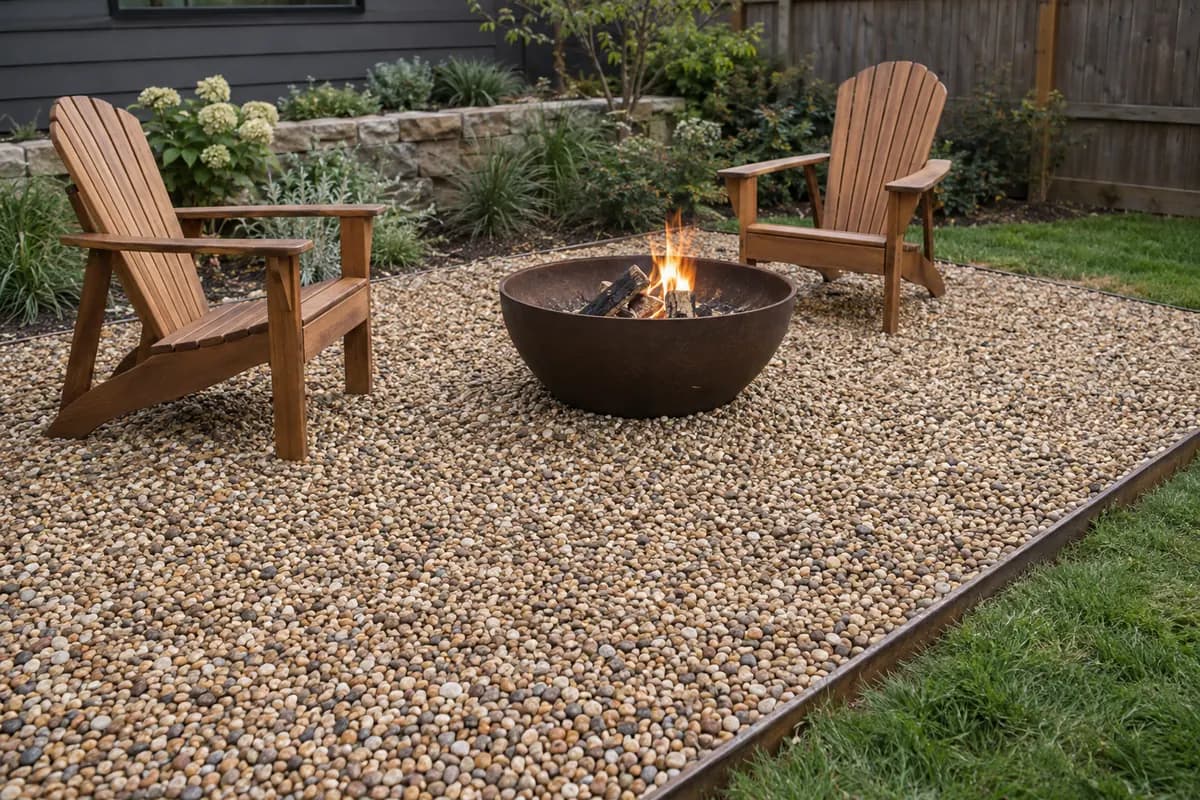
Pea Gravel is our main pick over weed barrier fabric. The small, rounded stones are about 3/8 inch across, in mixed tan and brown, so they cover fabric evenly and leave no sharp edges to tear it. The pebbles pour easily into corners and around plants, which makes a neat finish in tight beds.[1]
Walkway Gravel is a crushed stone of a similar small size. Its broken faces lock together and make a firmer surface than round pebbles do, so it suits fabric under a path or a side yard that people walk on daily. The angular edges are small enough that a good woven fabric holds up under them.[1]
River Rock is the choice for drainage strips and beds where the stone should look bold. The larger rounded stones sit heavily on the fabric and do not move in a storm. They leave wider gaps, so more dust can settle in between, and a few more weeds may root on top.[1]
Decomposed Granite packs into a smooth surface and works over fabric in formal beds and paths. Its fine grit fills every space, so it hides the fabric well. On a slope it can wash, and seeds root easily in its fine top layer, so it needs more care than pebbles.[1]
 From$4162 ton delivered
Pea Gravel
Driveway and Landscaping- Size
- 3/8 inch
- Weight
- 2,600 lb/yd³
- Color
- Mixed tan and brown
 From$4582 ton delivered
River Rock
Driveway and Landscaping- Size
- 1 to 3 inches
- Weight
- 2,600 lb/yd³
- Color
- Mixed earth tones
 From$4702 ton delivered
Decomposed Granite
Driveway and Landscaping- Size
- 1/4 inch and fines
- Weight
- 2,500 lb/yd³
- Color
- Gold to tan
 From$4242 ton delivered
Walkway Gravel
Driveway and Landscaping- Size
- 3/8 inch
- Weight
- 2,600 lb/yd³
- Color
- Mixed
What weed barrier gravel needs in a material
The stone must cover the fabric completely. Any patch of fabric left in sunlight breaks down faster and lets light reach weed seeds. Small stones near 3/8 inch settle into an even layer with no gaps, even where the bed curves around plants.[1]
It must be kind to the fabric. Smooth, rounded Pea Gravel spreads without snagging or puncturing the barrier, even when you rake it. Large, sharp stone dropped from a height can tear thin fabric, which lets weeds through the holes.[1]
It should hide dust and leaf litter. Weed seeds blow in and root in the debris that collects on top of the stone. A mixed tan and brown stone hides that grime better than a pale stone, so the bed looks clean between rakings.[1]
It must be heavy enough to hold the fabric down. A cubic yard of Pea Gravel weighs about 2,600 lb, and an even layer on top keeps the fabric flat through wind and rain. Bark mulch can blow off and leave the fabric exposed, while stone stays put.[1]
It must let water through. Rain should drain through both the stone and the fabric to reach the roots of plants in the bed. Clean pebbles leave open spaces for water to move down instead of pooling on top.[1]
How to install weed barrier gravel
Clear the area down to bare soil. Pull or dig out every weed with its roots, and remove grass runners and old mulch. Weeds left under the fabric can push up through it or find a seam.[1]
Grade and firm the soil. Rake out lumps and fill low spots so water drains away from the house and does not sit under the fabric. Tamp the soil lightly so the stone will not sink unevenly.[1]
Set edging around the area. A steel strip, plastic edging or a row of stones keeps the pebbles inside the bed and stops lawn grass from creeping under the fabric edge.[1]
Roll out a woven or nonwoven landscape fabric, not plastic sheeting, which blocks water. Overlap the seams generously and pin them with fabric staples. Turn the fabric up against the edging.[1]
For each plant, cut an X in the fabric, fold the flaps under and leave room for the stem to grow. Plant through the opening before the stone goes down.[1]
Spread the Pea Gravel with a shovel and rake it level, working gently so the rake teeth do not catch the fabric. Rinse the stone to show its tan and brown color and settle any dust.[1]
How much weed barrier gravel do you need
Over fabric, 2 inches of Pea Gravel is the usual minimum to hide the barrier. That takes about 0.80 tons for every 100 square feet. A thinner layer leaves fabric showing as the pebbles shift.[1]
For beds that get foot traffic or raking, 3 inches is safer. That depth takes about 1.20 tons per 100 square feet and keeps the fabric covered even after the stone moves around.[1]
Paths and side yards that carry wheelbarrows or bins need a deeper layer. At 4 inches, plan on about 1.60 tons per 100 square feet.[1]
A 6 inch fill is more than weed control needs. It takes about 2.41 tons per 100 square feet and suits only a low spot or drainage area.[1]
Measure each area, multiply length by width for square feet, divide by 100 and multiply by the tons for your depth. Pea Gravel is sold by the ton, so round up. The area calculator on the site will do the same math.[1]
| Project size | 3 inch depth | 4 inch depth |
|---|---|---|
| 100 sq ft | 0.9 cu yd / 1.2 tons | 1.2 cu yd / 1.6 tons |
| 300 sq ft | 2.8 cu yd / 3.6 tons | 3.7 cu yd / 4.8 tons |
| 600 sq ft | 5.6 cu yd / 7.2 tons | 7.4 cu yd / 9.6 tons |
What weed barrier gravel costs
Pea Gravel is sold by the ton and delivered in a dump truck. The delivered total depends on the number of tons, how far the truck travels from the yard that loads it and how easy your drop spot is to reach.[1]
Depth is the biggest factor. Laying 2 inches over the whole area keeps the order small, while deeper paths and side yards add tons quickly.[1]
The fabric, staples and edging are bought separately and are a small part of the job. Combining several beds or a path in one delivery puts more stone on one truck. Enter your ZIP on the site to see the delivered total for your area.[1]
Delivered, 2 tons: from $416 to $1,044 depending on the city (366 cities priced). Enter your ZIP for the exact figure.
Weed barrier gravel mistakes to avoid
Leaving weeds under the fabric is the first mistake. Perennial weeds with deep roots can push through or around the barrier. Clear them fully before you lay fabric.[1]
Using plastic sheeting instead of landscape fabric is the next. Plastic blocks water and air, so the soil below goes sour and plants suffer. Water pools on top and carries dirt into the stone.[1]
Laying the stone too thin leaves the fabric exposed to sun. Keep at least 2 inches of Pea Gravel over the barrier, about 0.80 tons per 100 square feet.[1]
Skipping the edging lets grass creep under the fabric and pebbles scatter into the lawn. An edge set a little above the stone fixes both.[1]
Letting debris pile up is the slow mistake. Leaves and dust on top of the stone turn into a thin layer of soil where seeds root. Blow or rake the bed now and then so it stays clean.[1]
Coverage
Browse more
FAQ for weed barrier gravel
What is the best gravel to put over weed barrier fabric?
Pea Gravel is our first choice. The rounded stones near 3/8 inch cover the fabric evenly and do not tear it. For a path that gets daily use, a small crushed stone such as Walkway Gravel packs firmer. For bold drainage strips, larger River Rock works. Pick the stone by how the area will be used.
How deep should gravel be over landscape fabric?
Lay at least 2 inches of Pea Gravel, about 0.80 tons per 100 square feet, so no fabric shows. For areas that get raked or walked on, 3 inches, about 1.20 tons per 100 square feet, keeps the fabric covered as the stone shifts.
Will weeds still grow through gravel and fabric?
Weeds from below are mostly blocked by the fabric. Seeds that blow in can still root in dust and leaves that collect on top of the stone. A quick pass with a blower or rake every few weeks, and pulling the odd weed while it is small, keeps the bed clear.
Should I use plastic or fabric under gravel?
Use landscape fabric. It blocks weeds but lets water and air reach the soil. Plastic sheeting traps water on top, starves the soil of air and tends to tear under stone. Woven fabric is the most durable choice under a walked area.
Does Pea Gravel move around on top of fabric?
Rounded pebbles shift more than crushed stone, especially on paths. At about 2,600 lb per cubic yard, Pea Gravel does not blow away, but feet and rakes push it around. Firm edging and a layer at least 3 inches deep on paths keep the fabric covered.