
Use case
Retaining Wall Gravel: Material Guide
A retaining wall holds back soil, but water is what pushes walls over. Wet soil is heavy, and when rain has nowhere to go it presses on the back of the blocks until they bulge or tip. The stone behind and under the wall gives that water a way out. This guide explains which stone to use, where it goes and how many tons a wall will need.
Best materials for a retaining wall
Drain Rock is the stone we send for the drainage zone behind a wall. It is a clean, gray crushed stone sized from 3/4 to 1-1/2 inches, with no sand or dust mixed in. The gaps between those pieces stay open for years, so water that soaks into the slope above runs down through the stone instead of building up against the blocks.[1]
Angular pieces matter here. Crushed Drain Rock has broken faces that wedge against each other, so the column of stone behind the wall stands firm while it drains. Round stone of the same size rolls under load and settles unevenly, and that settling can open gaps at the top of the wall.[1]
The footing under the first course needs a firm, level bed. Many builders use a compacted layer of crushed stone with fines for that leveling pad, since the dust packs down hard and holds the blocks dead level. Drain Rock can also serve as the pad for a short garden wall, as long as it is tamped well in thin layers.[1]
Native soil belongs only at the back and over the top of the drainage zone. A cap of soil above the stone lets grass or plants grow on the slope and keeps surface water from pouring straight into the drainage column.[1]
 From$4252 ton delivered
Drain Rock
Drainage and Base- Size
- 3/4 to 1-1/2 inches
- Weight
- 2,700 lb/yd³
- Color
- Gray
 From$4242 ton delivered
#57 Crushed Stone
Gravel and Crushed Stone- Size
- 3/4 to 1 inch
- Weight
- 2,700 lb/yd³
- Color
- Gray
 From$4372 ton delivered
#67 Stone
Gravel and Crushed Stone- Size
- 3/4 inch and under
- Weight
- 2,700 lb/yd³
- Color
- Gray
 From$4252 ton delivered
#89 Crushed Stone
Gravel and Crushed Stone- Size
- 3/8 inch
- Weight
- 2,700 lb/yd³
- Color
- Gray
What a retaining wall needs in a material
Free drainage is the first need. Water has to fall through the stone and reach the pipe at the base before it can build pressure. A clean stone between 3/4 and 1-1/2 inches leaves wide voids that pass water quickly and do not clog with silt as fast as smaller gravel would.[1]
The stone has to carry weight without moving. Drain Rock weighs about 2,700 lb per cubic yard, and the interlocked pieces stand firm under the load of the soil behind them. That mass also helps anchor the back of each block course.[1]
It must compact without turning solid. Tamped crushed stone settles into a tight frame, yet water still runs between the pieces. A material full of fines would pack into a hard, nearly watertight layer, and the wall would lose the drainage it was built around.[1]
Color hardly matters behind the wall, since the stone stays hidden. A plain gray stone is the usual choice. Where a strip of drainage stone shows along the top of a garden wall, the gray tone sits neatly against most block and natural stone faces.[1]
It should be easy to order in the right amount. Drain Rock is sold by the ton, so the volume of the drainage zone can be measured and converted into a single order before the first block goes down.[1]
How to install retaining wall gravel
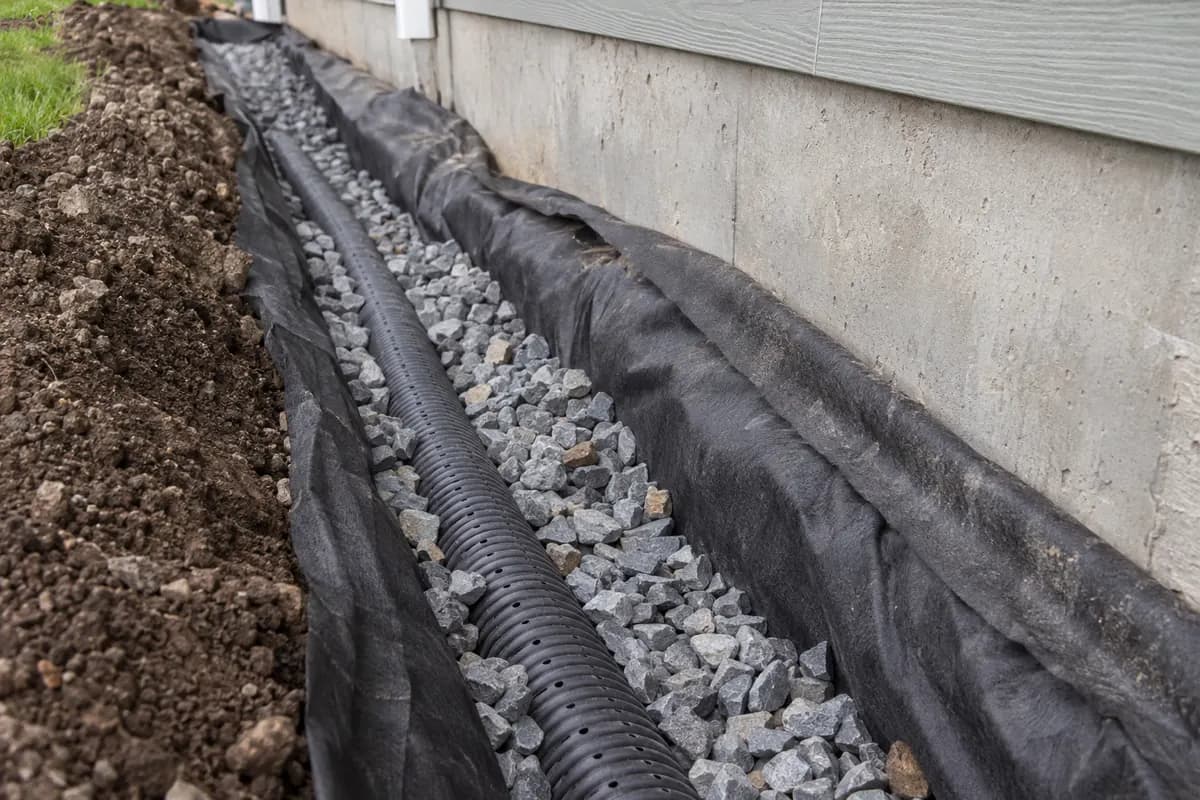
Dig a trench along the wall line, wide enough for the base course plus room behind it for drainage stone. Remove topsoil, roots and soft spots until you reach firm ground. Line the trench and the cut slope behind it with landscape fabric, leaving enough loose fabric to fold over the top later.[1]
Build the leveling pad in the trench and compact it in thin lifts. Check it with a long level in both directions. The first course of block sits on this pad, and any error here shows up as a tilt at the top of the wall.[1]
Lay a perforated drain pipe at the back of the base course, with the holes facing down, and run it to daylight at one or both ends of the wall. The pipe carries away water that the stone collects. Without an outlet, the drainage zone fills like a bucket.[1]
Set each course of block, then fill the cores and the zone behind it with gray Drain Rock before setting the next course. Tamp the stone as you go. Keep the drainage zone rising with the wall, course by course, so the blocks never stand with loose soil pressed against them.[1]
Near the top, fold the fabric over the stone and cap it with a layer of native soil. Shape that soil so surface water runs off along the wall rather than straight down into the stone.[1]
How much retaining wall gravel do you need
Think of the drainage zone as a slab standing on its edge. Multiply the length of the wall by its height to get the area of the wall face. A drainage zone 6 inches thick behind 100 square feet of wall face takes about 2.50 tons of Drain Rock.[1]
Many walls get a thicker zone, about a foot of stone behind the blocks. For that, double the 6 inch figure: plan on twice 2.50 tons for every 100 square feet of face.[1]
Add the leveling pad and the block cores. A pad 4 inches deep under 100 square feet of trench takes about 1.67 tons. A 3 inch pad, enough under a short garden wall on firm soil, takes about 1.25 tons per 100 square feet.[1]
Hollow blocks need their cores filled too. The block maker lists how much fill each block holds, so count the blocks in the wall and add that stone to the plan. Drain Rock is sold by the ton, so add up the pad, cores and drainage zone and round up.[1]
| Project size | 3 inch depth | 4 inch depth |
|---|---|---|
| 100 sq ft | 0.9 cu yd / 1.3 tons | 1.2 cu yd / 1.7 tons |
| 300 sq ft | 2.8 cu yd / 3.8 tons | 3.7 cu yd / 5.0 tons |
| 600 sq ft | 5.6 cu yd / 7.5 tons | 7.4 cu yd / 10.0 tons |
What retaining wall gravel costs
Drain Rock is sold by the ton and delivered in bulk, so the total follows the tonnage, the distance from the supplying quarry or yard and how close the truck can tip to the work site.[1]
Wall height drives the order more than wall length. Every extra course raises the drainage zone, and taller walls tend to get a thicker zone too, so tonnage climbs fast as walls get taller.[1]
Placing stone where the truck can drop it close to the trench saves hours of wheelbarrow work. On a sloped yard, plan the drop spot at the top of the wall line so gravity helps move the stone down.[1]
The stone is a small share of a wall project, and skimping on it is a false saving. A wall that fails from trapped water has to be taken down and rebuilt, block by block. Clean drainage stone is the least expensive protection the wall can get.[1]
Enter your ZIP in the box on the site to see the delivered figure, and use the calculator with your wall area to check the tonnage.[1]
Delivered, 2 tons: from $425 to $764 depending on the city (366 cities priced). Enter your ZIP for the exact figure.
Retaining wall mistakes to avoid
Backfilling with the soil you dug out. Clay and loam hold water, swell and push on the blocks. Only clean stone belongs in the zone directly behind the wall.[1]
Leaving out the drain pipe or burying its outlet. Stone without a pipe still collects water, and with nowhere to go it builds the same pressure the wall was meant to avoid. Make sure the pipe ends at open air.[1]
Skipping the fabric. Fine soil washes into the drainage stone over a few seasons and clogs the voids. A layer of fabric between soil and stone keeps the zone open for the life of the wall.[1]
Pouring all the stone in at the end. Filling the drainage zone in one go leaves loose pockets that settle later. Fill and tamp after every course.[1]
Building a tall wall without design help. Short garden walls are a weekend job, but tall walls hold back a great deal of soil and are a job for a trained wall builder with a proper plan.[1]
Coverage
Browse more
FAQ for retaining wall gravel
What size gravel goes behind a retaining wall?
A clean crushed stone between 3/4 and 1-1/2 inches is the standard backfill for a wall's drainage zone. Drain Rock fits that range and has no fines, so water passes through freely. Smaller stone or stone mixed with dust packs too tightly and holds water against the blocks.
How much gravel do I need behind a retaining wall?
Measure the wall face, length times height. A drainage zone 6 inches thick takes about 2.50 tons of Drain Rock per 100 square feet of face, and a foot-thick zone takes about twice that. Add stone for the leveling pad and for filling the block cores, then round up.
Do I need a drain pipe if I use gravel behind the wall?
Yes for most walls. The stone gathers water, and the pipe carries it away. Without a pipe running to an open outlet, water fills the stone and presses on the wall. Lay the pipe at the base of the drainage zone, holes facing down, and let it exit at one or both ends.
Should I put landscape fabric behind a retaining wall?
Yes. Line the back of the cut and the bottom of the trench with fabric, fill with drainage stone, and fold the fabric over the top before capping with soil. It stops fine soil from washing into the stone and clogging the voids, which keeps the drainage zone working for many years.
Can I use river rock behind a retaining wall?
Round stone drains, but it does not lock. Under the weight of the soil behind the wall, rounded pieces roll and settle, and the backfill can sink unevenly. Angular Drain Rock wedges together and holds its shape while still letting water pass, so it is the better choice for this job.