
Use case
Pipe Bedding Stone: Material Guide
Pipe bedding is the stone laid under and around a buried pipe. It gives the pipe an even, firm cradle so the weight of the soil above does not crack, crush or sag it. This guide covers which stone to use, what a good bedding needs, how to place it in a trench, how much to order and the habits that cause broken lines.
Best materials for pipe bedding
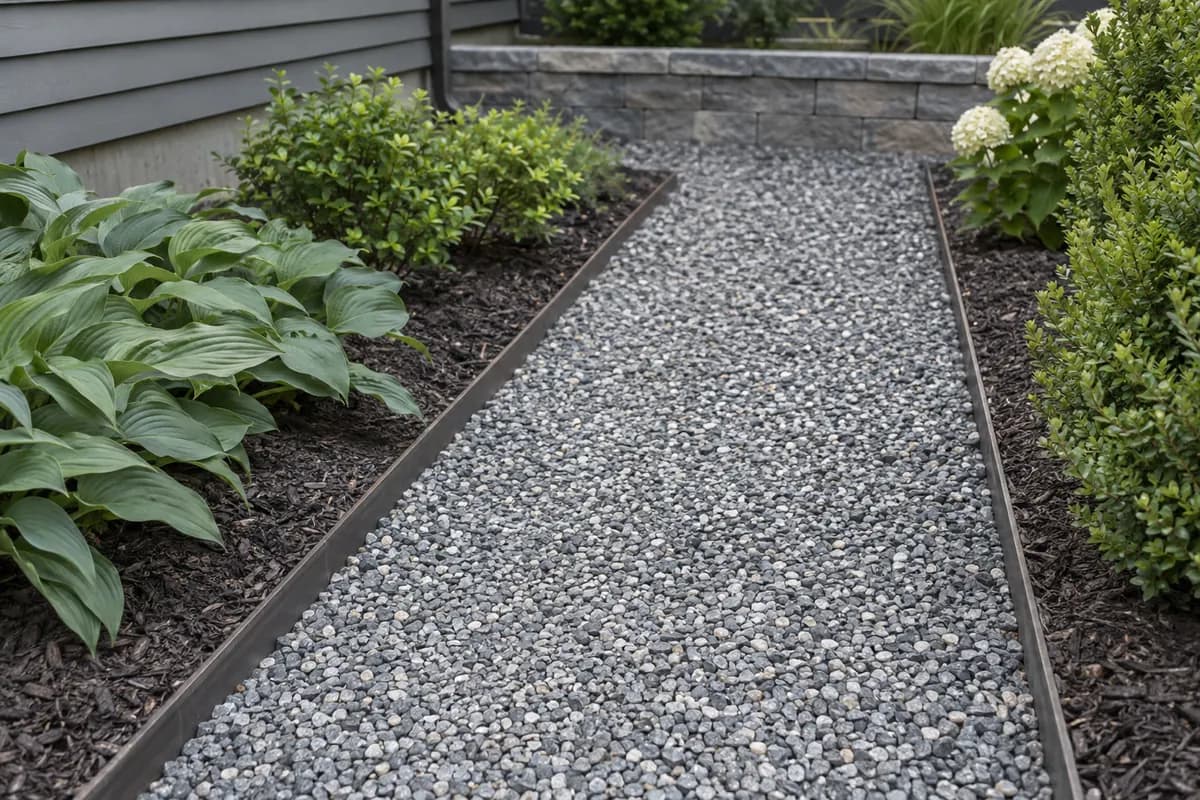
#89 Crushed Stone is our main pick for pipe bedding. It is small gray crushed stone about 3/8 inch across. The size is fine enough to fill around the curve of a pipe and coarse enough to drain. Its broken faces lock once tamped, so the pipe keeps its grade.[1]
#67 Stone is a step larger and also common for bedding larger pipes. It drains faster than #89 and packs well with a little tamping, but the larger pieces can leave gaps under a small pipe.[1]
#57 Crushed Stone is the usual stone around a perforated drain pipe, such as in a French drain. The open, single sized stone moves water toward the holes in the pipe. For a solid pipe that only needs support, the finer #89 gives a more even cradle.[1]
3/4" Crushed Stone and #4 Crushed Stone are larger. They suit the bottom of a wet trench, where large stone keeps the trench floor firm, but they are too coarse to sit directly against a pipe wall.[1]
 From$4252 ton delivered
#89 Crushed Stone
Gravel and Crushed Stone- Size
- 3/8 inch
- Weight
- 2,700 lb/yd³
- Color
- Gray
 From$4242 ton delivered
#57 Crushed Stone
Gravel and Crushed Stone- Size
- 3/4 to 1 inch
- Weight
- 2,700 lb/yd³
- Color
- Gray
 From$4372 ton delivered
#67 Stone
Gravel and Crushed Stone- Size
- 3/4 inch and under
- Weight
- 2,700 lb/yd³
- Color
- Gray
 From$4452 ton delivered
#4 Crushed Stone
Gravel and Crushed Stone- Size
- 1-1/2 to 2-1/2 inches
- Weight
- 2,700 lb/yd³
- Color
- Gray
What pipe bedding needs in a material
Bedding has to support the pipe along its whole length. A pipe sitting on a high rock or a hard clod carries the load at one point and can crack. Small stone fills the trench floor evenly, so the pipe rests on a smooth, continuous bed.[1]
It has to fill the haunches. The haunch is the space under the lower sides of the pipe, between the pipe wall and the trench floor. Stone that flows into that space and is tamped firm carries a large share of the soil load. Small 3/8 inch chips reach into the haunch better than bigger stone.[1]
It has to drain. A trench collects water from the soil around it after rain, and a bedding that holds water turns soft and lets the pipe move. Clean crushed stone lets water pass through and out along the trench, so the support under the pipe stays firm in wet weather.[1]
It needs to be free of sharp oversize pieces. Large points can press into plastic pipe under the weight of backfill. Crushed stone graded to a small size gives angular grip without large points.[1]
It should be heavy and stable. A cubic yard of #89 Crushed Stone weighs about 2,700 lb. Dense stone holds the pipe in line while the trench is backfilled and keeps the pipe from floating if water enters the trench.[1]
How to install pipe bedding
Call the local utility locating service before you dig, and mark every line in the work area. Dig the trench to the depth and slope the pipe needs, and wide enough to work a tamper on each side of the pipe. Remove rocks, roots and soft pockets from the trench floor.[1]
Spread a layer of the gray #89 Crushed Stone across the trench floor and rake it to the pipe's grade. Check the slope with a level on a straight board or with a string line, and tamp the layer lightly. The bed should be smooth, with no high spots.[1]
Lay the pipe on the bed and check its grade again. Add stone along both sides and work it under the lower curve of the pipe with a shovel blade or a short tamping bar. Tamp each side evenly so the pipe does not shift sideways.[1]
At each joint or fitting, scoop a small hollow in the bed so the wider bell of the pipe does not sit on a high point. Fill around the joint with stone after it is connected, so the full length of the pipe rests on the bed and not on the fittings.[1]
Keep adding stone in layers until it covers the top of the pipe, tamping by hand near the pipe and never running a heavy compactor directly over it. Then backfill the rest of the trench with soil in layers, compacting each one.[1]
How much pipe bedding do you need
Trench volume is what drives the order. A bed of 2 inches under the pipe takes about 0.83 tons for every 100 square feet of trench floor. A 3 inch bed, which suits larger pipe or soft ground, takes about 1.25 tons per 100 square feet.[1]
A trench where the bed, the sides and the cover layer add up to 4 inches over the floor area takes about 1.67 tons of #89 Crushed Stone per 100 square feet.[1]
When the stone surrounds the pipe and covers it, the depth over the trench floor can reach 6 inches or more. At 6 inches, 100 square feet takes about 2.50 tons. The pipe itself takes up some of that space, so a small allowance off the total is fair.[1]
For square feet of trench floor, multiply the trench length by its width. Divide by 100 and multiply by the tons for your stone depth. #89 Crushed Stone is sold by the ton. The calculator on the site works it out from length, width and depth.[1]
| Project size | 3 inch depth | 4 inch depth |
|---|---|---|
| 100 sq ft | 0.9 cu yd / 1.3 tons | 1.2 cu yd / 1.7 tons |
| 300 sq ft | 2.8 cu yd / 3.8 tons | 3.7 cu yd / 5.0 tons |
| 600 sq ft | 5.6 cu yd / 7.5 tons | 7.4 cu yd / 10.0 tons |
What pipe bedding costs
Bedding stone is sold by the ton and delivered by dump truck. The delivered total depends on the tons, how far the stone travels and where the truck can tip it along the trench line.[1]
The ground plays a part too. A wet or soft trench floor may need a layer of larger stone under the bedding before the pipe goes in, which adds tons to the order. A dry trench in firm soil needs only the bed and the cover.[1]
A long trench may need loads dropped at more than one spot. Tell us where the trench runs so the driver can place piles where you need them.[1]
Trench width shapes the order more than anything. A narrow trench dug by a mini excavator needs far less stone than a wide trench dug by hand with sloped sides.[1]
Enter your ZIP in the box on the site to see the delivered figure for your area.[1]
Delivered, 2 tons: from $425 to $924 depending on the city (366 cities priced). Enter your ZIP for the exact figure.
Pipe bedding mistakes to avoid
Laying pipe straight on the dug trench floor is the biggest mistake. Rocks and clods create point loads, and the pipe can crack or sag into a belly that collects debris.[1]
Failing to work stone into the haunches leaves the lower sides of the pipe unsupported. The soil load then squashes the pipe, which can shrink its opening or break a joint. Shovel and tamp the stone under both sides.[1]
Running a plate compactor right over a shallow cover layer can crack plastic pipe. Hand tamp until there is enough cover above the pipe, then compact the backfill.[1]
Pouring backfill soil straight from a bucket onto the pipe can knock it off grade or break a joint. Place the stone cover first, then add soil in thin layers from the side of the trench.[1]
Using large stone against the pipe leaves gaps and sharp points. Keep larger stone at the bottom of a wet trench and small chips in contact with the pipe.[1]
Coverage
Browse more
FAQ for pipe bedding stone
What is the best stone for pipe bedding?
#89 Crushed Stone is our main choice. It is small gray crushed stone about 3/8 inch across, which fills around the curve of the pipe, drains and locks once tamped. #67 Stone works for larger pipes, and #57 Crushed Stone suits perforated drain pipe where water needs to reach the holes.
How much bedding stone goes under a pipe?
A bed of 2 to 3 inches under the pipe is a common starting point. That takes about 0.83 tons per 100 square feet of trench floor at 2 inches, and about 1.25 tons at 3 inches. Larger pipe and soft trench floors need the deeper bed.
Can I bed pipe in sand instead of stone?
Sand can bed pipe in a dry trench, but it shifts and washes when water enters the trench, and it drains slowly. Small crushed stone stays put when wet, drains freely and locks under tamping. For drain lines and wet ground, crushed stone is the safer choice.
Should stone cover the top of the pipe?
Yes, in most trenches. Bring the stone up the sides and over the top of the pipe in layers, tamping by hand. That cover spreads the load of the soil above and protects the pipe from rocks in the backfill. Then fill the rest of the trench with soil.
Do I need fabric around pipe bedding stone?
A solid pipe bedded in stone does not need fabric. For a perforated drain pipe in silty or clay soil, wrapping the stone in fabric keeps fine soil from washing into the stone and clogging the drain over time.