
Use case
Patio Gravel: Material Guide
A gravel patio is a quick way to turn a patch of lawn into an outdoor room. It drains after storms, takes less work than poured or laid paving and can be reshaped later. This guide covers the stones that make a good patio floor, how to build it so chairs stay level, how much to order and the problems to watch for.
Best materials for a gravel patio
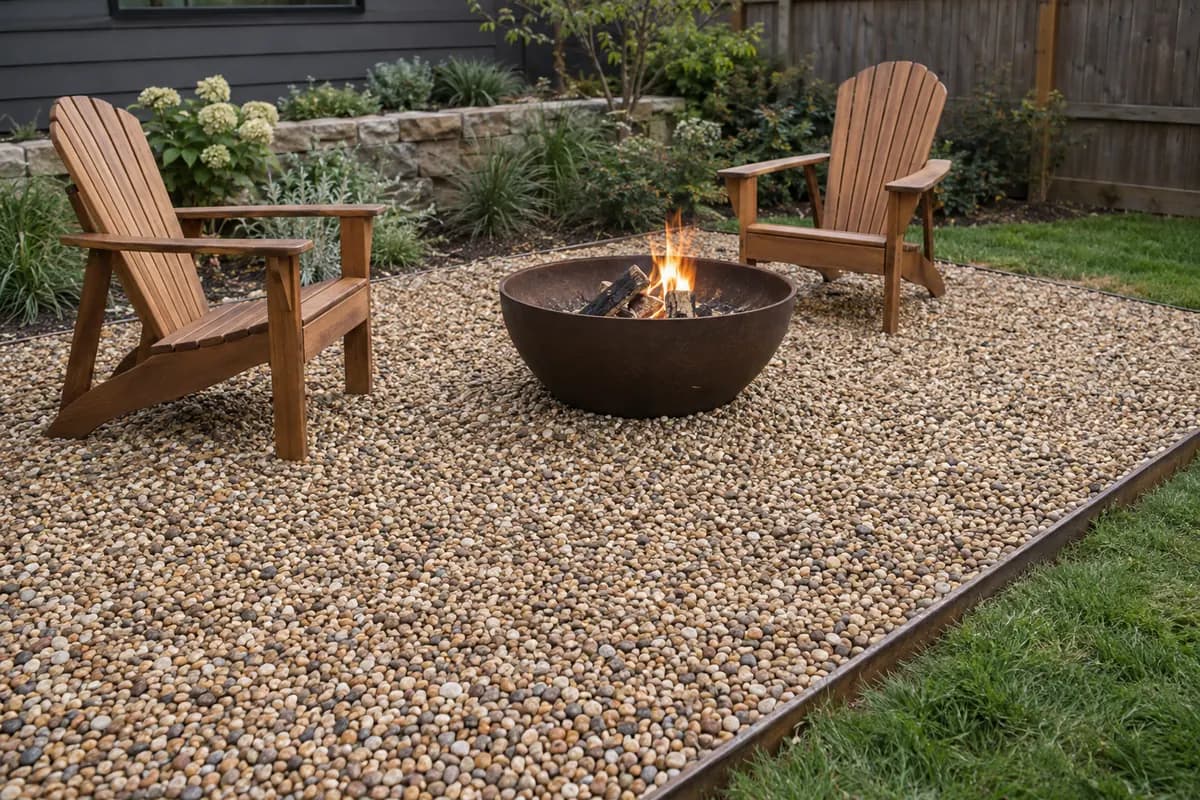
Pea Gravel is the stone we suggest for most gravel patios. It is small rounded stone around 3/8 inch, in a mixed tan and brown that feels warm and casual. The smooth pebbles are comfortable for bare feet, quiet to walk on and easy to rake back into place after a party.[1]
Decomposed Granite is the pick when the patio needs to feel solid. Its grit and fine particles pack into a firm, flat surface, so a dining table and its chairs stand without wobble. It needs a solid edge and a slight slope, because heavy rain can wash grooves into a packed surface.[1]
Walkway Gravel is a small crushed stone that locks better than rounded pebbles. It is a good middle ground for a patio where people move chairs often but still want a loose gravel look. If a path already leads to the patio in Walkway Gravel, using the same stone keeps the two areas matched.[1]
River Rock is far larger and too uneven to set furniture on. It looks good as a border around the patio, in a planting strip along its edge or in a dry bed that carries roof water past the seating.[1]
 From$4162 ton delivered
Pea Gravel
Driveway and Landscaping- Size
- 3/8 inch
- Weight
- 2,600 lb/yd³
- Color
- Mixed tan and brown
 From$4582 ton delivered
River Rock
Driveway and Landscaping- Size
- 1 to 3 inches
- Weight
- 2,600 lb/yd³
- Color
- Mixed earth tones
 From$4702 ton delivered
Decomposed Granite
Driveway and Landscaping- Size
- 1/4 inch and fines
- Weight
- 2,500 lb/yd³
- Color
- Gold to tan
 From$4242 ton delivered
Walkway Gravel
Driveway and Landscaping- Size
- 3/8 inch
- Weight
- 2,600 lb/yd³
- Color
- Mixed
What a gravel patio needs in a material
A patio needs a stone that is pleasant to sit beside. People spend hours on a patio with their feet on the ground, and children play there. Smooth, rounded 3/8 inch pebbles have no sharp edges, so a dropped toy, a bare foot or a dog lying in the sun meets nothing rough.[1]
A patio floor needs a firm layer under the loose top. Rounded pebbles alone shift under a chair leg. A compacted base of crushed stone under a thin layer of Pea Gravel holds furniture up, while the pebbles on top give the look and feel people want.[1]
The surface needs to drain quickly. People sit on a patio the evening after rain. Open gaps between 3/8 inch stones let water drop straight through, and the base below carries it away from the house if the ground is shaped with a slight fall.[1]
The color should suit the house and the planting. Mixed tan and brown sits well beside wood decking, brick, warm stucco and most plant greens. That blend hides the dust, pollen and leaf bits that land on any outdoor floor.[1]
The stone should be heavy enough to stay in place. A cubic yard of Pea Gravel weighs about 2,600 lb. A gust of wind or a quick rain moves almost none of it, so the patio keeps its level surface between rakes.[1]
How to install a gravel patio
Mark the shape with stakes and string, or with a hose for a curved patio. Dig out sod and topsoil inside the lines to firm ground. Shape the floor of the dig with a gentle fall away from the house so water drains out of the patio rather than toward the foundation.[1]
Install the edging around the full outline. A gravel patio with no edge spreads into the lawn and the beds. Steel edging gives a thin, clean line, while pavers or brick set on end make a border you can also step on. Set the edge so it stands just above the finished stone.[1]
Lay landscape fabric over the soil, then spread a few inches of compacted base stone such as Road Base. Dampen it and run a plate compactor over it until it is hard. This hidden layer is what keeps chair legs from sinking.[1]
Spread the Pea Gravel over the base in a thin, even layer and rake it level. Keep it thin. A deep layer of loose pebbles feels soft and lets furniture sink, while a shallow layer over a firm base walks like a hard floor. Hose the tan and brown stone down to rinse off dust and bring out its color.[1]
How much patio gravel do you need
Over a firm compacted base, 2 inches of Pea Gravel is the right top layer for most patios. That depth takes about 0.80 tons per 100 square feet.[1]
A 3 inch layer takes about 1.20 tons per 100 square feet. Use it where the patio has no separate base and sits on firm, sandy ground that drains well, accepting that chairs will settle a little more.[1]
Deeper layers are better spent on the base than on the pebbles. A 4 inch fill of Pea Gravel takes about 1.60 tons per 100 square feet, and 6 inches takes about 2.41 tons, but at those depths the surface feels loose underfoot.[1]
Measure the patio, multiply length by width, divide by 100 and multiply by the tonnage for your depth. Pea Gravel is sold by the ton. Order the base stone separately, then round up the pebble order slightly to cover the edges. The calculator on the site can work out both.[1]
| Project size | 3 inch depth | 4 inch depth |
|---|---|---|
| 100 sq ft | 0.9 cu yd / 1.2 tons | 1.2 cu yd / 1.6 tons |
| 300 sq ft | 2.8 cu yd / 3.6 tons | 3.7 cu yd / 4.8 tons |
| 600 sq ft | 5.6 cu yd / 7.2 tons | 7.4 cu yd / 9.6 tons |
What patio gravel costs
Patio stone is sold by the ton and delivered loose by dump truck. Your total depends on the tons you order, the trip from the supplier to your home and how close the truck can dump to the patio.[1]
A patio uses two materials, the base and the top layer. Ordering both together, and any path stone at the same time, puts more material on each trip.[1]
Access matters as well. A truck that can back up to the edge of the patio saves hours of wheelbarrow work. If the patio sits behind the house, a drop spot on the driveway with a clear path around the side is the next best choice.[1]
A thin top layer over a good base uses less Pea Gravel than a deep loose fill, so planning the layers well also keeps the order small.[1]
Enter your ZIP in the box on the site to see the delivered figure for your area.[1]
Delivered, 2 tons: from $416 to $1,044 depending on the city (366 cities priced). Enter your ZIP for the exact figure.
Patio gravel mistakes to avoid
Pouring a deep bed of pebbles with no base is the most common mistake. The patio feels like a sandbox, chairs sink and tip, and the stone drifts. Build a compacted base and keep the pebble layer thin.[1]
Skipping the edge lets the patio spread. Pebbles roll onto the lawn and into the beds, and the mower throws them. A firm border set slightly above the gravel keeps the shape.[1]
Ignoring drainage near the house can send water toward the foundation. Shape the base so it falls away from the walls, and keep the finished gravel a little below the door threshold.[1]
Placing a fire pit or grill straight on loose pebbles without a solid pad can let it tilt. Set heavy items on a few pavers bedded into the base, then bring the gravel up around them.[1]
Coverage
Browse more
FAQ for patio gravel
What is the best gravel for a patio?
Pea Gravel is our first choice for a relaxed patio, because the smooth 3/8 inch pebbles are comfortable and easy to rake. Choose Decomposed Granite for a firmer floor under a dining set, or Walkway Gravel if you want small crushed stone that shifts less under chairs. Any of them works best over a compacted base.
How do I stop patio chairs from sinking in gravel?
Build a compacted base of crushed stone first and keep the loose top layer thin. About 2 inches of Pea Gravel over the base is enough, which is roughly 0.80 tons per 100 square feet. Wide feet or glides on the chairs help too. Deep loose gravel is what makes chairs sink.
Do weeds grow through a gravel patio?
Weeds that root in the soil below are slowed by landscape fabric and a firm base. Seeds that blow in can still sprout in dust collected between the pebbles. Rake the patio now and then, pull small weeds while they are young, and blow off leaves before they break down on the surface.
Can I put a fire pit on a gravel patio?
A gravel patio is a sensible place for a fire pit, since stone does not burn. Set the pit on a level pad of pavers or a ring of block bedded into the base so it stays stable, and keep the pebbles around it rather than inside a fire bowl.
How do I keep a gravel patio looking clean?
Rake it every few weeks to even out the surface and turn up fresh stone. Blow leaves off before they rot into the gaps. Top up thin spots with a little new stone each year. The mixed tan and brown color of Pea Gravel hides most dust and pollen between rakes.