
Use case
Parking Lot Gravel: Material Guide
A gravel parking lot takes more abuse than a home driveway. Cars turn in place, trucks back in and out, and water from a wide surface has to go somewhere. This guide explains which crushed stone holds up, how to build the lot in layers, how many tons it takes and the habits that keep it from rutting and potholing.
Best materials for a gravel parking lot
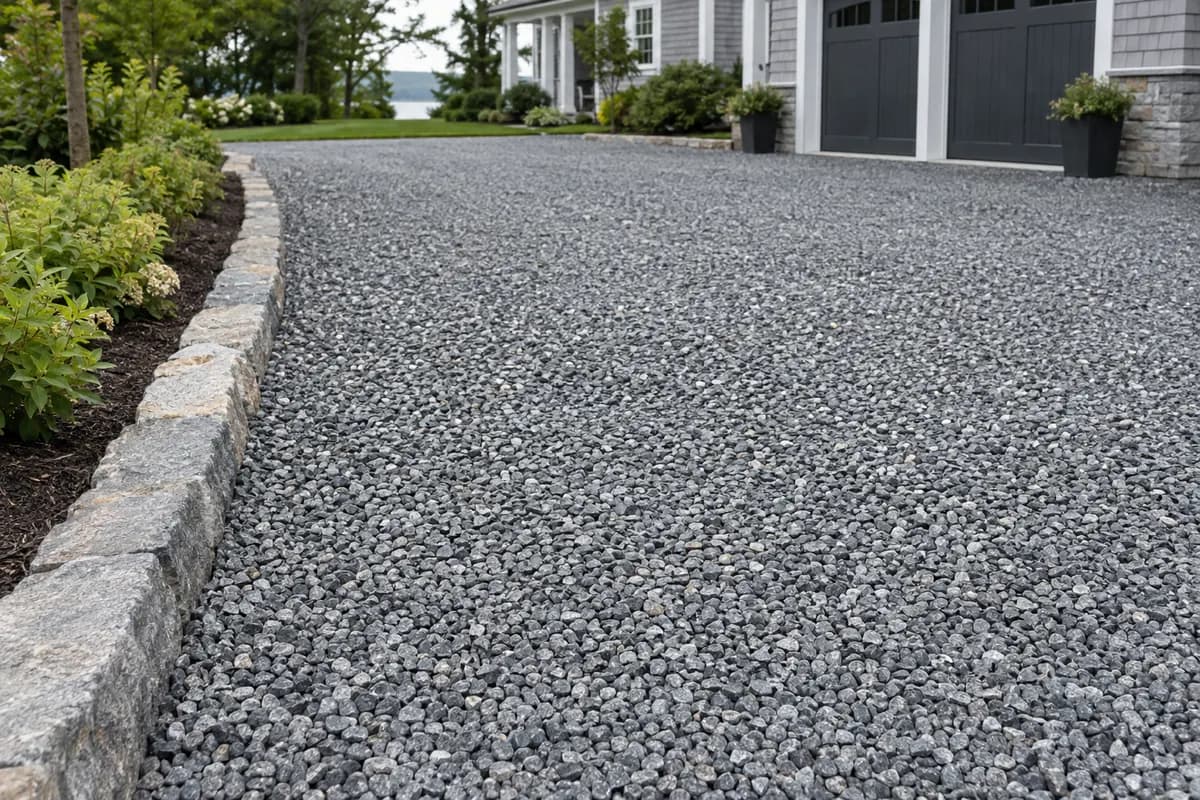
3/4" Crushed Stone is our main pick for the top of a gravel lot. It is gray stone crushed to about 3/4 inch, with sharp, broken faces on every piece. Those faces wedge together under tires, so the surface firms up as cars drive on it instead of spreading out the way round gravel does.[1]
#57 Crushed Stone is a common choice for the layer under the surface. It is a clean, mostly single sized stone that drains fast. In a lot built on wet ground, a layer of #57 lets water move out from under the surface stone so the base does not soften.[1]
#4 Crushed Stone is much larger, roughly fist sized, and suits the bottom of a lot built on soft or muddy ground. The big pieces press into the soil and bridge weak spots, giving the finer stone above a firm platform. The same stone works at an entrance where trucks pull off a paved road.[1]
#67 Stone and #89 Crushed Stone are smaller. #67 can top a lot where a slightly finer, smoother surface is wanted. #89 is too small for traffic on its own, but it fills low spots and smooths a worn surface between full regrades.[1]
 From$4272 ton delivered
3/4" Crushed Stone
Gravel and Crushed Stone- Size
- 3/4 inch
- Weight
- 2,700 lb/yd³
- Color
- Gray
 From$4242 ton delivered
#57 Crushed Stone
Gravel and Crushed Stone- Size
- 3/4 to 1 inch
- Weight
- 2,700 lb/yd³
- Color
- Gray
 From$4372 ton delivered
#67 Stone
Gravel and Crushed Stone- Size
- 3/4 inch and under
- Weight
- 2,700 lb/yd³
- Color
- Gray
 From$4252 ton delivered
#89 Crushed Stone
Gravel and Crushed Stone- Size
- 3/8 inch
- Weight
- 2,700 lb/yd³
- Color
- Gray
What a gravel parking lot needs in a material
A lot surface has to resist turning tires. When a car turns its wheels while standing still, it twists the stone under it. Angular stone holds against that twist much better than rounded stone. Crushed 3/4 inch pieces lock into a mat that stays flat around the spaces where cars turn most.[1]
It has to drain and carry weight at the same time. A lot sheds water over a wide area, and standing water is what softens the ground and starts potholes. The surface stone needs open spaces so rain can pass into the base, and the base needs enough strength to carry loaded vehicles without sinking.[1]
Heavy stone stays in place. A cubic yard of 3/4" Crushed Stone weighs about 2,700 lb. That weight, combined with the locked faces, means tires and plows push less of it to the edges of the lot.[1]
Gray stone keeps a neutral look that suits a church lot, a shop yard or a farm stand. Gray stone hides oil drips and tire marks better than a pale stone, and it pairs well with striping posts or wheel stops if you add them later.[1]
How to install a gravel parking lot
Strip the topsoil and roots over the whole area. Topsoil holds water and compresses, so a lot built on it sinks within a season. Grade the exposed subsoil so it slopes gently to one side or from the center outward, and plan where that water will go, such as a swale or a ditch.[1]
Compact the subsoil with a roller or a plate compactor. On clay or damp ground, roll out a woven stabilization fabric. The fabric keeps the stone from punching into the soil and stops mud from rising into the base after heavy rain.[1]
Build the base next. On firm ground a layer of #57 Crushed Stone or a dense graded stone works. On soft ground, start with a layer of #4 Crushed Stone and press it in before adding finer stone on top. Spread each layer in lifts and compact every lift before the next one goes down.[1]
Spread the 3/4" Crushed Stone as the final layer, grade it to keep the slope you set in the subsoil and roll it until it is firm. The fresh gray surface tightens over the first few weeks of traffic. Top up any soft or low areas once the stone has settled.[1]
How much parking lot gravel do you need
For the surface layer of a lot that sees cars only, 4 inches of 3/4" Crushed Stone is a sound depth. At 4 inches, 100 square feet takes about 1.67 tons.[1]
A lot that carries delivery trucks, trailers or farm equipment needs a deeper section, counting base and surface together. At 6 inches, 100 square feet of 3/4" Crushed Stone takes about 2.50 tons.[1]
Thinner layers fit maintenance work. Refreshing a worn lot with 2 inches of new stone takes about 0.83 tons per 100 square feet. A 3 inch top layer over a sound base takes about 1.25 tons per 100 square feet.[1]
To size the order, measure the length and width of the lot, multiply for square feet, divide by 100 and multiply by the tons for your depth. Add the drive lane and the entrance, which wear fastest. 3/4" Crushed Stone is sold by the ton, and a lot of any size will need several truck loads. The calculator on the site converts the area into tons.[1]
| Project size | 3 inch depth | 4 inch depth |
|---|---|---|
| 100 sq ft | 0.9 cu yd / 1.3 tons | 1.2 cu yd / 1.7 tons |
| 300 sq ft | 2.8 cu yd / 3.8 tons | 3.7 cu yd / 5.0 tons |
| 600 sq ft | 5.6 cu yd / 7.5 tons | 7.4 cu yd / 10.0 tons |
What parking lot gravel costs
Crushed stone for a lot is sold by the ton and delivered in dump trucks. The delivered total depends on the tons, the distance from the supplying quarry or yard, and how many trips the job takes.[1]
Lots need far more stone than a home driveway, so the order can fill several trucks. Larger orders spread each trip across more tons, which helps the overall figure.[1]
The ground under the lot can change the total more than the surface does. Soft ground calls for fabric and a thicker base with larger stone, while firm, well drained ground may need only a modest base under the surface.[1]
Enter your ZIP in the box on the site to see the delivered figure for your area, and call for a quote on a large lot.[1]
Delivered, 2 tons: from $427 to $806 depending on the city (366 cities priced). Enter your ZIP for the exact figure.
Parking lot gravel mistakes to avoid
Building on topsoil is the mistake that ruins the most lots. The organic layer compresses and holds water, and the stone sinks into ruts. Strip it before any stone goes down.[1]
Leaving the lot flat traps water. Rain that cannot run off soaks the base, and every puddle grows into a pothole. Even a slight crown or cross slope moves water to the edges.[1]
Using round pea sized gravel for the surface makes a lot that never firms up. Cars sink and spin in it, and it migrates out of the spaces. Crushed angular stone is the right surface.[1]
Forgetting the entrance apron leads to mud on the road and a broken lot edge. The spot where cars leave pavement and turn onto gravel takes the hardest wear. A thicker layer of larger stone there, capped with the surface stone, keeps that edge from crumbling.[1]
Waiting too long to fix potholes lets them spread. A small low spot fills with water, tires splash the stone out and the hole widens. Rake or grade the surface a few times a year and fill holes with fresh stone as soon as they appear.[1]
Coverage
Browse more
FAQ for parking lot gravel
What is the best gravel for a parking lot?
3/4" Crushed Stone is our main choice for the surface. Its angular 3/4 inch pieces lock together under traffic and still let water drain. Under it, #57 Crushed Stone makes a well draining base, and #4 Crushed Stone works as a bottom layer on soft ground. Avoid round gravel on the surface, since it keeps shifting under tires.
How thick should a gravel parking lot be?
For cars only, plan on at least 4 inches of surface stone, about 1.67 tons per 100 square feet. For trucks and trailers, build deeper. A 6 inch section takes about 2.50 tons per 100 square feet. Soft or wet ground needs a thicker base and fabric under the stone.
Do I need fabric under a gravel parking lot?
On clay, wet or soft ground, a woven stabilization fabric is worth the effort. It keeps the stone from pressing down into the soil and stops mud from pumping up into the base. On firm, sandy or rocky ground, many lots are built without it.
How do I keep a gravel lot from getting potholes?
Give the lot a slope so water drains off, build it on compacted subsoil instead of topsoil, and use angular stone. Grade or rake the surface a few times a year, and fill any low spot with fresh stone as soon as you see it. Small fixes done early stop holes from growing.
How often does a gravel parking lot need new stone?
Traffic slowly pushes stone into the base and toward the edges, so most lots need a top layer now and then. A refresh of 2 inches takes about 0.83 tons per 100 square feet. Busy lots and entrances need it more often than quiet parking rows.