
Use case
Mulch: Material Guide
Mulch is the layer of shredded wood that covers bare soil in planting beds and around trees. It holds moisture in the ground, keeps weeds down and gives a yard a finished look. This guide covers the mulch types we deliver, what a good bed cover has to do, how to spread it and how many cubic yards each depth takes.
Best materials for mulch beds
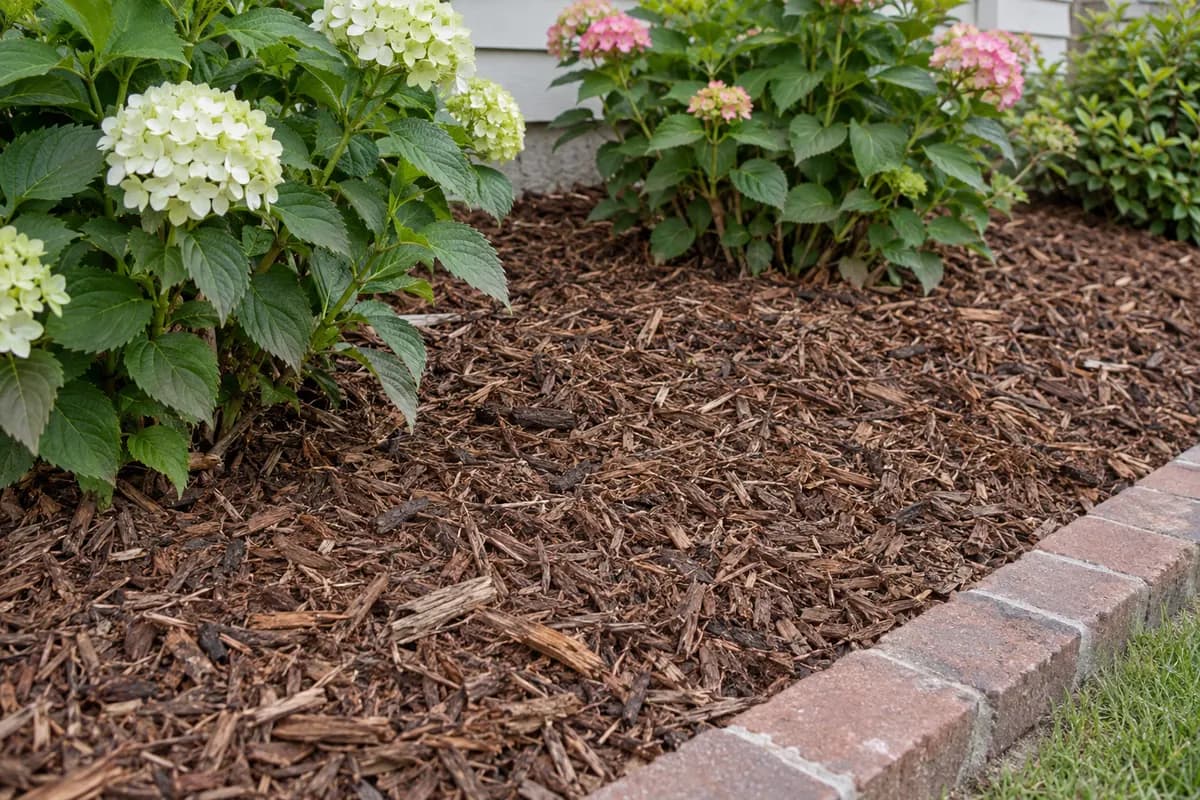
Brown Shredded Mulch is the one we recommend first for most beds. It is double shredded wood in a natural brown, so the strands are fine and fibrous. Those strands mat together after a rain or two, which keeps the layer from blowing off and lets it sit on gentle slopes without sliding down.[1]
Black Shredded Mulch is the same kind of fine shredded wood with a darker color. It gives strong contrast against bright green leaves and light colored house siding. Some owners like it for front beds where the look matters most, and it fades toward gray in strong sun faster than a natural shade.[1]
Red Mulch is shredded wood colored a warm red. It suits beds beside red brick or a home with warm trim, and it stands out in a large yard. Because the color is part of the appeal, it may need a fresh top layer sooner than brown when the sun bleaches it.[1]
Wood Chips are coarser pieces of chipped wood with no added color. They break down slowly and work well under play sets, on informal trails and in wide rings around trees in the back of a yard. They are too chunky for a neat front bed, where the finer shredded types look tidier.[1]
 From$4642 yd delivered
Brown Shredded Mulch
Mulch and Wood- Size
- Double shredded
- Weight
- 800 lb/yd³
- Color
- Brown
 From$4672 yd delivered
Black Shredded Mulch
Mulch and Wood- Size
- Double shredded
- Weight
- 800 lb/yd³
- Color
- Black
 From$4702 yd delivered
Red Mulch
Mulch and Wood- Size
- Double shredded
- Weight
- 800 lb/yd³
- Color
- Red
 From$5722 yd delivered
Wood Chips
Mulch and Wood- Size
- 1 to 3 inches
- Weight
- 700 lb/yd³
- Color
- Natural
What a mulch bed needs in a material
A bed cover has to stay put. Wind, rain and a leaf blower all push loose material around. Double shredded wood knits into a loose mat, so it holds its place better than chunky bark nuggets that roll and float.[1]
It has to let water through. Rain and sprinkler water should pass the mulch and reach the roots. A shredded layer at the right depth is open enough for water and air to move through it, while it still shades the soil and slows evaporation on hot days.[1]
It should feed the soil over time. Wood mulch breaks down slowly from the bottom up. As it does, it adds organic matter to the top of the ground, which helps clay drain better and helps sandy soil hold water. That steady breakdown is the reason a bed needs a new top layer from time to time.[1]
It should be light and easy to handle. A cubic yard of Brown Shredded Mulch weighs about 800 lb, far less than stone of the same volume. One person with a wheelbarrow and a pitchfork can move a full delivery in an afternoon or two, and the load does not crush the lawn on the way to the beds.[1]
How to install mulch
Start with weeding. Pull or dig out existing weeds, roots and all, because mulch slows new weeds but does little against ones already growing. Cut a clean edge along the lawn with a flat spade, angled away from the bed, so grass does not creep into the mulch.[1]
Water the bed well before you spread, especially in dry weather. Mulch keeps moisture in, so it works best over damp soil. If the old mulch has packed into a hard crust, break it up with a rake first so water can pass through it again.[1]
Move the brown mulch from the pile with a pitchfork or a wide shovel and drop it in small heaps around the bed. Spread the heaps by hand or with a rake to an even depth. Work it between plants with your fingers rather than piling it against stems.[1]
Around trees, pull the mulch back so none touches the trunk. A flat ring with a bare gap at the base, wide like a doughnut, protects the bark. A mound packed against the trunk, often called a mulch volcano, holds moisture on the bark and invites rot and pests.[1]
How much mulch do you need
Most beds want 2 to 3 inches of mulch. A 2 inch layer takes about 0.62 cubic yards for every 100 square feet. A 3 inch layer takes about 0.93 cubic yards per 100 square feet and does a better job against weeds in a new bed.[1]
When you are topping up a bed that already has mulch, a thinner fresh layer is enough. Rake the old layer loose, check how much remains, and add just enough to bring it back to about 2 inches.[1]
Deeper layers have a narrow use. At 4 inches, 100 square feet takes about 1.23 cubic yards, a depth that suits a path or a play area covered in wood. At 6 inches, it takes about 1.85 cubic yards, which is too deep for planting beds because it can starve roots of air.[1]
To find your order, measure each bed, add the square feet together, divide by 100 and multiply by the cubic yards for your depth. Brown Shredded Mulch is sold by the yard, so round up to the next whole yard. The calculator on the site turns bed sizes into yards.[1]
| Project size | 3 inch depth | 4 inch depth |
|---|---|---|
| 100 sq ft | 0.9 cu yd | 1.2 cu yd |
| 300 sq ft | 2.8 cu yd | 3.7 cu yd |
| 600 sq ft | 5.6 cu yd | 7.4 cu yd |
What mulch costs
Mulch is sold by the cubic yard and delivered loose in a dump truck. The delivered total depends on how many yards you need, how far the load travels from the supplier and whether the truck can reach a good spot to dump it.[1]
Bulk mulch makes sense once a yard has more than a few small beds. A single truck load replaces a stack of bags, with no plastic to throw away and no repeat trips to a store.[1]
The color you choose can change the delivered figure, since dyed types such as black and red go through an extra step. Natural brown has no added color.[1]
Enter your ZIP in the box on the site to see the delivered figure for your area, then use the calculator to turn your beds into cubic yards.[1]
Delivered, 2 cubic yards: from $464 to $1,363 depending on the city (366 cities priced). Enter your ZIP for the exact figure.
Mulch mistakes to avoid
Piling it too deep is the biggest mistake. Many beds gain a new layer every spring until the old mulch is a thick mat. Roots grow up into it instead of the soil, and water runs off a crusted top. Check the depth before you add more.[1]
Packing mulch against stems and trunks causes damage that shows up slowly. Wet wood against bark keeps it damp, so rot, disease and gnawing rodents get in. Keep a small gap around every stem.[1]
Spreading over weeds wastes material. Strong weeds push through, and grasses spread under the layer. Weed first, and the mulch can do its real job of stopping new seeds from taking hold.[1]
Dumping the pile on the lawn and leaving it for days can kill the grass beneath. Lay a tarp before the delivery, or spread the pile within a day or two of its arrival.[1]
Coverage
Browse more
FAQ for mulch
How deep should mulch be in a flower bed?
Aim for 2 to 3 inches. A 2 inch layer takes about 0.62 cubic yards per 100 square feet, and 3 inches takes about 0.93 cubic yards. Go thinner right next to small plants and keep mulch off their stems. Deeper than that can keep air and water from reaching roots.
Which mulch color should I choose?
Brown suits almost any yard and looks closest to natural forest floor. Black gives strong contrast with green plants and pale walls. Red pairs with brick and warm trim. All three are shredded wood, so the choice is mostly about looks. Dyed colors may fade in strong sun and need a fresh layer sooner.
How often should I add new mulch?
Check beds each spring. Shredded wood breaks down into the soil over time, so most beds need a thin top up every year or two. Rake the old layer first to see how much is left, and add only enough to return to your target depth. Do not keep adding a full layer on top of an old one.
Can I put mulch right after a delivery or does it need to sit?
You can spread it right away. Fresh shredded mulch may feel warm inside the pile, which is normal. Spread it within a day or two so it does not smother the grass under the pile, and open the pile with a pitchfork if you need to leave it longer.
Is mulch better than landscape fabric for weeds?
Mulch alone handles most bed weeds when it is laid at a proper depth over weeded soil. Fabric under mulch can help on paths, but in planting beds it blocks the organic matter that mulch adds to the soil, and weeds can still root in the mulch on top of it. Many gardeners skip fabric in beds they replant.