
Use case
Hardwood Mulch: Material Guide
Hardwood mulch is shredded wood and bark from broadleaf trees, run through a grinder until it turns into soft, stringy strands. Gardeners like it because it locks into place, breaks down into rich soil and looks natural around shrubs and trees. This guide explains how to choose it, spread it, size the order and avoid the habits that turn a good mulch into a problem.
Best materials for hardwood mulch
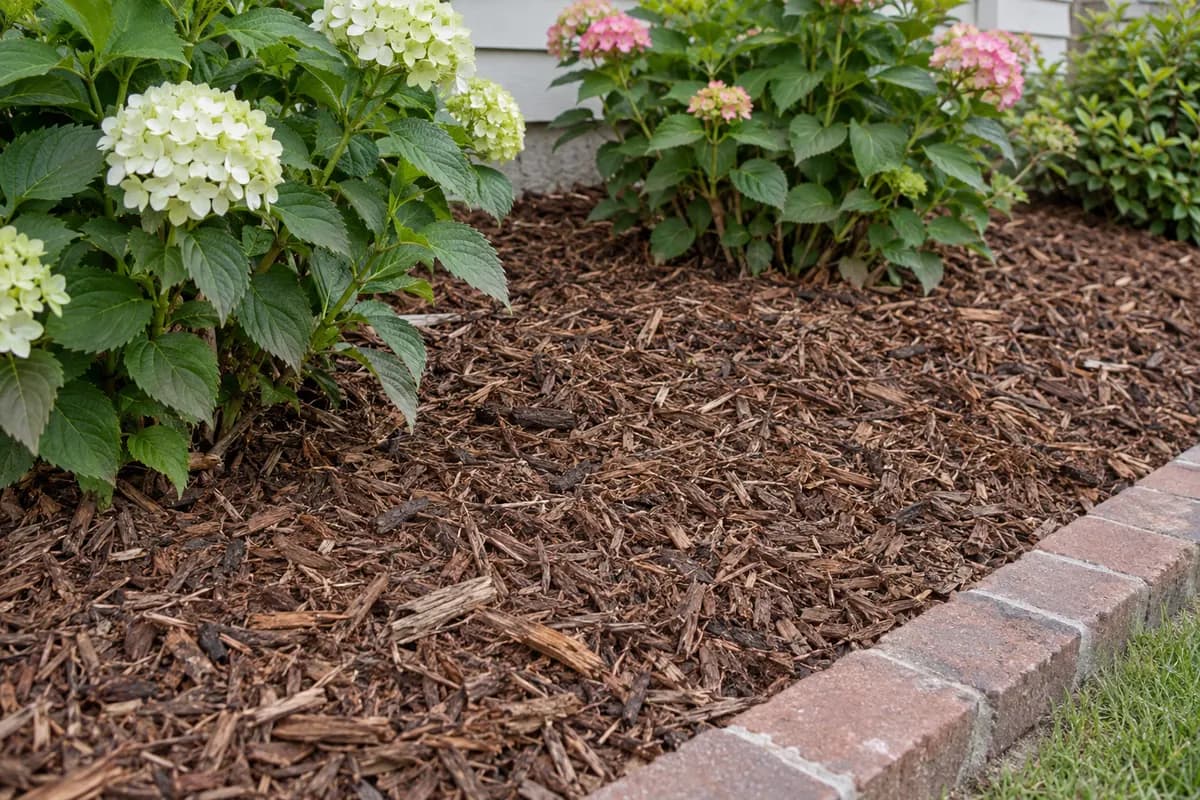
Brown Shredded Mulch is the hardwood mulch we deliver. It is double shredded, meaning the wood passes through the grinder twice, and the second pass tears the pieces into thin, fibrous strands. The color is a natural brown that darkens when wet and settles to a soft tan brown as it dries.[1]
Double shredding is what sets this product apart from coarse bark. Single ground wood leaves thick chunks that sit loosely on the bed. Twice shredded strands are finer and longer, so they tangle with one another like loose felt. That tangle is the reason hardwood mulch holds on a slope where nuggets would roll down.[1]
Black Shredded Mulch and Red Mulch are colored versions of shredded wood. They suit a homeowner who wants a set color in a front bed. For a natural look, for a vegetable border or for a bed you plan to dig into later, plain brown hardwood is the simpler choice, since it carries no added color.[1]
Wood Chips are a rougher option for areas where looks matter less. They last a long time on a woodland trail or under a swing set. In a shrub bed close to the house, the finer hardwood strands give a cleaner finish and feed the soil faster.[1]
 From$4642 yd delivered
Brown Shredded Mulch
Mulch and Wood- Size
- Double shredded
- Weight
- 800 lb/yd³
- Color
- Brown
 From$4672 yd delivered
Black Shredded Mulch
Mulch and Wood- Size
- Double shredded
- Weight
- 800 lb/yd³
- Color
- Black
 From$4702 yd delivered
Red Mulch
Mulch and Wood- Size
- Double shredded
- Weight
- 800 lb/yd³
- Color
- Red
 From$5722 yd delivered
Wood Chips
Mulch and Wood- Size
- 1 to 3 inches
- Weight
- 700 lb/yd³
- Color
- Natural
What hardwood mulch needs in a material
Good hardwood mulch should be shredded fine enough to knit. Hold a handful and pull it apart. The strands should cling together a little and not fall loose like gravel. That knitting is what keeps the layer on a bank during heavy rain and stops wind from blowing it across a patio.[1]
It should be mostly wood and bark with little soil or trash mixed in. Clean shredded wood breaks down evenly and leaves a dark crumbly layer at the soil line. A bed lined with that layer over a few seasons gains a richer, looser top soil that roots like.[1]
It should have a fresh, earthy smell. A sour smell, like vinegar, means the pile sat wet and packed without air. Spread that mulch thin and let it air out before it goes around tender plants. A good brown hardwood smells like a forest floor.[1]
It should be light on the barrow. A cubic yard of Brown Shredded Mulch weighs about 800 lb. Compared with stone or soil, that is easy to fork and push, which matters when a delivery has to travel around the side of a house to a back bed.[1]
How to install hardwood mulch
Clear the bed down to bare soil. Pull weeds by the root, rake out leaves and loose sticks, and trim back any plants that hang over the ground you plan to cover. Edge the bed with a spade so the line between lawn and mulch stays crisp.[1]
On a slope, start at the bottom of the bank and work up. Spread a layer, press it down with the back of a rake and soak it with a hose. The water helps the strands lock into one another. Each new strip upslope then anchors into the one below it.[1]
On flat beds, fork the mulch into small heaps spaced across the bed and level them with a rake. Fluff the layer with your hands near small plants so it does not cover their crowns. Water it once after spreading so it settles and starts to bind.[1]
Leave a clear space around every trunk and shrub stem. Bark that stays damp under wood strands softens and decays. A visible ring of bare soil a hand width wide at the base of each plant is enough, and the brown layer can flare out from there.[1]
How much hardwood mulch do you need
A shrub bed that already has some cover needs only a refresh. Bring it to 2 inches, which takes about 0.62 cubic yards of Brown Shredded Mulch for every 100 square feet of fresh coverage.[1]
A new bed of bare soil does best with 3 inches. That depth takes about 0.93 cubic yards per 100 square feet and gives enough shade at the soil line to keep weed seeds from sprouting while new plants fill in.[1]
Thicker layers belong on paths and work zones, not around plants. A 4 inch path of shredded wood takes about 1.23 cubic yards per 100 square feet. At 6 inches the figure rises to about 1.85 cubic yards, a depth that only makes sense where nothing grows.[1]
For your order, multiply the length by the width of each bed, add the beds, divide by 100 and multiply by the cubic yards for the depth. Brown Shredded Mulch is sold by the yard, so round up. The calculator on the site also handles round tree rings.[1]
| Project size | 3 inch depth | 4 inch depth |
|---|---|---|
| 100 sq ft | 0.9 cu yd | 1.2 cu yd |
| 300 sq ft | 2.8 cu yd | 3.7 cu yd |
| 600 sq ft | 5.6 cu yd | 7.4 cu yd |
What hardwood mulch costs
Hardwood mulch is sold by the cubic yard and dumped loose from the truck. The delivered total depends on the number of yards, the distance from the supplier and whether the driver can get close to the spot where you want the pile.[1]
Because mulch is light and bulky, a truck fills by volume long before it reaches its weight limit. A larger order shares one trip across more yards, so buying for every bed at once is sensible.[1]
Natural brown hardwood skips the coloring step that black and red mulch go through. That is one of the reasons many gardeners pick it for large areas.[1]
Put your ZIP in the box on the site to see the delivered figure for your area.[1]
Delivered, 2 cubic yards: from $464 to $1,363 depending on the city (366 cities priced). Enter your ZIP for the exact figure.
Hardwood mulch mistakes to avoid
Burying the crowns of perennials is a common error. Shredded hardwood packs into a mat, and a plant crown buried under it stays wet and may rot. Spread thinner near small plants and pull the layer back from their centers.[1]
Turning fresh mulch into the soil before planting can slow young plants. Raw wood mixed deep into the ground draws on soil nitrogen as it breaks down. Leave fresh hardwood on top, where it rots slowly and feeds the bed from above.[1]
Letting a delivery sit in a tall pile for weeks lets the center pack and turn sour. Spread it soon, or turn the pile now and then so air can reach the middle.[1]
Laying hardwood right up against a wooden deck or the siding of a house keeps those surfaces wet. Leave a strip of gravel or bare ground between the mulch and the building so it can dry.[1]
Raking the bed only once a year lets the top crust over and turn gray. A light fluff with a rake in midsummer breaks the crust, lets rain soak in again and brings the brown color back to the surface.[1]
Coverage
Browse more
FAQ for hardwood mulch
What is the difference between hardwood mulch and other mulch?
Hardwood mulch comes from broadleaf trees and is shredded into fine strands, while many bark products come in coarse chunks or nuggets. The double shredded strands of Brown Shredded Mulch knit together, stay in place on slopes and break down faster into the soil, which feeds the bed over time.
Is hardwood mulch good for vegetable gardens?
It works well on the paths between vegetable rows and as a top layer around large plants such as tomatoes once the soil has warmed. Keep it on the surface instead of digging it in, because raw wood in the soil can draw nitrogen away from young crops while it breaks down.
How much hardwood mulch do I need for a new bed?
Plan on 3 inches for bare soil. That takes about 0.93 cubic yards for every 100 square feet. Measure the bed, divide the square feet by 100 and multiply by that figure, then round up to the next whole yard so you have enough to finish the edges.
Will hardwood mulch attract termites?
Mulch does not draw termites from far away, but any damp wood next to a house can give them cover. Keep mulch a short distance back from the foundation and siding, keep it thin near the house, and let that strip dry. Those habits help with any wood mulch.
Why does my new mulch have white threads in it?
The white threads are fungi that help break down the wood. They are a normal part of healthy mulch and do not harm plants. Rake the layer to loosen it if you do not like the look, and they fade as the surface dries out.