
Use case
Garden Path Gravel: Material Guide
A garden path gets daily foot traffic, wheelbarrow trips and the odd hose dragged across it, and it still has to look at home between the beds. The right gravel stays put, drains after rain and stays comfortable to walk on. This guide compares the stones that work, explains how to build the path in layers and shows how many tons each depth takes.
Best materials for a garden path
Walkway Gravel is our main pick for garden paths. It is a crushed stone screened to about 3/8 inch, in a mixed color that blends with soil, bark and green foliage. Because the pieces are crushed, each one has flat, broken faces. Under a few weeks of footsteps those faces settle against each other, and the path firms up instead of rolling away from your shoes.[1]
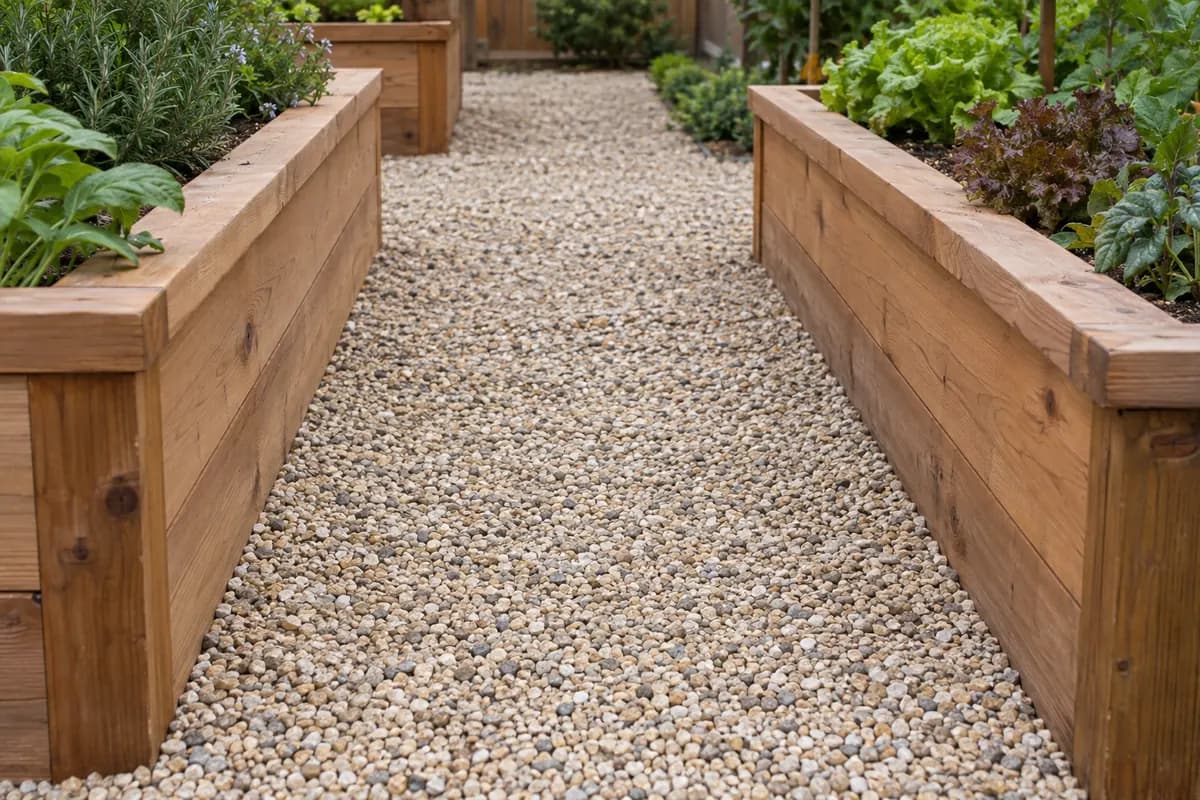
Pea Gravel is the rounded cousin. It is about the same small size, but tumbled smooth, so it feels soft under bare feet and pours easily from a shovel. That smoothness is also its weakness on a path. The round stones keep shifting, so a Pea Gravel walk feels a little loose and needs firm edging to stay inside its lines.[1]
Decomposed Granite suits a path that should feel almost paved. It is weathered granite with plenty of fine grit, and it packs into a smooth, level tread when it is dampened and tamped. It works well for a formal walk or a route a wheelchair must use. On a slope it can wash, so it needs a gentle grade and a solid border.[1]
River Rock is too large and lumpy to walk on, but it earns a place beside the path. A band of it along the edge frames the walk, catches splash from the beds and gives roof water a place to run. Many gardens pair a Walkway Gravel tread with a River Rock border for that reason.[1]
 From$4242 ton delivered
Walkway Gravel
Driveway and Landscaping- Size
- 3/8 inch
- Weight
- 2,600 lb/yd³
- Color
- Mixed
 From$4162 ton delivered
Pea Gravel
Driveway and Landscaping- Size
- 3/8 inch
- Weight
- 2,600 lb/yd³
- Color
- Mixed tan and brown
 From$4582 ton delivered
River Rock
Driveway and Landscaping- Size
- 1 to 3 inches
- Weight
- 2,600 lb/yd³
- Color
- Mixed earth tones
 From$4702 ton delivered
Decomposed Granite
Driveway and Landscaping- Size
- 1/4 inch and fines
- Weight
- 2,500 lb/yd³
- Color
- Gold to tan
What a garden path needs in a material
A path stone has to lock. Loose, rolling gravel tires the legs and kicks out onto the lawn. Angular pieces near 3/8 inch are small enough to feel even underfoot and large enough that they do not stick to shoe soles and ride into the house.[1]
It has to drain. Garden paths run between watered beds and catch runoff from both sides. Clean crushed stone has open spaces between the pieces, so water sinks through instead of standing in puddles. A path that dries fast after the sprinkler runs stays usable and grows fewer weeds on its surface.[1]
It should look right next to plants. A mixed color reads as natural, since it holds a little of every shade found in a garden. Bright white stone glares in full sun and shows every dropped leaf, while a dark stone can look heavy beside small perennials. A blended tone hides dust and soil that drift onto the tread.[1]
It should be heavy enough to stay where you raked it. A cubic yard of Walkway Gravel weighs about 2,600 lb, so a hard rain or a leaf blower moves little of it. Lighter materials such as bark chips float off in a storm and leave thin spots on the walk.[1]
How to install a garden path
Lay out the route with a garden hose or marking paint, and walk it a few times before you dig. Gentle curves feel better than sharp corners, and a path wide enough for a wheelbarrow saves trouble later. Strip the sod and roots inside the lines and dig down to firm soil, keeping the bottom roughly level from side to side.[1]
Set the edging next. Steel strips, plastic edging staked into the ground, brick on end or a row of flat stones all work. The edge should sit slightly above the finished gravel so stones stay in and soil from the beds stays out. Without an edge, even crushed stone creeps into the lawn over a season.[1]
Roll landscape fabric over the dug-out bed and tuck it up against the edging. The fabric stops the gravel from sinking into the soil and slows weeds coming up from below. On soft clay, a thin layer of compacted base under the fabric gives the walk a firmer floor.[1]
Spread the Walkway Gravel with a shovel and a steel rake, then wet it down and run a hand tamper or a plate compactor over it. Rake once more to level any low spots. The mixed color stone looks dusty at first, and the first good rain washes the fines down and brings the true color up.[1]
How much garden path gravel do you need
For a path over firm, well drained soil, 2 inches of Walkway Gravel is a good tread layer. That depth takes about 0.80 tons for every 100 square feet. A deeper 3 inch layer takes about 1.20 tons per 100 square feet and gives a softer feel and more room to rake.[1]
A path that carries a wheelbarrow, a garden cart or heavy foot traffic benefits from a deeper bed. At 4 inches, 100 square feet takes about 1.60 tons. That depth also suits a walk across soft ground, where some stone will press down into the soil at first.[1]
A 6 inch depth is more than most garden walks need. It takes about 2.41 tons per 100 square feet and fits a service path that doubles as a route for a small tractor or a mower.[1]
To work out your order, measure the length and the average width of the path, multiply them for square feet, divide by 100, and multiply by the tons for your chosen depth. Walkway Gravel is sold by the ton, so round up and keep a little extra for top ups. The area calculator on the site does the math for you.[1]
| Project size | 3 inch depth | 4 inch depth |
|---|---|---|
| 100 sq ft | 0.9 cu yd / 1.2 tons | 1.2 cu yd / 1.6 tons |
| 300 sq ft | 2.8 cu yd / 3.6 tons | 3.7 cu yd / 4.8 tons |
| 600 sq ft | 5.6 cu yd / 7.2 tons | 7.4 cu yd / 9.6 tons |
What garden path gravel costs
Walkway Gravel is sold by the ton and arrives by dump truck. Your delivered total depends on how many tons you order, how far the truck travels from the yard that supplies it and how easy the drop spot is to reach.[1]
A garden path is a small order compared with a driveway, so the trip itself is a large share of the bill. Folding other jobs into the same load, such as a patio refresh or stone for a downspout, puts more material on one truck.[1]
Depth drives the order more than anything else. A neat 2 inch tread over a well dug bed uses far less stone than a deep fill poured onto soft ground to make up for poor prep, so time spent on the dig saves tons.[1]
Type your ZIP into the box on the site to see the delivered figure for your area, then plug your path size into the calculator.[1]
Delivered, 2 tons: from $424 to $878 depending on the city (366 cities priced). Enter your ZIP for the exact figure.
Garden path mistakes to avoid
Skipping the edge is the most common mistake. Stones migrate into the lawn, the mower throws them, and the path loses its shape within a season. An edge set slightly proud of the gravel solves it.[1]
Laying gravel straight onto sod is the next. Grass and weeds grow up through the stone, and the soil underneath mixes in and turns the path muddy. Strip the turf, add fabric and give the stone a clean bed.[1]
Choosing the wrong stone for the job causes trouble too. A deep layer of round Pea Gravel on a busy walk feels like walking on marbles, and a large decorative rock leaves no flat place to step. For a path people use every day, small crushed stone stays firmer.[1]
Forgetting drainage ruins good work. A path dug lower than the beds beside it becomes a channel in a storm, and the water carries soil and mulch onto the stone. Keep the finished surface level with the ground or a touch above it, and the mixed color tread stays clean.[1]
Coverage
Browse more
FAQ for garden path gravel
What is the best gravel for a garden path?
Walkway Gravel is our first choice. It is crushed stone about 3/8 inch across, so its broken faces settle together and make a firm tread that still drains. Pea Gravel feels softer but shifts more, and Decomposed Granite packs smoother but can wash on a slope. Pick by how the path will be used and how formal you want it to look.
How deep should a gravel garden path be?
A path over firm soil does well with 2 inches of stone, which takes about 0.80 tons per 100 square feet. For carts, wheelbarrows or soft ground, go to 4 inches, about 1.60 tons per 100 square feet. Dig the bed to match, so the finished surface sits level with the ground beside it.
Do I need landscape fabric under a gravel path?
Fabric is worth it on almost every garden path. It keeps the stone from sinking into the soil, stops the soil from rising into the stone and slows weeds that sprout from below. It will not stop seeds that blow onto the surface, so plan to pull a few weeds or rake the path now and then.
Will crushed gravel stick to shoes and come into the house?
Stone around 3/8 inch is large enough that it rarely lodges in shoe treads, and the angular pieces lock in place once tamped. A short stretch of pavers or a mat at the door catches the odd stone. Fine materials such as Decomposed Granite track indoors more, especially when the path is wet.
How do I keep a gravel path from spreading into the lawn?
Use a firm edge and set it a little higher than the finished stone. Steel or staked plastic edging is easy to bend around curves, while brick or stone gives a heavier, more formal line. Rake stray stones back after mowing, and top up thin spots instead of piling extra stone at the edges.