
Use case
French Drain Gravel: Material Guide
A French drain is a sloped trench filled with stone, often with a perforated pipe at the bottom, that collects ground water and carries it away. The stone does most of the work. Drain Rock, a washed gray stone with wide gaps, is the fill that keeps the trench flowing for years. Here is how to pick it, place it and order the right amount.
Best materials for a French drain
Drain Rock is the fill for a French drain. The stones run from 3/4 to 1-1/2 inches, washed, gray and angular. Water that soaks into the soil beside the trench finds the open gaps in the stone, drops to the pipe and runs downhill to the outlet. Every gap kept free of fines is a path for that water.[1]
The washed finish is the reason to choose it. Rock straight from the crusher carries dust, and dust packed into a trench acts like a sponge that never wrings out. Drain Rock goes through a rinse that strips the fines away, so the trench starts with clean voids from top to bottom.[1]
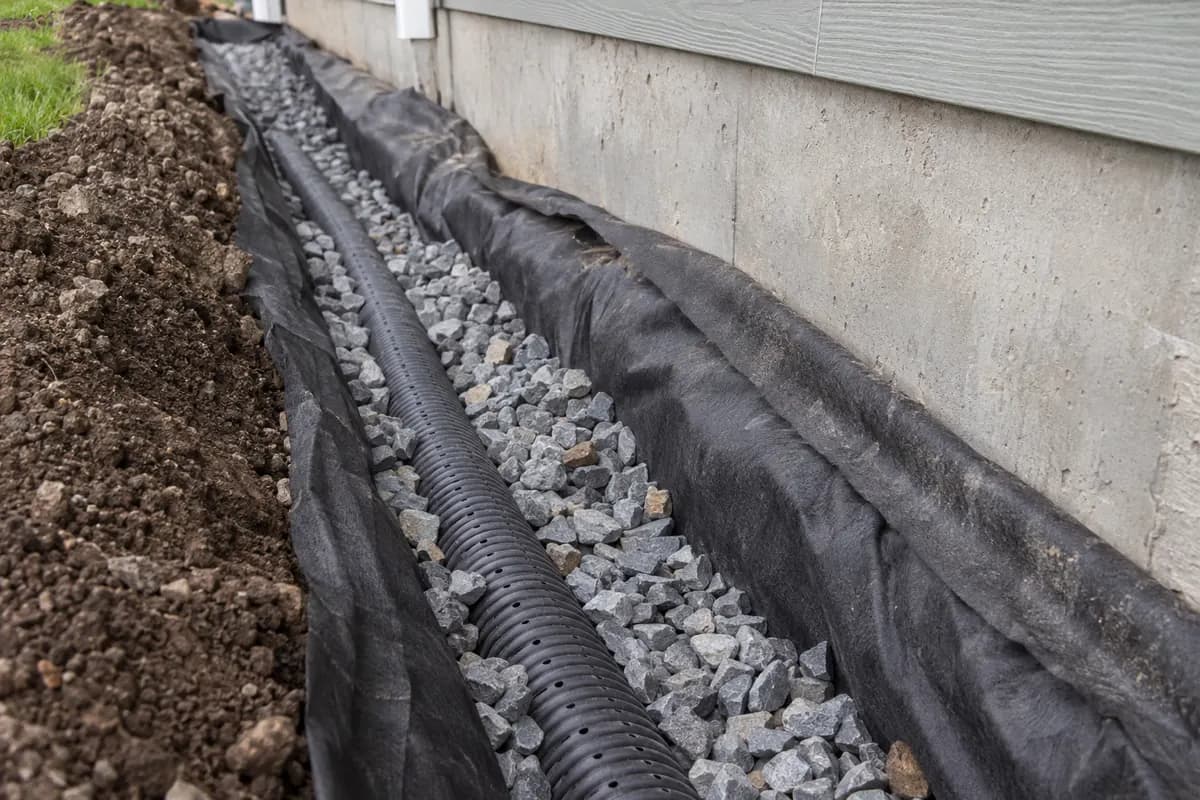
A perforated pipe and a fabric wrap round out the build. The pipe speeds water along the bottom of the trench. The fabric, a non-woven geotextile, wraps the stone like a sleeve and keeps the soil around the drain from washing into it. The stone holds the shape of the trench and carries water to the pipe.[1]
Some short drains skip the pipe and use stone alone. A trench of Drain Rock with no pipe still moves water, only more slowly, and it suits a short run that empties into a dry well or a low corner of the yard. A long drain or one that takes a lot of water does better with a pipe in the bed.[1]
 From$4252 ton delivered
Drain Rock
Drainage and Base- Size
- 3/4 to 1-1/2 inches
- Weight
- 2,700 lb/yd³
- Color
- Gray
 From$4242 ton delivered
#57 Crushed Stone
Gravel and Crushed Stone- Size
- 3/4 to 1 inch
- Weight
- 2,700 lb/yd³
- Color
- Gray
 From$4372 ton delivered
#67 Stone
Gravel and Crushed Stone- Size
- 3/4 inch and under
- Weight
- 2,700 lb/yd³
- Color
- Gray
 From$4252 ton delivered
#89 Crushed Stone
Gravel and Crushed Stone- Size
- 3/8 inch
- Weight
- 2,700 lb/yd³
- Color
- Gray
What a French drain needs in a material
A French drain needs stone that stays open for a long time. Soil, roots and silt are always trying to move in. A rock with fines starts the clogging on day one. Washed angular stone in the 3/4 to 1-1/2 inch range leaves big enough channels that a little silt does not shut the flow down.[1]
The pieces must bridge over the pipe holes without falling into them. Stones near the top of the size range sit across the perforations and let water in without blocking the pipe. Fine stone can wash into the pipe and settle along the bottom.[1]
The stone has to carry the weight above it. A French drain may run under lawn, a walkway or a planted strip. Crushed rock holds its shape under that load and does not compress the way soil or sand does. At about 2,700 lb per cubic yard, it also stays put when the trench fills with storm water.[1]
Durability is the last need. The trench gets wet, dries out and may freeze through many seasons. Hard crushed rock goes through those cycles without breaking down into sand that would plug the gaps.[1]
How to install a French drain
Map the run. Mark where the water collects and where the drain will empty, such as a lower part of the yard, a dry well or a curb outlet. The trench must slope downhill along its whole length. A string line pulled tight between stakes and a line level show the fall.[1]
Dig the trench. Make it wide enough for the pipe with room for stone on both sides, and deep enough to catch the water you are after. Keep the bottom smooth and sloped, with no dips. Pile the spoil on a tarp so the lawn stays clean.[1]
Line the trench with fabric. Lay non-woven fabric along the bottom and up both walls, with a wide flap left on each side to fold over the top. This sleeve is what keeps the stone clean for years.[1]
Add stone and pipe. Pour a bed of Drain Rock a couple of inches deep along the bottom, set the perforated pipe on it with its holes as the maker directs, and check the slope again. Cover the pipe with more Drain Rock until the stone sits a few inches below the lawn line.[1]
Close and finish. Fold the fabric flaps over the stone so they overlap, then backfill with soil and sod, or leave the stone exposed and top it with a decorative layer. Run a hose into the high end to see water come out at the outlet.[1]
How much French drain gravel do you need
French drain trenches are narrow but deep, so figure the stone by volume. Multiply the trench length by its width to get the floor area in square feet. Then use the depth of the stone to find the tons. Drain Rock over 100 square feet takes about 2.50 tons for every 6 inches of depth.[1]
For shallow sections or a stone cap near the surface, the smaller figures help. A 2 inch layer takes about 0.83 tons per 100 square feet, a 3 inch layer about 1.25 tons, and a 4 inch layer about 1.67 tons.[1]
Take the pipe out of the count only on large drains. In a narrow trench, the pipe takes a small share of the space and the stone settles around it, so most installers order as if the trench were solid stone. That margin covers uneven walls and the bed under the pipe.[1]
Drain Rock is sold by the ton. Round up the total, then use the calculator on the site to check each section if the trench changes width or depth along its run.[1]
| Project size | 3 inch depth | 4 inch depth |
|---|---|---|
| 100 sq ft | 0.9 cu yd / 1.3 tons | 1.2 cu yd / 1.7 tons |
| 300 sq ft | 2.8 cu yd / 3.8 tons | 3.7 cu yd / 5.0 tons |
| 600 sq ft | 5.6 cu yd / 7.5 tons | 7.4 cu yd / 10.0 tons |
What French drain gravel costs
Drain Rock is sold by the ton, and the total for a French drain comes from the tons in the trench and the trucking to your yard. A long or deep drain uses more stone than its narrow footprint suggests, so measure depth along with length and width.[1]
The stone is a modest part of a French drain project. Digging the trench, the pipe and the fabric all take time and money on top of it. Buying the right amount of stone in one load avoids a second delivery after the trench is already open and waiting.[1]
Drop location matters on drain jobs. A trench along a house or a back fence may sit far from the drive. Ask the driver to dump close to the work, or plan for many wheelbarrow trips. The ZIP box on the site shows delivered figures for your address.[1]
Delivered, 2 tons: from $425 to $764 depending on the city (366 cities priced). Enter your ZIP for the exact figure.
French drain mistakes to avoid
Filling the trench with the wrong stone. Base stone, crusher run or any mix with fines packs into a solid that water cannot pass. Use washed Drain Rock in the 3/4 to 1-1/2 inch range.[1]
Leaving out the fabric sleeve. Without fabric, fine soil washes into the stone over a few seasons and the drain slowly stops working. Wrap the stone fully, with the flaps overlapping on top.[1]
Losing the slope. A trench that levels out or dips along its run leaves standing water in the pipe. Check the fall every few feet as you dig and again after the bedding stone goes in.[1]
Running the drain to nowhere. A French drain has to empty somewhere lower than its high end. A trench that ends in a flat spot or against a wall only moves the problem a few feet.[1]
Burying the stone too deep under soil. If the goal is to catch surface water, stop the backfill a few inches short and leave the top of the gray stone open or covered only with a thin layer of gravel, so water can reach it.[1]
Coverage
Browse more
FAQ for french drain gravel
What is the best gravel for a French drain?
Washed angular stone from about 3/4 to 1-1/2 inches, such as Drain Rock, is the standard fill. It leaves wide gaps for water, bridges over the pipe holes and does not break down underground. Avoid any stone with fines or dust in it, since those fines clog the trench.
Do I need a pipe in a French drain?
A pipe is the better choice for long runs or for drains that carry a lot of water, because it moves water faster than stone alone. A short run into a dry well or a low corner can work with Drain Rock only. Either way, wrap the stone in fabric.
How deep should French drain gravel be?
Put a couple of inches of Drain Rock under the pipe and fill above it until the stone sits a few inches below the surface. The full depth depends on how deep the water sits. Each 6 inches of stone depth over 100 square feet takes about 2.50 tons.
Should French drain gravel be covered?
It can be. Most drains fold the fabric over the stone and finish with soil and sod. If the drain is meant to catch surface water, leave the stone open at the top or cover it with a thin layer of gravel instead of soil.
Can I reuse old gravel in a French drain?
Only if it is clean and free of soil. Old gravel dug from a drive or a failed drain may carry fines that clog a new trench quickly. Fresh washed Drain Rock is the safer fill when the drain is meant to last.