
Use case
Drainage Gravel: Material Guide
Drainage gravel gives water somewhere to go. It fills dry wells, backs up retaining walls, wraps foundation pipe and turns soggy low spots into firm ground. The stone for the job is Drain Rock, a clean gray rock with wide gaps between the pieces. This guide explains why it works, how to place it in common drainage jobs and how much to order.
Best materials for drainage gravel
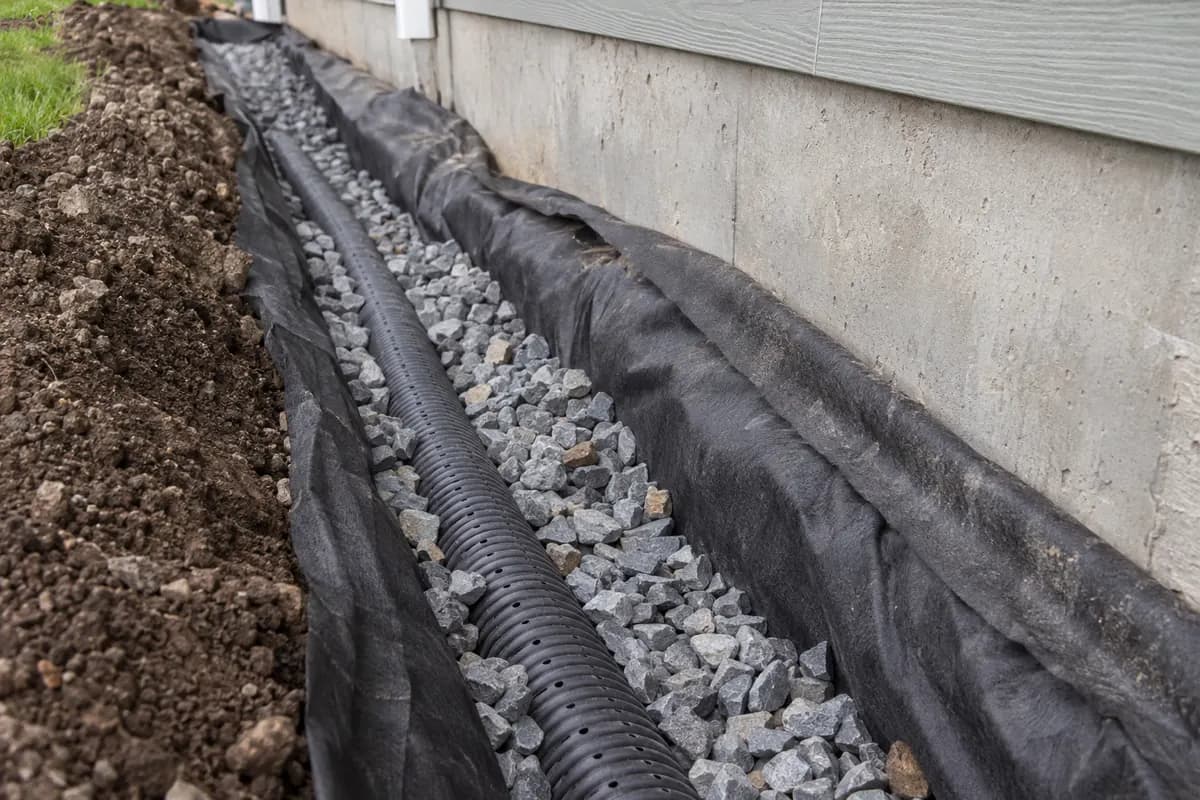
Drain Rock is the core product. It is washed crushed rock from 3/4 to 1-1/2 inches, gray, with the sand and dust taken out. With no fines to plug the spaces, a bed of it holds a large share of open air, and water moves through that air quickly.[1]
The angular faces matter almost as much as the size. Broken rock stacks with gaps that stay open even under the weight of soil above it. In a dry well or behind a wall, the stone carries the load from the backfill and still leaves channels for water.[1]
Drain Rock covers most residential drainage jobs. Use it to fill a dry well that takes roof water, to back up a block or timber retaining wall, to bed a perforated pipe along a footing, to build a soak-away pit at the end of a downspout line, and to make a free-draining layer under a gravel patio on heavy soil.[1]
Choose a dense, graded stone with fines only where you need a firm surface, such as a driveway on top of a drainage layer. Keep the two jobs apart. Mixing a base stone into a drain bed fills the voids and slows the water to a crawl.[1]
 From$4252 ton delivered
Drain Rock
Drainage and Base- Size
- 3/4 to 1-1/2 inches
- Weight
- 2,700 lb/yd³
- Color
- Gray
 From$4242 ton delivered
#57 Crushed Stone
Gravel and Crushed Stone- Size
- 3/4 to 1 inch
- Weight
- 2,700 lb/yd³
- Color
- Gray
 From$4372 ton delivered
#67 Stone
Gravel and Crushed Stone- Size
- 3/4 inch and under
- Weight
- 2,700 lb/yd³
- Color
- Gray
 From$4252 ton delivered
#89 Crushed Stone
Gravel and Crushed Stone- Size
- 3/8 inch
- Weight
- 2,700 lb/yd³
- Color
- Gray
What drainage gravel needs in a material
Open space comes first. A clean stone of one size range leaves voids, and those voids hold and pass water. Any sand, silt or rock dust in the load sits in those gaps and blocks them. Washed Drain Rock arrives without that dust, so the flow paths are there on day one.[1]
Size has to fit the job. Pieces from 3/4 to 1-1/2 inches are large enough to leave wide channels and small enough to pack around pipe and fill corners. Smaller stone drains more slowly. Much larger stone leaves gaps that soil can fall into from above.[1]
The rock must stay put. Drainage stone sits underground for decades and carries soil, lawn and sometimes a wall. Hard crushed rock does not rot, swell or break down in water, and at about 2,700 lb per cubic yard it does not float or shift when the hole fills during a storm.[1]
Fabric is part of the system. Even the best stone clogs if soil can wash into it. A wrap of non-woven geotextile around the stone, or at least between the stone and the soil above, keeps silt out. The fabric lets water pass while holding back the fine soil.[1]
How to install drainage gravel
Plan where the water ends up. Drainage stone moves water, but it has to move it somewhere: a lower part of the yard, a dry well, a street gutter or a pipe outlet. Walk the yard in a rain if you can, and note where water comes from and where it pools.[1]
Dig the hole or trench. For a dry well, dig a pit sized to the roof area it will take. For wall backfill, leave a strip of open space behind the wall face from the footing to near the top. Keep the sides firm so soil does not fall in while you work.[1]
Line it with fabric. Lay non-woven fabric across the bottom and up the sides, with enough left over to fold across the top. Overlap any seams by a hand width or more so soil cannot slip through the joint.[1]
Place the stone. Tip Drain Rock in from a wheelbarrow or straight from a loader bucket, working up in layers. Around pipe, set a bed of stone first, lay the pipe with its holes as the maker directs, then cover it. Behind a wall, place the stone as each course of block goes up.[1]
Close the top. Fold the fabric over the stone, then cap it with soil and sod, mulch or a decorative layer. Leave the top of a dry well or a downspout pit easy to find in case you need to inspect it later.[1]
How much drainage gravel do you need
Shallow drainage layers are measured like any surface. Under a gravel patio on clay, 2 inches of Drain Rock takes about 0.83 tons per 100 square feet, and 3 inches takes about 1.25 tons.[1]
Deeper beds are common in drainage work. A 4 inch layer over 100 square feet takes about 1.67 tons. A 6 inch layer, a good depth for a drainage bed under a shed on wet ground, takes about 2.50 tons per 100 square feet.[1]
Pits and trenches go deeper still. Work out the floor area of the pit or the length times the width of the trench, then stack the 6 inch figure once for each 6 inches of depth. A trench that is twice as deep needs twice the stone.[1]
Drain Rock is sold by the ton. Round the total up, since stone settles a little and the walls of a dig are rarely straight. The calculator on the site handles the arithmetic for a single area.[1]
| Project size | 3 inch depth | 4 inch depth |
|---|---|---|
| 100 sq ft | 0.9 cu yd / 1.3 tons | 1.2 cu yd / 1.7 tons |
| 300 sq ft | 2.8 cu yd / 3.8 tons | 3.7 cu yd / 5.0 tons |
| 600 sq ft | 5.6 cu yd / 7.5 tons | 7.4 cu yd / 10.0 tons |
What drainage gravel costs
Drain Rock is sold by the ton, and your total is set by how many tons the job needs and the trucking to your site. Washed stone goes through an extra rinse, but tonnage and hauling usually shape the bill more than the stone itself.[1]
Deep drainage work uses a lot of stone. A pit or trench may take several tons even when its footprint looks small. Measure the depth along with the length and width before you order, so the truck brings enough in one trip.[1]
Placement matters too. If the truck can dump close to the dig, you save hours of wheelbarrow work. If the site is tight, ask for the load to be dropped on a tarp near the closest open area. The ZIP box on the site shows current delivered figures.[1]
Delivered, 2 tons: from $425 to $764 depending on the city (366 cities priced). Enter your ZIP for the exact figure.
Drainage gravel mistakes to avoid
Using a stone with fines. Base stone and screened mixes pack tight and slow water. Drainage needs washed stone with open gaps, such as Drain Rock.[1]
Leaving out the fabric. Soil washes into unprotected stone over a few years and turns a drain into a buried mud pocket. Wrap the stone, or at least cap it with fabric before the soil goes back.[1]
Building a drain with no outlet. Stone holds water only until its voids fill. Without a way out to lower ground or a pipe, the water rises back to the surface. Plan the exit first.[1]
Sloping the wrong way. A trench or pipe bed that dips in the middle holds a puddle underground. Check the fall with a level along its length before the stone goes in.[1]
Ordering too little. Drain work is deeper than most surface jobs. A pit only a few feet across can still need a full ton or more of gray stone. Measure all three sides of the dig.[1]
Coverage
Browse more
FAQ for drainage gravel
What size gravel is best for drainage?
Clean stone from about 3/4 to 1-1/2 inches, such as Drain Rock, drains well for most yard jobs. The pieces leave wide gaps for water and still pack around pipe. Smaller stone drains slower, and any stone with dust or fines in it clogs much sooner.
Can I use small rounded gravel for drainage?
Small rounded stone does pass water, but its smaller gaps fill with silt faster, and it rolls instead of holding its shape behind a wall. For dry wells, wall backfill and pipe beds, washed angular Drain Rock is the sturdier pick.
Do I need fabric with drainage gravel?
Yes, for almost every buried drain. Non-woven fabric lets water in while keeping soil out of the stone. Without it, silt slowly fills the voids and the drain stops working. Wrap the stone fully or at least lay fabric over the top before backfilling.
How deep should drainage gravel be under a patio?
On heavy soil, a layer of about 4 inches of Drain Rock under the patio base gives water room to spread out and leave. That depth takes about 1.67 tons per 100 square feet. On sandy ground that drains on its own, a thin layer or none may be enough.
Does drainage gravel need to be compacted?
Light tamping is fine to settle the stone, but heavy compaction is not needed and can crush corners and close gaps. Clean angular stone locks into a stable bed under its own weight. Save the plate compactor for the base layers that sit on top of the drain.