
Use case
Decorative Gravel: Material Guide
Decorative gravel is stone chosen for how it looks as much as for what it does. It fills planting beds, rings trees, edges walks and turns bare corners into finished ground. Pea Gravel leads the list, with three other stones close behind. This guide covers each one, the way to lay it so it stays tidy, and the tons each depth takes.
Best materials for decorative gravel
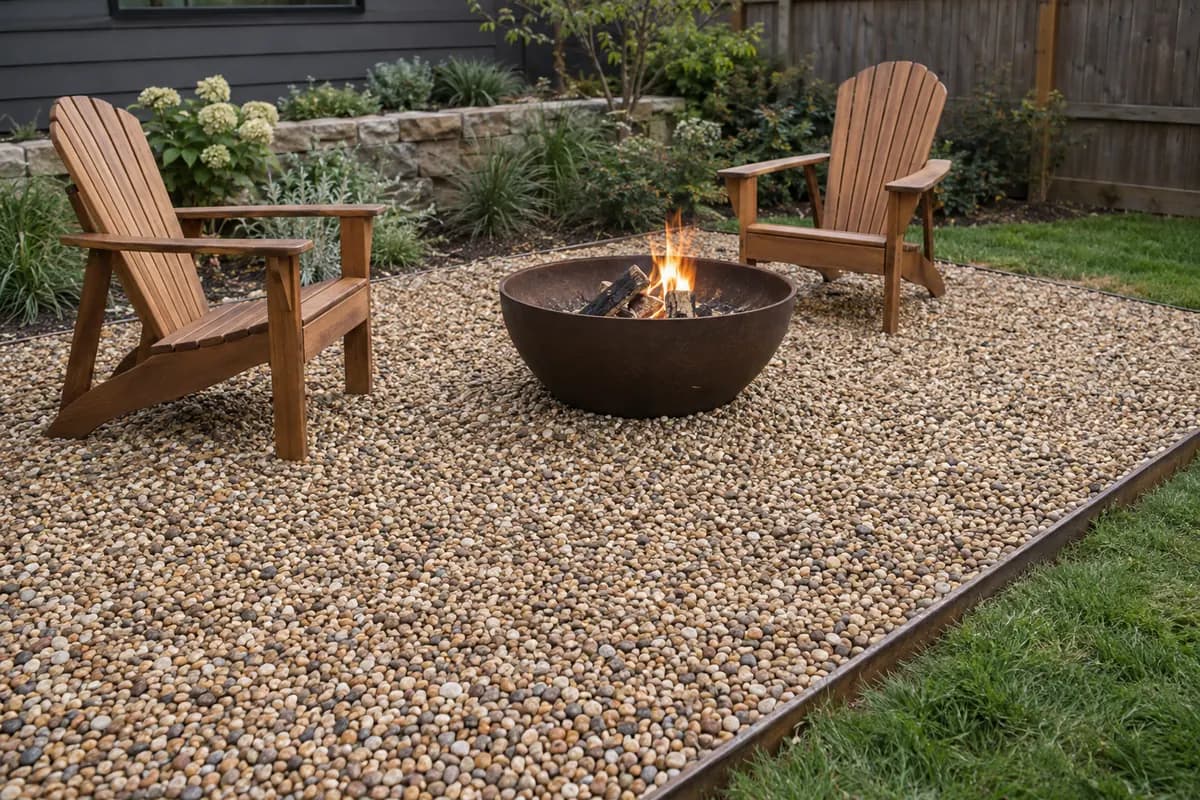
Pea Gravel is the classic choice. Its stones are small and smooth, about 3/8 inch across, in a mix of tan and brown that blends with mulch, wood fences and brick. Rounded edges make it pleasant to walk on and easy to rake into soft curves. It is the stone most people picture for a cottage garden, a sitting area or a play corner.[1]
River Rock steps up the scale. The larger, water-smoothed stones read as bold texture in a dry creek bed, along a downspout or around a boulder. They are too big to walk on comfortably, so they suit areas meant to be seen, not crossed.[1]
Decomposed Granite gives a soft, sandy finish that packs down. It works for a path or a patio with a natural look and for the floor of a seating area under trees. Its fine texture suits a gentle grade with a firm edge to keep it from wandering.[1]
Walkway Gravel is a small crushed stone with angular pieces. It looks similar to Pea Gravel from a distance, but it locks under foot instead of rolling. Choose it where a decorative surface also has to carry daily traffic, such as a path to a shed or a side yard used as a walkway.[1]
 From$4162 ton delivered
Pea Gravel
Driveway and Landscaping- Size
- 3/8 inch
- Weight
- 2,600 lb/yd³
- Color
- Mixed tan and brown
 From$4582 ton delivered
River Rock
Driveway and Landscaping- Size
- 1 to 3 inches
- Weight
- 2,600 lb/yd³
- Color
- Mixed earth tones
 From$4702 ton delivered
Decomposed Granite
Driveway and Landscaping- Size
- 1/4 inch and fines
- Weight
- 2,500 lb/yd³
- Color
- Gold to tan
 From$4242 ton delivered
Walkway Gravel
Driveway and Landscaping- Size
- 3/8 inch
- Weight
- 2,600 lb/yd³
- Color
- Mixed
What decorative gravel needs in a material
The color has to work with the house and the plants. Warm tans and browns suit brick, cedar and earth-toned siding. Mixed colors hide leaves and dust better than a single bright shade. Lay a few stones beside the siding before you order and look at them in sun and shade.[1]
Size changes the effect. Small stone around 3/8 inch makes a fine, even surface that looks calm in a tight space. Larger stone adds shadow and texture and fills a big area with less visual clutter. For a planting bed, small stone settles between plants without crushing stems.[1]
Shape decides whether you can walk on it. Rounded stone such as Pea Gravel feels soft but shifts under each step. Angular stone such as Walkway Gravel firms up into a path. Pick by how the area will be used before you pick by look.[1]
Weight keeps it in place. A cubic yard of Pea Gravel weighs about 2,600 lb, so rain and a leaf blower barely move it. Bark and wood mulch can float off in a heavy storm, which is one reason many owners switch beds near downspouts to stone.[1]
How to install decorative gravel
Clear the area. Pull weeds by the root, remove sod, and dig out a shallow bed so the finished stone sits level with or slightly below the lawn. A sunken bed keeps stone from spilling into the grass when the mower passes.[1]
Set a border. Steel or aluminum edging, brick on end, timber or a line of flat stones keeps the gravel in its shape. Install the edge before the stone goes in, and set it a little proud of the finished surface.[1]
Lay a weed barrier. Landscape fabric over the soil slows weeds from below and stops the stone from sinking into mud. Overlap the seams and pin them. In planting beds, cut an X in the fabric for each plant, fold the flaps back under, and tuck them around the stem.[1]
Spread the stone. Tip it from a wheelbarrow in small piles and rake it out to an even depth. Rinse it with a hose after spreading to wash off the dust and bring out the color. Pea Gravel shows its tan and brown tones best once it is wet.[1]
Add a base under walked areas. For a patio or a path, a thin compacted layer of crushed base under the fabric gives a firmer feel and keeps the decorative stone from sinking into soft soil.[1]
How much decorative gravel do you need
Beds and borders look covered at shallow depths. At 2 inches deep, 100 square feet of Pea Gravel takes about 0.80 tons. That depth hides fabric and soil in a planting bed without burying the base of the plants.[1]
For a sitting area or a path, go a little deeper. At 3 inches, 100 square feet takes about 1.20 tons, and at 4 inches the figure rises to about 1.60 tons. Deeper stone stays covered after kids, pets and rakes have moved it around.[1]
Deep beds are rare in decorative work, but a play area or a fire pit surround may call for one. At 6 inches, 100 square feet takes about 2.41 tons of Pea Gravel.[1]
Measure each bed, add up the square feet, divide by 100 and multiply by the tons for your depth. Pea Gravel is sold by the ton. A small margin covers corners, slopes and the stone that settles into the fabric.[1]
| Project size | 3 inch depth | 4 inch depth |
|---|---|---|
| 100 sq ft | 0.9 cu yd / 1.2 tons | 1.2 cu yd / 1.6 tons |
| 300 sq ft | 2.8 cu yd / 3.6 tons | 3.7 cu yd / 4.8 tons |
| 600 sq ft | 5.6 cu yd / 7.2 tons | 7.4 cu yd / 9.6 tons |
What decorative gravel costs
Decorative gravel is sold by the ton, and the delivered total depends on tons, stone type and trucking. Plain local stone tends to land lower than a special color or a stone hauled from far away. Pea Gravel is widely produced, which keeps it among the easiest decorative stones to source.[1]
Depth is the hidden lever. Moving from 2 inches to 3 inches across every bed adds half again to the order. For beds that will not be walked on, the shallower depth looks just as good.[1]
Bulk delivery beats bags for any area larger than a small bed. A truck brings the whole order in one trip, and one ton fills many wheelbarrow loads. Check the ZIP box on the site for delivered figures, then order every bed at once.[1]
Delivered, 2 tons: from $416 to $1,044 depending on the city (366 cities priced). Enter your ZIP for the exact figure.
Decorative gravel mistakes to avoid
Skipping the edge. Without a border, Pea Gravel spreads into the lawn and the mower throws it. Edging is the single step that keeps a gravel bed looking new.[1]
Using rounded stone on a slope or a busy path. Smooth stone rolls downhill and shifts under feet. On a slope or a daily route, choose Walkway Gravel or Decomposed Granite with a firm edge.[1]
Piling stone against the house. Gravel heaped up against siding holds moisture and hides pests. Keep the stone below the siding line and slope the bed away from the wall.[1]
Choosing color from a photo. Screens and printed pictures shift color. Tan and brown stone can look gray in shade and gold in sun. Look at a real sample in your own light before ordering a full load.[1]
Spreading too thin. A single layer of stones lets fabric and soil show through within a season. Plan at least 2 inches for beds, more for anything walked on.[1]
Coverage
Browse more
FAQ for decorative gravel
What is the best decorative gravel for a garden bed?
Pea Gravel is the easiest pick for most beds. Its small rounded stones settle between plants, the tan and brown mix blends with soil and mulch, and it rakes smoothly. For a bolder look in a larger bed, River Rock adds texture and shadow.
Is Pea Gravel good for walkways?
It works for light foot traffic and feels soft under bare feet, but the rounded stones shift and can feel loose. For a path used every day, Walkway Gravel locks under foot and stays firmer. Either way, set a solid edge and lay fabric below.
How deep should decorative gravel be?
For planting beds and borders, about 2 inches of stone covers fabric and soil, which takes about 0.80 tons of Pea Gravel per 100 square feet. Paths and sitting areas do better at 3 inches, since the stone stays covered after it gets moved around.
Do I need landscape fabric under decorative gravel?
In most cases, yes. Fabric slows weeds coming up from below and stops the stone from sinking into the soil over time. In beds full of spreading plants, some gardeners skip it, but they spend more time weeding the stone.
Will decorative gravel wash away in heavy rain?
Stone this heavy rarely washes away on flat ground. A cubic yard of Pea Gravel weighs about 2,600 lb, so a normal storm leaves it in place. On a slope or under a downspout, larger River Rock or a firm edge keeps it from moving.