
Best picks
Best Stone for a Retaining Wall: 2026 Picks
The blocks get the attention, but the stone hidden behind and under a retaining wall decides how long it stands. Our pick for the backfill is Drain Rock, a washed gray stone from 3/4 to 1-1/2 inches that lets water escape before it pushes on the wall. Below we cover why it works, where other stones belong in the build, and how much to order.
Drain Rock
drainage · size 3/4 to 1-1/2 inches · 2,700 lb/yd³ · sold by the ton

Bottom line: Drain Rock for stone for a retaining wall
Our top pick: Drain Rock
Most retaining walls that bulge or lean have a water problem behind them. Rain soaks into the slope, the wet soil grows heavy, and that weight presses on the back of the blocks until they slide out of line. The stone that matters most is one you never see once the job is done: a zone of clean Drain Rock packed between the blocks and the hillside.[1]
Drain Rock is washed crushed stone in sizes from 3/4 to 1-1/2 inches, gray in color. With the fines rinsed out, it leaves open channels between the pieces. Water seeping out of the slope drops into those channels and runs down to a pipe at the foot of the wall, so it never gets the chance to press against the blocks.[1]
It is sold by the ton, and a cubic yard weighs about 2,700 lb. That mass works in the wall's favor. Heavy, angular stone behind the blocks settles into a firm wedge that does not wash out or slump, and the face of the wall keeps its line through wet seasons.[1]
Clean stone also makes the build easier. It pours from a shovel or a skid steer bucket straight into the gap behind the blocks, finds its own level, and needs only a light tamp. Backfill soil, by contrast, must go in thin layers and be packed hard, and a wet day can stop the job. With Drain Rock the wall can rise course after course without waiting for the ground to dry.[1]
Why Drain Rock fits a retaining wall
Soil holds water like a sponge. Clay can stay wet for days after a storm, and wet soil pushes far harder than dry soil. A wall backfilled with the same dirt that came out of the cut has to resist all of that weight. A band of clean stone relieves the load, because water drains out of the slope instead of sitting in it.[1]
Frost is the second threat. Where winters freeze, water trapped behind a wall turns to ice and expands, nudging the blocks forward a little more each year. Clean stone drains before that water can freeze in place, so the ice has far less to push with.[1]
Angular crushed stone compacts into a stable mass without turning solid. Tamp it lightly as you fill, one course at a time, and it locks around the back of each block and around the grid layers if the wall uses them. Rounded stone would roll and settle, leaving voids that let the blocks shift.[1]
Segmental block walls with hollow cores take the same stone in the cores. Filling them with Drain Rock ties each block to its neighbors and adds weight without trapping water. The gray stone disappears inside the blocks and under the cap, so its color never shows.[1]
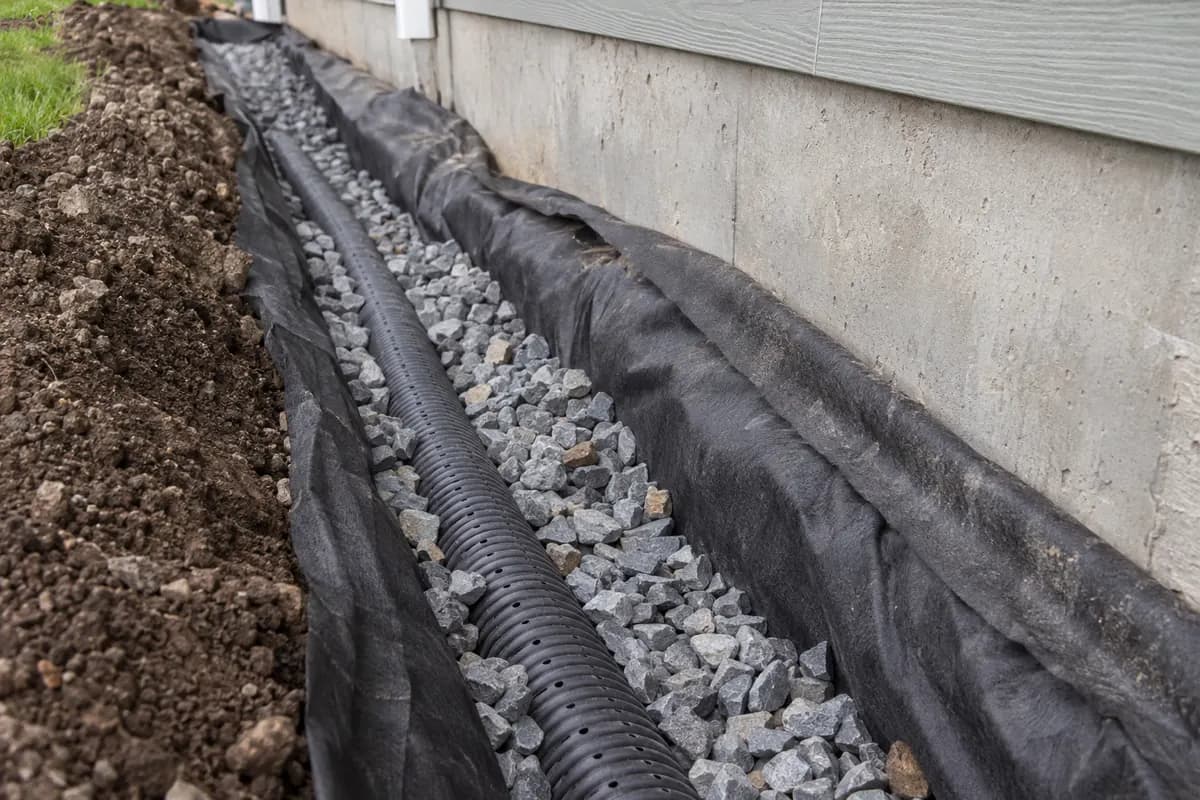
Pipe and fabric finish the drainage zone. Lay a perforated pipe along the back of the first course and run it out to daylight at the low end of the wall. Then line the face of the cut slope with filter fabric, so the native soil cannot creep into the stone. Built this way, the drainage zone keeps working for as long as the wall stands.[1]
Worth considering
Road Base belongs under the wall rather than behind it. A compacted pad of crushed stone with its fines left in gives the first course a level, solid footing that will not shift. Dig a trench, pack the base in thin lifts, and set the bottom blocks on it. Drain Rock then goes behind the blocks as the wall rises, so each stone does the job it suits.[1]
#57 Crushed Stone is a clean, single-size crushed stone a bit smaller than Drain Rock. Many block wall instructions name it as the drainage fill. It wins when a plan calls for it by number, and its smaller pieces fill hollow cores neatly with less hand work.[1]
3/4" Crushed Stone matches the smaller end of the Drain Rock range. It wins on a short garden wall, where the drainage zone is narrow and the stone goes in by shovel. It pours easily behind small blocks and into tight cores, and it compacts with a hand tamper.[1]
Riprap and other large rock are a different kind of wall altogether. Big stones stacked without mortar can hold a gentle bank on their own, but they still need clean gravel packed behind them, and Drain Rock fills that role there too.[1]
 From$4242 ton delivered
#57 Crushed Stone
Gravel and Crushed Stone- Size
- 3/4 to 1 inch
- Weight
- 2,700 lb/yd³
- Color
- Gray
 From$4372 ton delivered
#67 Stone
Gravel and Crushed Stone- Size
- 3/4 inch and under
- Weight
- 2,700 lb/yd³
- Color
- Gray
 From$4252 ton delivered
#89 Crushed Stone
Gravel and Crushed Stone- Size
- 3/8 inch
- Weight
- 2,700 lb/yd³
- Color
- Gray
How much to order
The drainage zone behind a wall is a band of stone running from the footing to near the top of the wall. Measure the wall length times its height to get the face area. A zone 6 inches thick takes about 2.50 tons for every 100 square feet of wall face. Many walls use a band a foot thick, which doubles that figure.[1]
Hollow block cores add to the total. Check the block maker's instructions for core volume, or plan on a modest extra pile for the cores and the gaps between blocks. Shallow pieces of the job use the thinner figures: about 1.25 tons per 100 square feet at 3 inches and about 1.67 tons at 4 inches, handy for the bedding under the drain pipe and a cap of stone behind the last course.[1]
A thin 2 inch blanket, about 0.83 tons per 100 square feet, works as the bed under the drain pipe along the base of the wall. It does not replace the full band behind the blocks, even on a low wall.[1]
The leveling pad under the wall is a separate order of Road Base. Plan both stones together so the base and the backfill are on site before the first block is set. Leave a little Drain Rock in the pile for topping up the zone after the first heavy rain settles it.[1]
| Project size | 3 inch depth | 4 inch depth |
|---|---|---|
| 100 sq ft | 0.9 cu yd / 1.3 tons | 1.2 cu yd / 1.7 tons |
| 300 sq ft | 2.8 cu yd / 3.8 tons | 3.7 cu yd / 5.0 tons |
| 600 sq ft | 5.6 cu yd / 7.5 tons | 7.4 cu yd / 10.0 tons |
Top picks side by side
| Material | Spec | Fit and price |
|---|---|---|
| Drain RockTop pick | 3/4 to 1-1/2 inches, gray, 2,700 lb/yd³, by the ton | from $425 delivered, 2 tons |
| #57 Crushed Stone | 3/4 to 1 inch, gray, 2,700 lb/yd³, by the ton | from $424 delivered, 2 tons |
| #67 Stone | 3/4 inch and under, gray, 2,700 lb/yd³, by the ton | from $437 delivered, 2 tons |
| #89 Crushed Stone | 3/8 inch, gray, 2,700 lb/yd³, by the ton | from $425 delivered, 2 tons |
Verdict
Drain Rock is the best stone for a retaining wall project because it does the work that keeps walls standing: it drains the soil behind the blocks. Its gray pieces from 3/4 to 1-1/2 inches stay open, compact into a stable wedge and do not wash out.[1]
Build the wall on a pad of compacted Road Base, set a perforated pipe behind the first course, line the cut slope with filter fabric, and fill with Drain Rock as each course goes up. Use #57 Crushed Stone or 3/4" Crushed Stone if a plan names them.[1]
Get a delivered quote for Drain Rock
Tell us your project and we price Drain Rock delivered to your ZIP, no obligation.
Frequently Asked Questions
What gravel goes behind a retaining wall?
Clean, washed crushed stone such as Drain Rock. It drains the soil so water cannot build pressure against the blocks. Fill a band behind the wall as each course goes up, and set a perforated pipe at the base to carry the water out to daylight. Keep the stone apart from the native soil with filter fabric.
What goes under the first row of blocks?
A compacted pad of crushed stone with fines, such as Road Base. Dig a trench, pack the base in thin lifts until it is firm and level, and bury the first course partly below grade. The pad keeps the wall from settling unevenly, and a straight first course is what makes a straight wall.
Do short garden walls need drainage stone?
Even a short wall holds back soil that gets wet, so a band of Drain Rock behind it is good insurance. Low walls fail more slowly than tall ones, but a wall that leans after a few winters is harder to fix than one built right at the start. A narrow strip of stone and a small pipe make a real difference.
Can I use the soil I dug out as backfill?
Use it only beyond the drainage zone, as the layer farthest from the wall. Clean stone goes right behind the blocks. Native soil, and clay most of all, holds water and pushes on the wall when it is wet. Keep the dug soil for the top few inches, where you can plant on it or grade the yard.
Where does the water from the wall drain go?
The perforated pipe behind the first course should run to daylight at the low end of the wall, or to a dry well or a storm drain line. Give it a steady fall along its length. Bed the pipe on a thin layer of Drain Rock, cover it with more stone, and keep the outlet clear of leaves.