
Best picks
Best Stone for Drainage: 2026 Picks
Water that will not leave a yard needs a faster path than the soil gives it. A trench or pit full of the right stone is that path. Our pick is Drain Rock, a washed gray crushed stone from 3/4 to 1-1/2 inches. Below we explain why it moves water so well, when other stones fit better, and how to size a drainage order.
Drain Rock
drainage · size 3/4 to 1-1/2 inches · 2,700 lb/yd³ · sold by the ton

Bottom line: Drain Rock for stone for drainage
Our top pick: Drain Rock
Drain Rock is clean crushed stone graded from 3/4 to 1-1/2 inches and washed so almost no fines remain. The gray pieces touch at their corners and leave open pockets between them. Water flows through those pockets quickly, and moving water is the only thing a drainage stone has to do well.[1]
The size range gives it a useful balance. Pieces at the larger end leave big voids that carry a lot of water. Pieces at the smaller end fill some of the gaps, so a perforated pipe sits snug in the trench instead of rattling in loose rock. Together they make a bed that moves water fast and keeps the pipe in line.[1]
Drain Rock is sold by the ton, and one cubic yard weighs about 2,700 lb. It is hard, dense stone that does not soften or break down in wet ground, so a drain built with it keeps working for many years as long as fabric keeps silt out of the gaps.[1]
Why Drain Rock fits a drainage project
Every drainage job comes down to giving water an easier route than the one it is taking now. Soil, and clay most of all, lets water through slowly. A trench filled with Drain Rock is a channel of open space that water can enter from the sides and then follow along the trench or down into deeper ground.[1]
Clean is the key word. Gravel that keeps its fines, such as crusher run or road base, packs tight and behaves almost like soil, so it holds water instead of passing it. Washed stone keeps its gaps open, and the trench stays free-flowing long after it is built.[1]
Angular faces help in a second way. Crushed stone locks in place once it settles, so a trench topped with a little soil and turf does not slump into a groove across the lawn. Round stones roll and shift under a mower or a foot, and a drain line filled only with them can sink at the surface.[1]
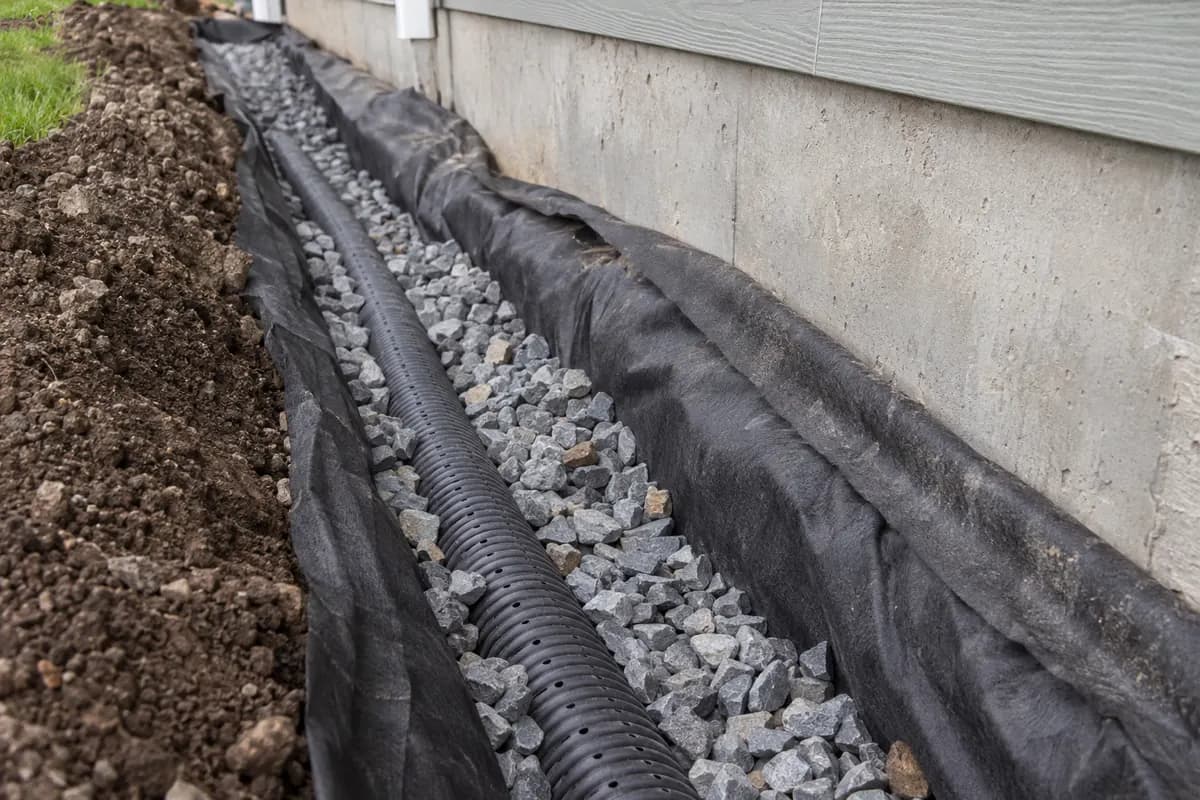
The jobs it handles cover most of a property: French drains along a soggy fence line, the stone around a foundation footing drain, dry wells that collect roof water, and the gravel pad under a downspout outlet. In each one, the gray stone stores water for a short while and passes it on to a pipe or into the ground.[1]
Fabric is the partner every buried drain needs. Line the trench with a non-woven filter cloth before the stone goes in, then fold the cloth over the top once the trench is full. Water passes through the cloth easily, while soil particles stay outside it. Without that wrap, silt creeps into the voids year after year until the stone is choked and the drain stops working.[1]
Worth considering
#57 Crushed Stone is a close cousin, a washed crushed stone with a slightly smaller top size than Drain Rock. It wins when a site plan or an engineer names it by number, and it packs a little tighter around small pipes. In a home French drain the two do nearly the same work.[1]
River Rock wins where the drain shows. A dry creek bed, the visible top of a French drain or a splash strip along the house looks finished with smooth, rounded stones. A good pattern fills the buried part of the trench with Drain Rock and caps it with a layer of River Rock for looks.[1]
Pea Gravel wins in narrow spots, such as a slim trench beside a walkway or the space around a small sump basin. The small round pebbles pour easily into tight places. They pass water well but shift more than crushed stone, so they suit light, shallow drains better than deep trenches that carry heavy flows.[1]
Drain Rock beats all three in the jobs that matter most below ground: deep trenches, large dry wells and foundation drains. Its mix of sizes leaves more open space than smaller stone, and its crushed shape holds the trench walls in place. The plain gray color never matters there, since soil and turf cover it.[1]
 From$4242 ton delivered
#57 Crushed Stone
Gravel and Crushed Stone- Size
- 3/4 to 1 inch
- Weight
- 2,700 lb/yd³
- Color
- Gray
 From$4372 ton delivered
#67 Stone
Gravel and Crushed Stone- Size
- 3/4 inch and under
- Weight
- 2,700 lb/yd³
- Color
- Gray
 From$4252 ton delivered
#89 Crushed Stone
Gravel and Crushed Stone- Size
- 3/8 inch
- Weight
- 2,700 lb/yd³
- Color
- Gray
How much to order
Drainage jobs are trenches and pits, not flat areas, so think about the floor of the trench and how deep the stone goes. Trench floor area is its length times its width. A French drain a foot wide and 100 feet long has a floor of 100 square feet. At 6 inches deep, 100 square feet takes about 2.50 tons of Drain Rock.[1]
Deep trenches add up fast. A trench filled with 2 feet of stone takes four times the 6 inch figure for the same floor area. Dry wells are the same idea: measure the pit floor, then multiply the 6 inch tonnage by how many half-foot layers the pit holds.[1]
Thin layers have their own uses. A splash strip along a wall or a bed under a downspout may need only 3 or 4 inches. At 3 inches, 100 square feet takes about 1.25 tons, and at 4 inches about 1.67 tons. A 2 inch layer, about 0.83 tons per 100 square feet, is enough to top off a drain line or freshen a worn strip.[1]
Order a little extra. Stone around a pipe fills uneven voids, trench walls wander a little, and a small spare pile is handy for the next wet spot in the yard.[1]
Check the slope as you plan the order. A drain needs a steady fall from the wet spot to the outlet, so the trench gets deeper as it runs toward daylight. Measure the depth at both ends and use the average when you work out tons, rather than the shallow end alone. At 6 inches per layer, every 100 square feet of trench floor adds about 2.50 tons, so a long run with a deep outlet end can need much more stone than a first guess.[1]
| Project size | 3 inch depth | 4 inch depth |
|---|---|---|
| 100 sq ft | 0.9 cu yd / 1.3 tons | 1.2 cu yd / 1.7 tons |
| 300 sq ft | 2.8 cu yd / 3.8 tons | 3.7 cu yd / 5.0 tons |
| 600 sq ft | 5.6 cu yd / 7.5 tons | 7.4 cu yd / 10.0 tons |
Top picks side by side
| Material | Spec | Fit and price |
|---|---|---|
| Drain RockTop pick | 3/4 to 1-1/2 inches, gray, 2,700 lb/yd³, by the ton | from $425 delivered, 2 tons |
| #57 Crushed Stone | 3/4 to 1 inch, gray, 2,700 lb/yd³, by the ton | from $424 delivered, 2 tons |
| #67 Stone | 3/4 inch and under, gray, 2,700 lb/yd³, by the ton | from $437 delivered, 2 tons |
| #89 Crushed Stone | 3/8 inch, gray, 2,700 lb/yd³, by the ton | from $425 delivered, 2 tons |
Verdict
Drain Rock is the best all-round stone for drainage. Its washed gray pieces, from 3/4 to 1-1/2 inches, leave wide voids that move water fast, lock together so the trench holds its shape, and do not break down in wet ground.[1]
Wrap it in filter fabric so soil stays out, slope the trench so water has somewhere to go, and add a perforated pipe for long runs. Use #57 Crushed Stone if a plan calls for it, River Rock where the drain shows, and Pea Gravel only in tight, light-duty spots.[1]
Get a delivered quote for Drain Rock
Tell us your project and we price Drain Rock delivered to your ZIP, no obligation.
Frequently Asked Questions
Do I need fabric around drainage stone?
In almost every buried drain, yes. Without fabric, fine soil washes into the gaps between the stones over time and the drain slowly clogs. Line the trench with a non-woven filter fabric, fill it with Drain Rock and pipe, then fold the fabric over the top before covering. The stone stays clean and keeps passing water.
Should drainage stone be round or angular?
For most buried drains, angular crushed stone works best because it locks in place and holds the trench shape. Round stone passes water well too, but it shifts and can let the surface settle. Round stone wins where looks matter, like a visible dry creek bed or the top layer of a French drain.
Is a perforated pipe needed with Drain Rock?
For short runs and dry wells, the stone alone can store water and release it slowly into the ground. For longer drains that must carry water a good distance, a perforated pipe in the stone moves it much faster. Bed the pipe on a few inches of stone, keep a steady fall toward the outlet, and cover it fully.
Can I use gravel with fines for drainage?
Avoid it in a drain. Gravel with fines, such as crusher run, compacts into a dense layer that holds water. That density is useful under a driveway but works against you in a trench. Washed stone like Drain Rock keeps open spaces between the pieces, and those spaces are what let water through.
How deep should a French drain be?
Depth depends on where the water sits. For a soggy lawn surface, a shallow trench a little deeper than a spade blade works. For water near a basement wall, the trench goes down close to the level of the footing. In both cases, give the bottom a steady fall toward the outlet and fill it with clean stone around the pipe.