
Best picks
Best Rock for a Fire Pit: 2026 Picks
The ground around a fire pit takes heat, stray sparks, ash and chairs dragged in and out all evening. Our pick for that surround is Pea Gravel, a 3/8 inch rounded stone in mixed tan and brown. It cannot burn and it dries fast after rain. Below we compare it with three other stones and work out how much a fire pit circle needs.
Pea Gravel
decorative · size 3/8 inch · 2,600 lb/yd³ · sold by the ton

Bottom line: Pea Gravel for rock for a fire pit
Our top pick: Pea Gravel
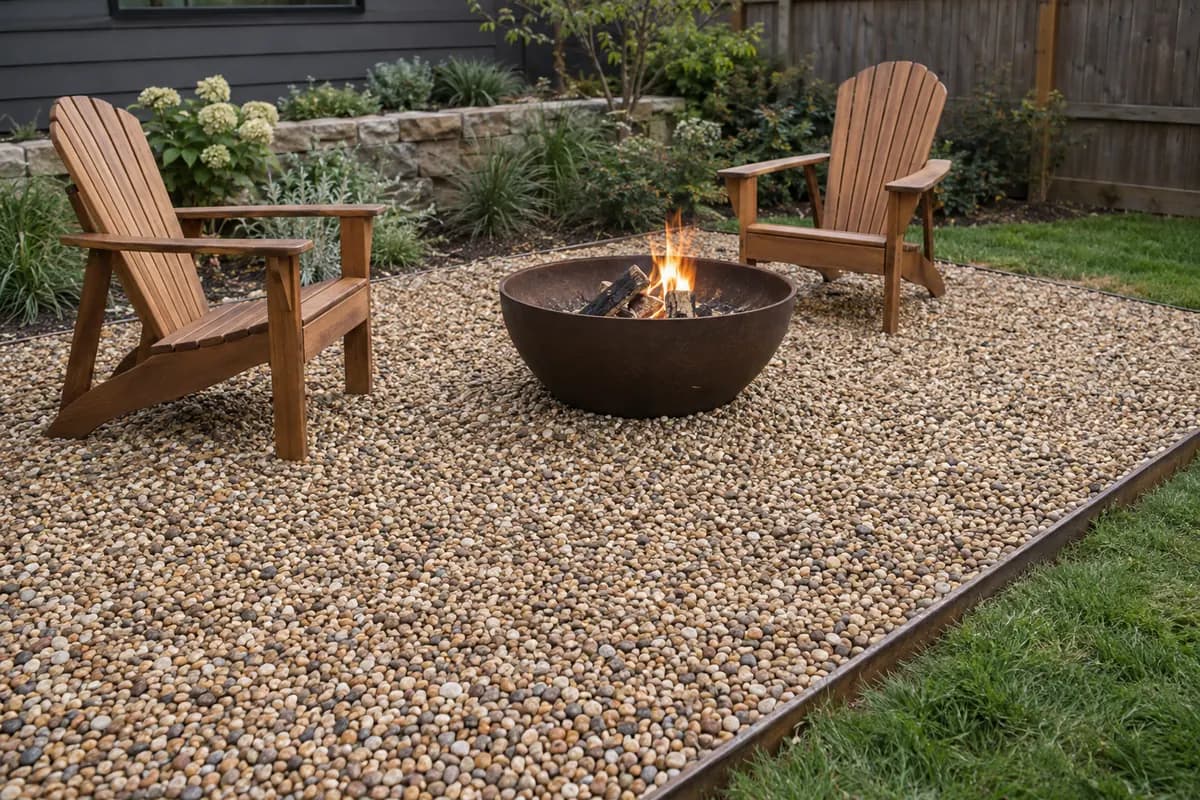
Pea Gravel is small, rounded stone screened to about 3/8 inch. Each piece has smooth sides with no sharp corners to catch a bare heel or scrape a chair leg. The color is a mixed tan and brown, a warm shade that sits well beside a dark steel ring, a stacked block wall or a circle of brick. A pale gray rock shows every smudge of ash, while this warmer blend keeps looking tidy after a long season of evening fires.[1]
Rock is the right family for a fire pit surround because nothing in it can catch. An ember that pops out of the bowl lands on stone and goes dark. Bark mulch and Wood Chips can smolder unseen for hours after the guests leave, which is the last thing you want next to a fence or a deck. A lawn run right up to the pit edge browns from the heat and turns to mud where the chair legs sit, so a ring of loose stone fixes two problems with one material.[1]
Pea Gravel is sold by the ton, and a cubic yard of it weighs about 2,600 lb. That weight helps on a breezy night. Ash lifts and drifts with the wind, while the heavy little stones stay where you raked them. After each fire, a few strokes with a leaf rake move the gray ash down into the gaps, where the next rain rinses it into the soil below.[1]
Why Pea Gravel fits a fire pit
A fire pit surround should give chairs a level floor and dry out quickly after a storm. Rounded 3/8 inch stones pour into place almost like coarse sand, so one person with a garden rake can level a wide circle in an afternoon. Rain drops straight through the spaces between the pebbles instead of pooling, and the seating area is ready to use the next evening.[1]
Comfort is the second reason people choose it. Many fire pits sit in a quiet corner of the yard where people walk in sandals or bare feet on summer nights. Small, smooth pebbles are kind to feet and to kids who sit on the ground to toast marshmallows. Crushed rock with fractured edges feels harsh by comparison, and it can scratch the finish on outdoor furniture.[1]
Pea Gravel does have one weak point. Round pebbles roll against each other, so the legs of a heavy chair can sink a little, and stones can drift out of the circle onto the grass. Good edging solves the drift. A steel, brick or paver border holds the pebbles in, and a firm layer of compacted base under the loose stone keeps chair legs from settling.[1]
A good build starts by stripping sod and roots from the whole circle, since grass will push up through loose stone. Lay landscape fabric over the bare soil, then a few inches of compacted base, then the tan and brown pebbles on top. The fabric keeps dirt from mixing upward, and the base gives chairs a firm floor a short way below the surface.[1]
Keep the stone for the surround and for the floor under the pit, and let a steel ring or a block liner hold the fire itself. Any rock that sits in direct flame can crack as moisture inside it turns to steam, and large rounded stones from a stream bed are the worst offenders. A bed of gravel below a lined pit lets rainwater drain out of the bowl, so the next fire lights without a puddle of soggy ash.[1]
Worth considering
River Rock is the same smooth, rounded stone in much larger sizes. It wins as a decorative frame around the outer edge of the surround, or as a dry bed that carries roof water past the seating area. The stones are too big and lumpy to set a chair on, so most yards use River Rock as a border and keep a smaller pebble for the floor. Keep it out of the fire bowl, since water held inside big river stones can make them split when heated.[1]
Decomposed Granite is granite weathered down to coarse grit and fine particles. Packed with a tamper, it sets into a firm, flat floor that feels close to a hard patio. It wins when you want chairs and a side table to stand steady, or when someone with a walker or a wheelchair needs to reach the fire. Its fines can track indoors on shoes, and a heavy storm can carve grooves in it unless the area has a slight slope and a solid edge.[1]
Walkway Gravel is a small crushed stone made for paths, with sharper faces than Pea Gravel. Those faces lock together, so it shifts less under a chair leg. It wins when a gravel path already leads from the house to the fire pit and you want one stone for both. Its edges feel a little rougher underfoot, which matters a lot to some families and not at all to others.[1]
 From$4582 ton delivered
River Rock
Driveway and Landscaping- Size
- 1 to 3 inches
- Weight
- 2,600 lb/yd³
- Color
- Mixed earth tones
 From$4702 ton delivered
Decomposed Granite
Driveway and Landscaping- Size
- 1/4 inch and fines
- Weight
- 2,500 lb/yd³
- Color
- Gold to tan
 From$4242 ton delivered
Walkway Gravel
Driveway and Landscaping- Size
- 3/8 inch
- Weight
- 2,600 lb/yd³
- Color
- Mixed
How much to order
A good depth for the seating area is 2 to 3 inches of Pea Gravel over a compacted base. At 2 inches, 100 square feet takes about 0.80 tons of stone. At 3 inches, the same patch of ground takes about 1.20 tons. A thicker layer feels softer and hides the base better, but chair legs sink further into deep loose pebbles.[1]
Measure the whole circle you plan to cover, including room for chairs and a path behind them, and leave the fire bowl itself out of the sum. A ring wide enough for seats on every side is far larger than the pit. For a square patio, multiply length by width. For a round one, measure straight across the circle, halve that figure to get the radius, multiply the radius by itself, and then multiply by pi.[1]
Some spots call for more stone. At 4 inches, 100 square feet takes about 1.60 tons, and at 6 inches it takes about 2.41 tons. A 6 inch layer of loose round pebbles is too soft to walk on, so save that depth for a drainage bed under the pit bowl and keep the seating floor shallow.[1]
Round your total up a little to allow for settling and a final top dressing in the second year. The area calculator turns your measurements into tons. Any spare stone from the pile can fill a planter edge or a splash strip under a downspout.[1]
| Project size | 3 inch depth | 4 inch depth |
|---|---|---|
| 100 sq ft | 0.9 cu yd / 1.2 tons | 1.2 cu yd / 1.6 tons |
| 300 sq ft | 2.8 cu yd / 3.6 tons | 3.7 cu yd / 4.8 tons |
| 600 sq ft | 5.6 cu yd / 7.2 tons | 7.4 cu yd / 9.6 tons |
Top picks side by side
| Material | Spec | Fit and price |
|---|---|---|
| Pea GravelTop pick | 3/8 inch, mixed tan and brown, 2,600 lb/yd³, by the ton | from $416 delivered, 2 tons |
| River Rock | 1 to 3 inches, mixed earth tones, 2,600 lb/yd³, by the ton | from $458 delivered, 2 tons |
| Decomposed Granite | 1/4 inch and fines, gold to tan, 2,500 lb/yd³, by the ton | from $470 delivered, 2 tons |
| Walkway Gravel | 3/8 inch, mixed, 2,600 lb/yd³, by the ton | from $424 delivered, 2 tons |
Verdict
For the ground around a backyard fire pit, Pea Gravel is our first choice. It cannot burn, rain passes straight through it, and its 3/8 inch rounded pebbles are comfortable for feet and easy to rake level. The mixed tan and brown color hides ash well and suits most yards.[1]
Pick Decomposed Granite if a firm, flat floor matters more than softness. Pick Walkway Gravel if the pit sits at the end of a gravel path and you want the two to match. Use River Rock for borders and drainage around the outer edge. In every case, set the fire in a proper ring or liner and keep loose rock out of the flames.[1]
Get a delivered quote for Pea Gravel
Tell us your project and we price Pea Gravel delivered to your ZIP, no obligation.
Frequently Asked Questions
Can I put Pea Gravel inside the fire pit?
Use it below the fire, never in it. A layer of gravel at the bottom of a lined pit lets rain drain out of the bowl. The fire itself should burn inside a steel ring or a fire brick liner set on that layer. Stone placed straight into flames can crack when trapped moisture heats up, so keep loose rock at the base and around the outside.
How far should the gravel extend from the fire pit?
Far enough that every chair sits fully on stone, with room to walk behind it. In most yards that means a circle several feet wider than the pit on each side. A wider ring also keeps sparks off grass, fences and wood decking, which is the main safety reason to surround a pit with rock in the first place.
Will the stones get hot near the fire?
Pebbles closest to the ring warm up during a long fire, much like the bricks of a hearth. They cool quickly once the fire burns down. Keep the first stretch of stone clear of rugs, cushions and plastic furniture for that reason. Further out, the gravel stays at the same temperature as the rest of the yard.
Do I need landscape fabric under the gravel?
Fabric is worth the small effort. It stops soil from working up into the stone, which keeps the gravel clean and slows weeds. The fabric also stops the pebbles from sinking into soft ground over time. Lay it after you strip the sod and before you spread the base, and overlap the seams so no dirt shows through.
Which rock is safest around a fire pit?
Any stone is safer than mulch or grass next to an open flame, and Pea Gravel, Decomposed Granite and Walkway Gravel all work well. The bigger risk is wet stone placed inside the flames, where it can crack. Keep loose rock outside the ring, use a lined pit, and clear leaves and twigs off the gravel before each fire.