
Best picks
Best Gravel for a Shed Base: 2026 Picks
A shed set on bare ground soon rots at the floor and leans as the soil moves. A gravel pad fixes both problems. It keeps the frame up out of the wet and spreads the weight evenly. Our pick for the pad is 3/4" Crushed Stone, a clean gray stone with sharp faces. We explain why it wins, which three other stones can work and how many tons to buy.
3/4" Crushed Stone
crushed stone · size 3/4 inch · 2,700 lb/yd³ · sold by the ton

Bottom line: 3/4" Crushed Stone for gravel for a shed base
Our top pick: 3/4" Crushed Stone
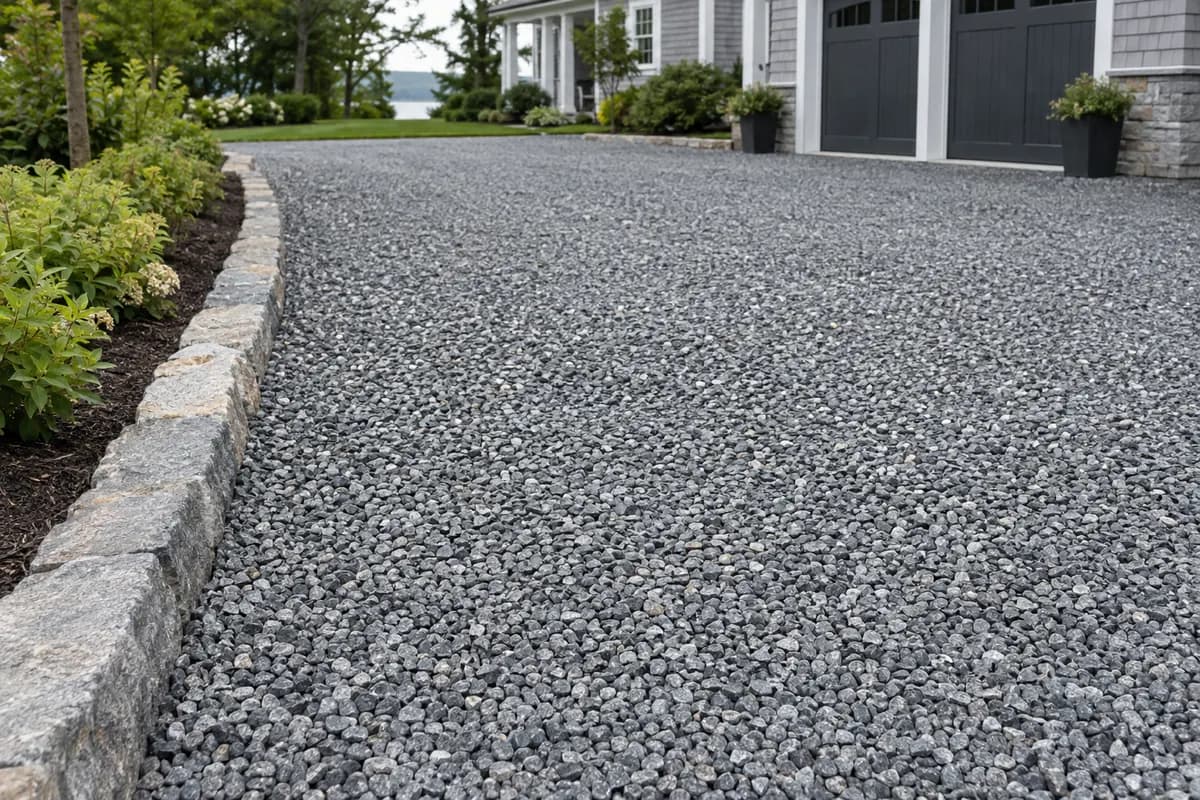
For a shed pad, 3/4" Crushed Stone balances drainage and support. The pieces are broken rock screened to 3/4 inch, with fractured edges and the dust washed off. Raked flat and tamped, they settle into a firm bed that holds skids or blocks level while water drains straight through to the soil.[1]
Moisture is the enemy of a wooden shed. Rain that splashes off the roof and puddles around the base soaks into the floor frame and starts rot. A pad of clean gray stone stops that cycle. Water hits the gravel, drops through it and leaves the underside of the shed dry and open to air.[1]
The stone weighs about 2,700 lb per cubic yard and comes by the ton. For a backyard shed, the order is usually small enough to move with a wheelbarrow in an afternoon. The weight works in your favor once it is down, since heavy angular pieces stay where you rake them.[1]
Gravel also gives you room to correct small mistakes. If one corner of the shed settles after a wet winter, you can jack that side up a little, push more stone under the skid and lower it back down. A slab offers no such fix. That forgiving quality is a big reason many shed builders prefer a stone pad for sheds of ordinary size.[1]
Why 3/4" Crushed Stone fits a shed base
A shed base needs to be level, stable and dry. Concrete does that too, but a gravel pad is simpler to build, easier to adjust and lets water out instead of shedding it toward the walls. 3/4" Crushed Stone gives you most of the stiffness of a slab with far better drainage.[1]
Angular stone matters here. Round gravel rolls under the weight of a loaded shed, and the floor slowly tips toward the heaviest corner. Crushed pieces wedge against each other and stay put. Once you tamp the pad, a shed full of mowers, tools and bags of soil sits flat on it for years.[1]
The build is simple. Mark the shed footprint plus a margin on each side, strip the sod and level the soil. Set a frame of pressure-treated timbers around the edge and pin it to the ground. Lay landscape fabric inside the frame to block weeds and keep soil from mixing up into the stone. Fill with 3/4" Crushed Stone, rake it level and tamp it in layers.[1]
The frame is what keeps a pad square. Without it, the edges of the gravel spread outward over time and the shed corners lose their support. A timber border holds the stone tight, gives you a clean line for mowing and makes leveling easy, because you can drag a straight board across the top of the frame to screed the surface.[1]
Check the pad before the shed goes on. Lay a long straight board across the frame in several directions and set a level on it. Low spots show as gaps under the board. Add stone, tamp again and check once more. A pad that is level now saves a door that sticks or a floor that creaks later.[1]
Worth considering
#57 Crushed Stone is a slightly larger clean stone that drains even faster. It is a good choice on low, soggy spots where water sits after rain, since the bigger gaps move water out of the pad quickly. It feels a little looser underfoot, so tamp it well before the shed goes on.[1]
#89 Crushed Stone is a small chip stone. It packs smooth and easy to level, which makes it handy as a thin top layer over a coarser pad when a shed sits right on the gravel with no skids. On its own, the small pieces hold more moisture and can shift on a slope, so use it for the final leveling pass rather than the full depth.[1]
#67 Stone sits between the two in size. Some builders like it for a pad because it drains well and still rakes fairly smooth. It is a fair stand-in when 3/4" Crushed Stone is short in your area. For most backyard sheds, though, the 3/4 inch stone remains the most balanced choice.[1]
Mixing stones in one pad is an option too. A lower layer of #57 Crushed Stone for drainage with a thin cap of #89 Crushed Stone for a smooth finish works well under sheds with a plywood floor that sits right on the gravel. For sheds on skids or blocks, a single layer of 3/4" Crushed Stone is simpler and does the job.[1]
 From$4242 ton delivered
#57 Crushed Stone
Gravel and Crushed Stone- Size
- 3/4 to 1 inch
- Weight
- 2,700 lb/yd³
- Color
- Gray
 From$4372 ton delivered
#67 Stone
Gravel and Crushed Stone- Size
- 3/4 inch and under
- Weight
- 2,700 lb/yd³
- Color
- Gray
 From$4252 ton delivered
#89 Crushed Stone
Gravel and Crushed Stone- Size
- 3/8 inch
- Weight
- 2,700 lb/yd³
- Color
- Gray
How much to order
Base the order on the pad size, which is larger than the shed. Add a margin of about a foot on every side so roof runoff lands on gravel. Multiply the length and width of that larger rectangle to get the pad area in square feet.[1]
Most backyard pads are about 4 inches deep. At that depth, 3/4" Crushed Stone takes about 1.67 tons per 100 square feet. Scale that figure up or down to match your own pad area.[1]
On soft or sloped ground, build deeper. A 6 inch pad takes about 2.50 tons per 100 square feet, and the extra depth gives a firmer footing for heavy sheds with riding mowers inside. On firm, level soil under a small garden shed, 3 inches is enough at about 1.25 tons per 100 square feet, and a 2 inch leveling layer takes about 0.83 tons.[1]
On a slope, the downhill side of the frame stands taller than the uphill side, so the stone depth varies across the pad. Measure the depth at each corner, average them and use that figure for the whole area. Add a little extra for settling during tamping.[1]
Think about access too. A pad that extends a little further in front of the shed door gives you a firm spot to roll a mower or a wheelbarrow in and out. That apron of gray stone stays clean and dry where foot traffic is heaviest.[1]
| Project size | 3 inch depth | 4 inch depth |
|---|---|---|
| 100 sq ft | 0.9 cu yd / 1.3 tons | 1.2 cu yd / 1.7 tons |
| 300 sq ft | 2.8 cu yd / 3.8 tons | 3.7 cu yd / 5.0 tons |
| 600 sq ft | 5.6 cu yd / 7.5 tons | 7.4 cu yd / 10.0 tons |
Top picks side by side
| Material | Spec | Fit and price |
|---|---|---|
| 3/4" Crushed StoneTop pick | 3/4 inch, gray, 2,700 lb/yd³, by the ton | from $427 delivered, 2 tons |
| #57 Crushed Stone | 3/4 to 1 inch, gray, 2,700 lb/yd³, by the ton | from $424 delivered, 2 tons |
| #67 Stone | 3/4 inch and under, gray, 2,700 lb/yd³, by the ton | from $437 delivered, 2 tons |
| #89 Crushed Stone | 3/8 inch, gray, 2,700 lb/yd³, by the ton | from $425 delivered, 2 tons |
Verdict
3/4" Crushed Stone is the best gravel for a shed base. It drains fast, locks into a firm pad and keeps a wood floor up out of the wet. Contain it in a pinned timber frame over landscape fabric, tamp it in layers and check it with a level before the shed arrives.[1]
Use #57 Crushed Stone on a wet site, #89 Crushed Stone for a smooth final leveling layer, or #67 Stone as a close substitute. For a standard backyard shed on ordinary ground, a framed pad of clean gray 3/4 inch stone is the setup we recommend.[1]
Get a delivered quote for 3/4" Crushed Stone
Tell us your project and we price 3/4" Crushed Stone delivered to your ZIP, no obligation.
Frequently Asked Questions
What is the best gravel for under a shed?
Clean, angular crushed stone around 3/4 inch. It drains well, tamps into a firm, level pad and does not roll under weight. 3/4" Crushed Stone inside a timber frame over landscape fabric makes a pad that keeps a shed level and dry for years.
How deep should a gravel shed pad be?
About 4 inches suits most sheds on level ground, which takes about 1.67 tons of 3/4" Crushed Stone per 100 square feet. Go to 6 inches on soft soil, on a slope or under a heavy shed with equipment inside.
Is a gravel pad better than concrete for a shed?
For most backyard sheds, gravel works as well and drains better. Water drops through the stone instead of pooling against the walls. A gravel pad is also easier to build and adjust. Concrete makes more sense for a workshop with a heavy floor load.
Do I need a frame around a gravel shed base?
A frame is strongly recommended. Pressure-treated timbers pinned to the ground keep the stone from spreading at the edges, so the shed corners stay supported. The frame also gives you a straight edge to level the gravel against.
Should I put landscape fabric under a shed pad?
Yes. Fabric stops weeds from growing up through the stone and keeps the soil below from mixing into the gravel. That keeps the pad draining well and holds its depth over time. Lay it after leveling the soil and before adding stone.
How big should a gravel pad be for my shed?
Make the pad larger than the shed by about a foot on each side. Rain dripping off the roof edge then lands on gravel instead of soil, which keeps mud off the walls and helps the base drain.